

A country’s import bill can reveal where domestic demand exceeds local supply, but it does not automatically identify an export opportunity. Imports may reflect specialised components unavailable locally, temporary price movements, re-exports or demand already served by entrenched global suppliers. Manufacturers need to understand the product flow behind the number before deciding where to compete.
A manufacturing trade opportunity study connects import dependence with export capability, supplier-country dynamics and the commercial conditions under which buyers might change sourcing.
Start With the Product Flow, Not the Country Ranking
Trade analysis is most useful when it begins at product level. HS-coded import and export data can show which goods enter a market, where they originate, and how those flows have changed over time. Unit values, quantities, and partner-country shares help distinguish sustained demand from a one-off surge.
The first task is to identify products with a persistent import requirement. These may include components used by domestic manufacturers, machinery required for industrial investment, replacement parts, or finished goods where local production is limited. A persistent import gap is more informative than a single year of high imports, particularly where commodity prices or exchange rates have shifted.
The next task is to establish whether the apparent gap is addressable. A product may have substantial imports but require intellectual property, certifications, precision tolerances or after-sales support that domestic suppliers cannot yet provide. In that case, the gap is evidence of demand, not proof of immediate export potential.
Read Sourcing Shifts Carefully
Global supply chains are changing, although not in a simple march towards reshoring. OECD analysis published in 2026 found limited aggregate change in global value-chain participation across 2023–2024, with significant differences between economies and sectors. The evidence suggests that firms are adjusting sourcing relationships unevenly rather than abandoning international production networks wholesale.
For exporters, this distinction matters. A buyer moving away from one supplier country may be diversifying risk, adding a second source or relocating only one production stage. It may not be seeking a complete replacement. Suppliers that can qualify quickly, offer consistent documentation and integrate into existing production schedules may be better positioned than companies pitching a broad national manufacturing story.
The analysis should track changes in supplier market shares, import growth from alternative origins, concentration among leading suppliers, and shifts in unit values. It should also look for evidence of local production investment, new trade agreements, and changes in procurement rules. These signals help distinguish a structural sourcing shift from a temporary disruption.
Where Can Exporters Capture the Gap?
Import dependence becomes commercially useful when it intersects with an exporter’s capabilities. A manufacturer may be able to serve a market because it has a cost advantage, an established product specification, excess capacity, or access to specialised inputs. In other cases, the opportunity may be to supply a component to a foreign manufacturer rather than compete for finished-product sales.
A Manufacturing trade opportunity study should therefore map three connected flows: what the target market imports, what the exporter can supply competitively, and which intermediaries or industrial buyers connect the two. This mapping reveals whether the best route is direct export, component supply, contract manufacturing, a distributor partnership or local assembly.
Tariffs and non-tariff requirements need to be evaluated at the same product level. The WTO’s tariff and trade data platform combines applied and preferential tariffs with trade flows at detailed product classifications. It can help identify whether a potential supplier has a meaningful tariff advantage, but product classification and rules of origin still need to be confirmed for the actual transaction.
Separate Trade Signals from Commercial Proof
A robust opportunity assessment tests the initial data against buyers and market participants. Importers can explain qualification requirements, order frequency, supplier dissatisfaction, and acceptable lead times. Distributors can clarify price bands, inventory needs, and channel margins. Domestic producers may reveal whether import dependence reflects a capability gap or simply a preference for established international brands.
The study should also account for the exporter’s own constraints. A market that requires small, frequent shipments may be unattractive for a factory designed around long production runs. A buyer requiring long payment terms can create a financing burden that overwhelms an otherwise positive margin. A product with strong demand but complex certification may be a medium-term opportunity rather than an immediate one.
Trade Flow-to-Opportunity Framework
Use a five-step sequence to move from data to a decision:
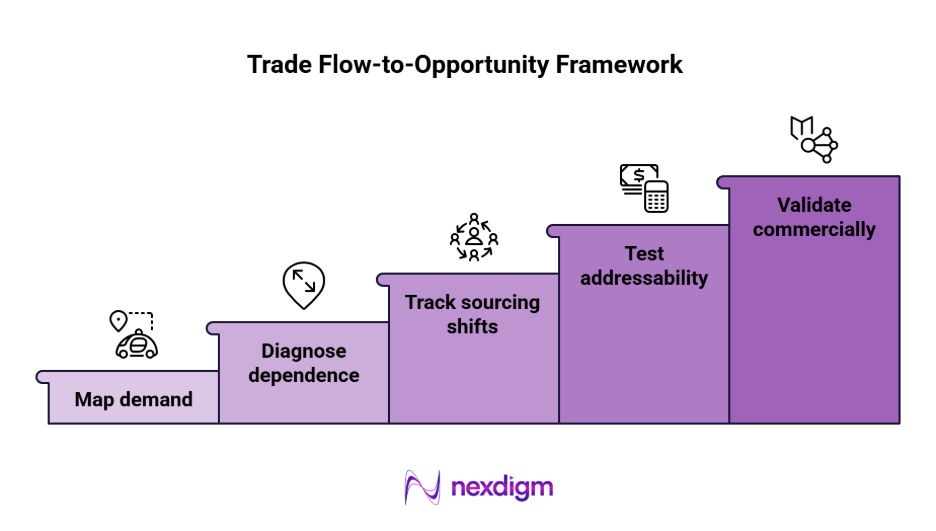
- Map demand: Identify product-level imports, growth, quantities, and buyer industries.
- Diagnose dependence: Determine whether the import pattern reflects structural supply gaps, specialised inputs, or re-export activity.
- Track sourcing shifts: Measure supplier-share changes, concentration and new origins entering the market.
- Test addressability: Compare product specifications, tariffs, standards, pricing, and logistics with exporter capabilities.
- Validate commercially: Confirm buyer requirements, order potential, payment terms and a viable route to market.
The final output should be a ranked list of product-market opportunities, each with a clear evidence trail, target customer segment, cost-to-serve estimate, and next validation step.
Nexdigm Case Study: Converting Import Dependence into Qualified Export Leads
Nexdigm analysed trade flows for an Indian manufacturer of electrical and mechanical components across 10 destination markets. The review covered 34 HS-coded product groups, five-year import trends, supplier concentration, unit values, tariff conditions, and potential customer industries. The initial screen identified 26 product-market combinations with sustained import demand. After comparing technical requirements, competitor positioning and delivered-cost estimates, Nexdigm narrowed the list to 9 qualified opportunities.
Four were prioritised for immediate buyer outreach because the client’s existing specifications could be used with limited modification, and the target markets had multiple potential sourcing channels. The study also identified 2 apparently attractive markets where demand was concentrated in products requiring certification and technical capabilities the client did not yet possess.
To take the next step, simply visit our Request a Consultation page and share your requirements with us.
Harsh Mittal
+91-8422857704