

Manufacturers are becoming more selective about where they place critical spend, favoring suppliers that can combine competitive costs with quality, reliability, capacity, and resilience. Recent procurement data reinforces this shift: 84% of leading procurement organizations reported meeting or exceeding supplier-performance expectations, compared with 59% among followers.
Meanwhile, 74% of surveyed CPOs identified active alternative supply sources as an effective risk-mitigation strategy. These trends suggest that vendors best positioned to capture manufacturing spend are those demonstrating consistent performance, scalable capabilities, strong delivery reliability, and the flexibility to support changing sourcing strategies.
What Separates High-Value Manufacturing Vendors
Winning manufacturing spend increasingly depends on a supplier’s ability to deliver consistent value rather than simply offer the lowest price. Deloitte’s latest CPO research found 74% of procurement leaders view alternative supply sources as an effective risk-mitigation strategy, while 68% prioritize operational efficiency.
Buyers are therefore assessing vendors across production capabilities, quality, delivery performance, capacity, responsiveness, technology, and financial stability. Suppliers that perform consistently across these dimensions are better positioned to become strategic partners and support manufacturers’ evolving resilience and cost objectives.
Manufacturers in Shortlisting Strategic Suppliers
With multiple vendors competing across cost, quality, capacity, and reliability, manufacturers increasingly use structured supplier evaluations to distinguish strategic partners from transactional providers.
Performance history, technical capabilities, scalability, financial strength, geographic footprint, and supply-risk exposure can all influence supplier rankings. A consistent evaluation approach helps procurement teams allocate spend toward vendors that can deliver dependable performance while supporting changing production and sourcing requirements.
Nexdigm’s Role in Vendor Shortlisting and Assessment
Selecting the right vendors requires more than comparing prices. Nexdigm uses Manufacturing vendor landscape analysis which combines the following areas and industry expertise to help manufacturers evaluate vendors against the factors that influence long-term commercial and operational value:
- Supplier Capability Assessment: Evaluation of production capacity, technical capabilities, quality standards, certifications, delivery performance, and scalability to identify suppliers capable of meeting current requirements and supporting future manufacturing needs.
- Supplier Benchmarking and Risk Analysis: Comparison of vendors across cost competitiveness, geographic presence, financial strength, reliability, and supply-risk exposure to identify performance gaps and potential dependencies before allocating significant manufacturing spend.
- Strategic Supplier Prioritization: Combination of supplier-level insights with market and industry analysis to rank vendors according to strategic fit, commercial attractiveness, resilience, and potential contribution to long-term business objectives.
This structured approach helps manufacturers move from broad vendor identification to evidence-based supplier selection, spend allocation, consolidation, and diversification decisions.
The Need for Manufacturing Vendor Landscape Analysis
Evaluating individual suppliers provides only part of the picture. Manufacturers also need to understand the broader vendor landscape, including the number and types of suppliers available, their geographic presence, capabilities, market positioning, capacity, and competitive strengths.
A Manufacturing vendor landscape analysis helps organizations identify leading vendors, emerging suppliers, capability gaps, concentration risks, and potential alternatives. This broader perspective enables procurement teams to understand where competitive options exist and where supplier dependencies may limit negotiating power or operational flexibility.
By combining supplier-level assessment with a wider market view, businesses can make more informed decisions around vendor selection, consolidation, diversification, sourcing, and long-term supplier development.
How Nexdigm Conducts Manufacturing Vendor Landscape Analysis
Nexdigm combines market intelligence, supplier research, competitive benchmarking, and industry expertise to build a detailed view of the manufacturing vendor ecosystem. This enables clients to understand not only who the key suppliers are, through:
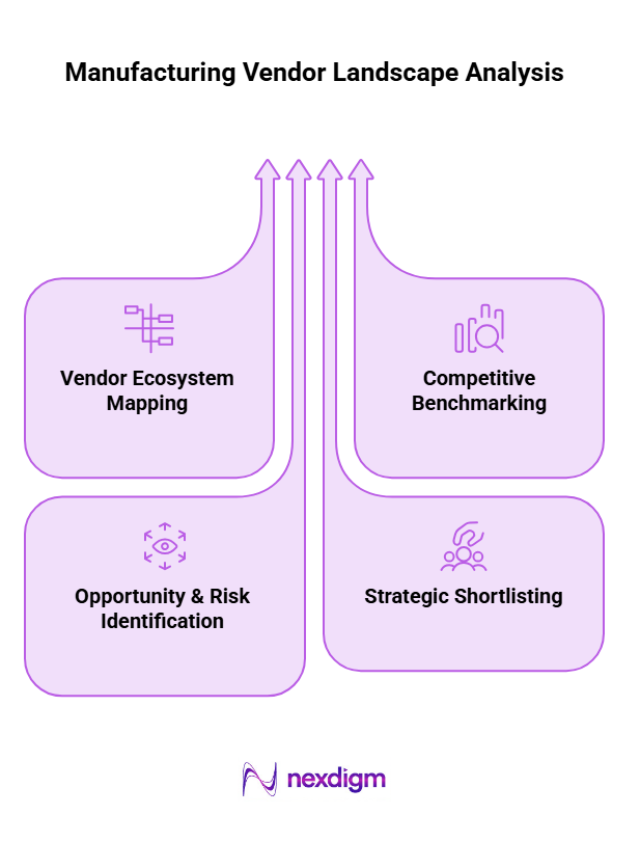
- Vendor Ecosystem Mapping: Identifying leading, emerging, regional, and specialized suppliers across relevant manufacturing categories and geographic markets.
- Competitive Benchmarking: Comparing vendors across capabilities, capacity, quality, pricing, technology, market presence, and strategic positioning.
- Opportunity & Risk Identification: Highlighting alternative suppliers, capability gaps, concentration risks, emerging competitors, and markets with potential for sourcing diversification.
- Strategic Shortlisting: Prioritizing vendors based on commercial attractiveness, operational strength, scalability, reliability, and alignment with the client’s procurement requirements.
This approach helps manufacturers convert a fragmented supplier landscape into structured intelligence that supports sourcing, supplier selection, consolidation, and spend-allocation decisions.
Nexdigm’s Vendor Landscape Analysis Leading to Strategic Spending Decisions
Understanding the vendor landscape gives manufacturers a stronger basis for deciding where procurement spend should be concentrated. Nexdigm’s analysis helps with:
- Prioritizing High-Value Suppliers: Directing greater spending toward vendors demonstrating strong performance, competitive economics, scalable capacity, and strategic relevance.
- Balancing Supplier Concentration: Allocating volumes strategically to avoid excessive dependence while retaining sufficient purchasing leverage and supplier competition.
- Identifying Emerging Suppliers: Considering capable new or regional vendors that can introduce competitive pricing, specialized capabilities, or additional supply capacity.
- Aligning Spend With Risk: Adjusting allocations based on supplier criticality, geographic exposure, business continuity requirements, and availability of alternatives.
This enables manufacturers to move from simply knowing their suppliers to strategically deciding where, how much, and why to allocate manufacturing spend.
Nexdigm’s Case
Nexdigm supported a global electronics manufacturer facing dependence on a single Asian supplier through a multi-country sourcing assessment. Nexdigm evaluated 14 alternative suppliers across five regions. Within four months, the client onboarded three new suppliers, reduced lead-time volatility by 27%, and lowered category dependency risk by 40%, leading to greater sourcing flexibility and supply resilience.
To take the next step, simply visit our Request a Consultation page and share your requirements with us.
Harsh Mittal
+91-8422857704