

Maritime logistics pricing intelligence enables carriers, freight forwarders, and shippers to evaluate rates across ports, routes, contracts, and service levels supporting global merchandise trade. Through pricing analysis, businesses can assess capacity availability, fuel costs, congestion, surcharges, transit reliability, equipment imbalances, and seasonal demand.
This insight strengthens rate benchmarking, contract negotiations, cost recovery, and route profitability. It also helps organizations respond to volatility, improve network utilization, protect margins, and develop commercially resilient pricing strategies across interconnected maritime supply chains and international trading corridors.
Maritime transport carries over 80% of international trade in goods by volume, while seaborne trade grew 2.2% in 2024. This scale creates significant opportunities for pricing intelligence to improve cost visibility and long-term logistics resilience worldwide.
Maritime Freight Pricing Analysis for Global Merchandise Trade
Maritime freight pricing analysis combines trade flows, route economics, capacity conditions, and market intelligence to support competitive rates, cost control, resilience, and profitable decision-making across global merchandise networks. Some key aspects of maritime freight pricing analysis are:
- Commodity-Based Rate Differentiation: Adjust pricing for perishables, machinery, consumer goods, chemicals, and high-value cargo according to handling needs, urgency, density, and risk exposure.
- Port-Pair Cost Mapping: Compare origin and destination combinations using port charges, congestion, inland access, terminal efficiency, and transit reliability to reveal route-specific pricing differences.
- Seasonal Demand Sensitivity: Account for peak trade periods, agricultural cycles, holiday demand, inventory restocking, and manufacturing schedules when setting responsive maritime freight rates.
- Equipment Availability Intelligence: Monitor dry containers, reefers, special equipment, depot positioning, and shortages to incorporate scarcity costs and improve equipment utilization through pricing.
Nexdigm’s Strategic Support for Global Maritime Pricing Analysis Decisons
Nexdigm provides strategic support for global maritime pricing decisions through maritime logistics pricing intelligence and advanced pricing analysis. Its expertise analyzes demand forecasting, route profitability assessment and market intelligence, supporting businesses with:
- Improved route profitability
- Better capacity utilization
- Freight rate benchmarking
- Margin protection
- Contract negotiation support
With the following capabilities, businesses can optimize pricing decisions, increase revenue realization, strengthen margins and drive sustainable profitability across global merchandise trade networks.
Nexdigm’s Maritime Freight Pricing Analysis and Benchmarking Blueprint
Nexdigm’s blueprint integrates market intelligence, route economics, capacity planning, customer segmentation, and pricing governance to improve rate realization, margin protection, network efficiency, and sustainable maritime profitability across global trade. Major strategies used in the blueprint model are:
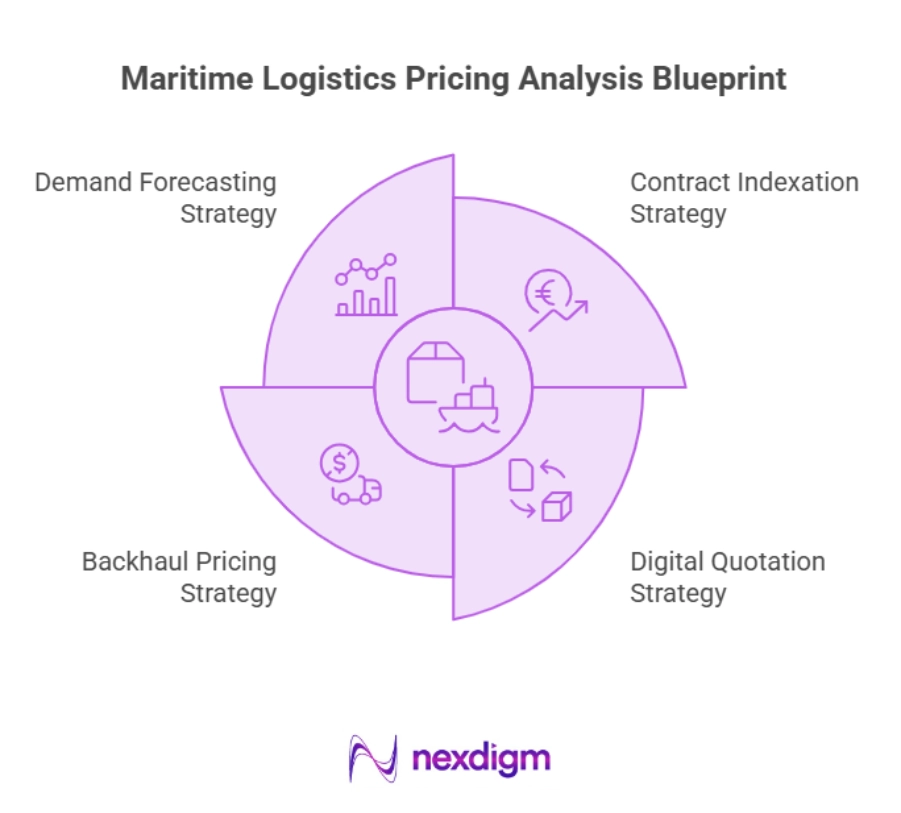
- Contract Indexation Strategy: Connect long-term freight rates to fuel, inflation, or market indices, supporting transparent adjustments and reducing exposure to unexpected cost movements.
- Digital Quotation Strategy: Use standardized pricing rules, automated approvals, and real-time market inputs to accelerate quotations, improve consistency, and increase booking conversion.
- Backhaul Pricing Strategy: Apply targeted incentives on low-demand return lanes to attract cargo, reduce empty repositioning, and improve round-trip vessel and container economics.
- Demand Forecasting Strategy: Use historical bookings, customer projections, commodity flows, and seasonal trends to anticipate demand changes and guide proactive freight rate adjustments.
Nexdigm’s Case
In a recent maritime engagement, Nexdigm supported a global logistics provider with trade-lane segmentation, dynamic pricing, and surcharge governance. Within ten months, the initiative improved rate realization by 12%, increased capacity utilization by 9% and strengthened route profitability by 8% across priority shipping corridors worldwide.
To take the next step, simply visit our Request a Consultation page and share your requirements with us.
Harsh Mittal
+91-8422857704