

Maritime port benchmarking studies play a crucial role in improving operational efficiency, reducing congestion, and strengthening global trade competitiveness. As international trade volumes continue to increase, ports must continuously evaluate cargo handling efficiency, vessel turnaround times, infrastructure utilization, and logistics coordination against global industry standards and competing trade hubs.
Research indicates that inefficient port operations and congestion can increase global shipping costs by 10–20% due to vessel delays, extended dwell times, and cargo handling inefficiencies. Ports implementing benchmarking studies and operational analytics report measurable improvements in berth productivity, cargo throughput, and turnaround efficiency. Additionally, digital monitoring systems and automated cargo handling solutions can improve terminal productivity by up to 25%, reduce vessel waiting times, and enhance logistics coordination across high-volume maritime trade hubs.
Analytics Used in Maritime Port Benchmarking Studies
Maritime port benchmarking studies evaluate operational efficiency, cargo movement, infrastructure utilization, and service reliability to identify improvement opportunities and strengthen productivity across global trade hubs.
- Vessel Turnaround Time Analysis – Measure average docking, unloading, and departure timelines to improve operational flow and reduce shipping delays.
- Cargo Throughput Performance – Evaluate cargo handling volumes, container movement efficiency, and terminal productivity to strengthen port operational capacity.
- Berth Utilization Benchmarking – Assess berth occupancy, crane productivity, and loading efficiency to optimize infrastructure utilization and reduce congestion.
- Port Congestion and Dwell Time Monitoring – Track cargo dwell times, truck movement efficiency, and yard utilization to improve logistics coordination and throughput.
- Shipping Line Service Reliability Metrics – Analyze carrier schedules, operational responsiveness, and service consistency to improve trade route efficiency and customer satisfaction.
Nexdigm Maritime Logistics and Port Productivity Assessment
Nexdigm Maritime Logistics and Port Productivity Assessment and maritime port benchmarking studies evaluates port operations, cargo handling efficiency, terminal performance, and logistics coordination across international maritime trade hubs. By combining operational analytics with competitive intelligence and benchmarking studies, Nexdigm identifies inefficiencies, infrastructure bottlenecks, and optimization opportunities. These assessments enable organizations to improve port productivity, strengthen logistics visibility, optimize cargo movement, and enhance operational resilience across global maritime supply chains.
Nexdigm Port Productivity Across Trade Hubs
Nexdigm improves port productivity across major trade hubs by implementing benchmarking frameworks, real-time operational monitoring, logistics analytics, and performance optimization strategies to strengthen efficiency across maritime logistics operations:
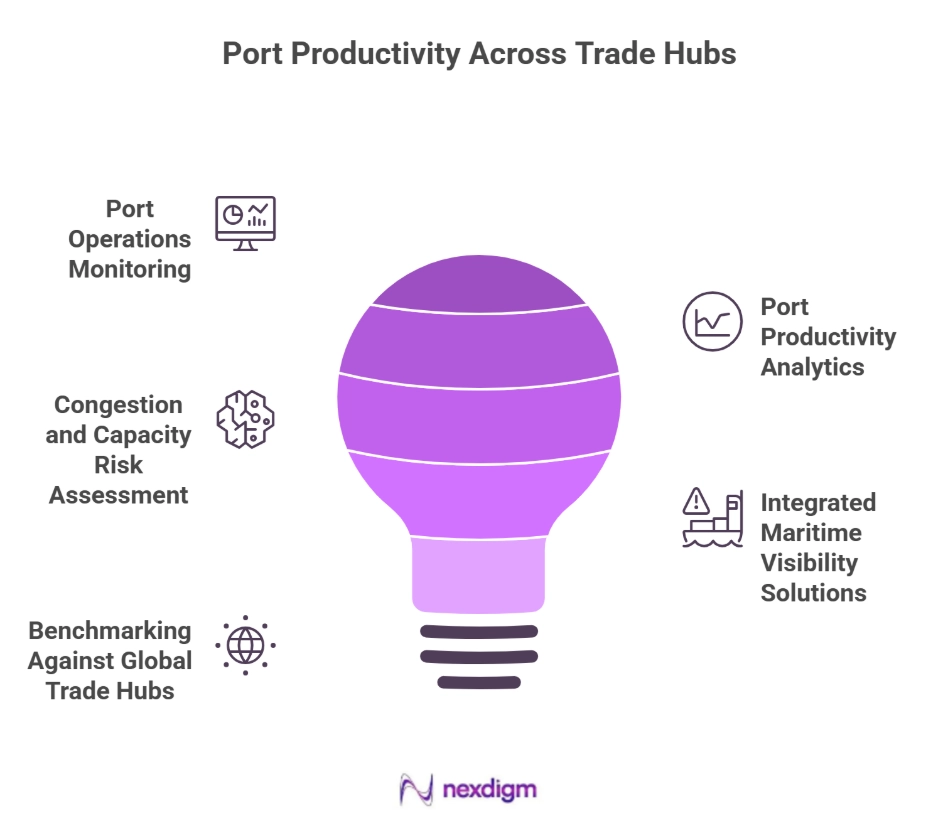
- Port Operations Monitoring – Implement digital dashboards to monitor cargo movement, berth occupancy, vessel schedules, and terminal productivity continuously, enabling faster operational responses and improved coordination across maritime logistics activities.
- Port Productivity Analytics – Analyze throughput performance, turnaround times, and cargo handling efficiency to identify operational improvement opportunities, supporting data-driven planning and enhanced terminal productivity across high-volume port operations.
- Congestion and Capacity Risk Assessment – Evaluate infrastructure bottlenecks, yard utilization, and traffic patterns to improve logistics coordination and reduce delays, minimizing operational disruptions and strengthening overall port network efficiency significantly.
- Integrated Maritime Visibility Solutions – Enable centralized reporting and shipment tracking systems for enhanced coordination across port and shipping operations, improving cargo visibility and facilitating proactive logistics management across trade routes.
- Benchmarking Against Global Trade Hubs – Compare operational KPIs against leading international ports to support continuous productivity and infrastructure improvement initiatives, helping organizations identify performance gaps and strengthen maritime operational competitiveness globally.
Nexdigm’s Case:
Nexdigm optimized port productivity for an international logistics company through maritime benchmarking, berth allocation improvements, and terminal workflow optimization, increasing cargo throughput by 18%, reducing vessel turnaround times by 24%, and enhancing trade efficiency, coordination, and supply chain reliability.
To take the next step, simply visit our Request a Consultation page and share your requirements with us.
Harsh Mittal
+91-8422857704