

Expanding into a new market, launching a new product, or targeting a different customer segment can unlock significant growth opportunities. However, successful businesses not just rely on assumptions before making major investments, they seek answers to a critical question: Is this market truly worth pursuing?
This is where market assessment services play a vital role. A comprehensive market assessment helps businesses understand customer demand, competitive dynamics, growth opportunities, risks, pricing realities, and go-to-market requirements. Most importantly, it provides the intelligence needed to make informed strategic decisions, to support long-term growth.
Is A Market Opportunity Large Enough?
Businesses must assess the market properly before entering. However, one of the important steps before lies in if the opportunity justifies investment. A robust market assessment should assess:
- Current market size
- Future growth potential
- Emerging demand trends
- Geographic opportunities
- High-growth customer segments
According to Nexdigm, understanding market size and growth potential is a foundational element of any market assessment because it helps organizations identify expansion opportunities and evaluate long-term feasibility. Without this visibility, businesses risk entering markets that appear attractive on the surface but lack sustainable growth potential.
Who Are the Right Customers?
A large market does not promise business success. Companies need to identify the customers most likely to adopt their products or services. Effective market assessment services should provide deep insights into:
- Customer needs and pain points
- Purchasing behavior
- Decision-making processes
- Buyer demographics
- Usage patterns and preferences
Nexdigm emphasizes customer insights as a core component of market assessment, helping businesses understand customer needs, behavior, and purchasing patterns so they can tailor offerings to market realities. The better an organization understands its customers, the more effectively it can position its products and services.
What Does the Competitive Landscape Look Like?
It is important to identify who the potential competitors are within the same market. A market assessment should answer the following questions, to support businesses in refining their market entry strategies:
- Who are the key competitors?
- What are their strengths and weaknesses?
- Where are the market gaps?
- How differentiated is your offering?
- What barriers exist for new entrants?
Nexdigm’s market assessment framework plays a significant role in competitive landscape analysis, enabling businesses to understand market positioning, identify opportunities, and evaluate risks before expansion. Understanding the competitive environment allows businesses to develop strategies that create sustainable differentiation.
How Should the Businesses Position Themselves?
Market assessment alone does not determine success. Organizations must also understand how to position themselves effectively. They must conduct a comprehensive assessment which should reveal:
- Customer value drivers
- Differentiation opportunities
- Feature priorities
- Brand positioning options
- Messaging strategies
Nexdigm’s research-driven market entry approach helps businesses understand market dynamics, customer preferences, and competitive positioning, supporting stronger go-to-market decisions. These insights help businesses communicate value more clearly and improve market adoption.
What Should the Go-to-Market Strategy Look Like?
A strong market assessment analyzes and gathers valuable insights into clear go-to-market recommendations. These insights help businesses in the following areas:
- Target customer segments: Identify the most relevant customer groups based on needs, behavior, demographics, and purchasing patterns to maximize market success.
- Pricing considerations: Determine optimal pricing by evaluating customer willingness to pay, competitor pricing, perceived value, and profitability objectives.
- Sales strategies: Develop effective sales approaches, messaging, and engagement methods that influence buying decisions and accelerate customer acquisition.
- Channel selection: Choose the most effective distribution and communication channels to reach target customers and support product adoption.
- Market-entry sequencing: Prioritize markets, customer segments, or regions strategically to optimize resources, reduce risks, and maximize growth opportunities.
Nexdigm’s market entry and consulting expertise focuses on these areas, to enable businesses to enter new markets with confidence and long-term sustainability. This bridge between research and execution is where market assessments create the greatest value.
How Nexdigm’s Assessment Help Businesses with Go-to-Market Decisions
Nexdigm takes a research-driven approach to helping organizations evaluate opportunities and reduce uncertainty. Through its market assessment services, the firm combines qualitative and quantitative research methodologies to deliver actionable market intelligence tailored to specific business goals. Nexdigm’s deep industry expertise includes:
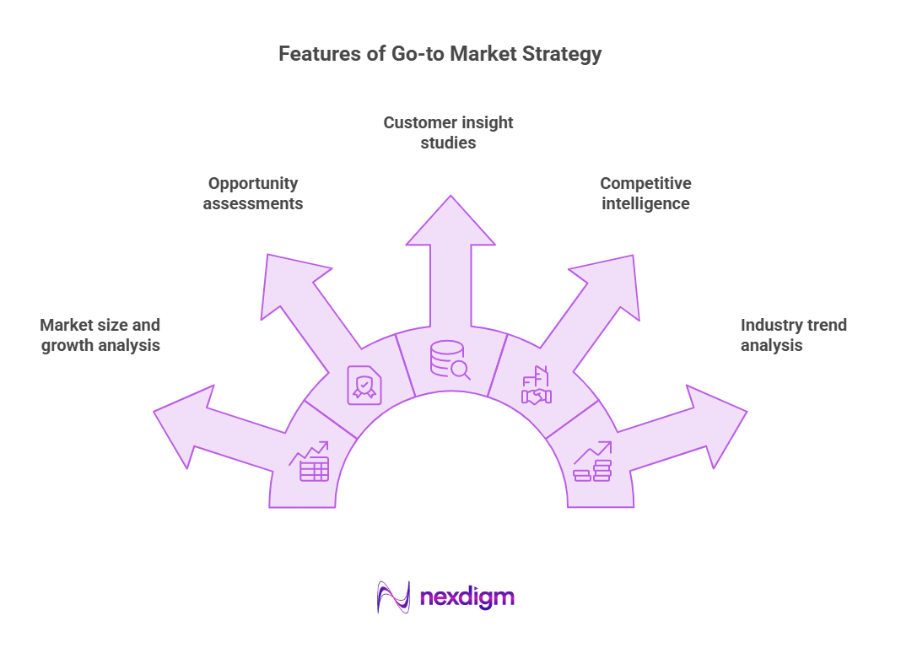
- Market size and growth analysis: Assess market potential, current demand, growth rates, and future opportunities to support investment and expansion decisions.
- Opportunity assessments: Identify attractive market opportunities by evaluating customer needs, market gaps, competitive dynamics, and revenue potential.
- Customer insight studies: Gather customer preferences, behaviors, expectations, and purchasing drivers to improve product positioning and market strategies.
- Competitive intelligence: Gather customer preferences, behaviors, expectations, and purchasing drivers to improve product positioning and market strategies.
- Industry trend analysis: Monitor emerging trends, innovations, and market shifts that may influence customer demand and business growth.
Such an approach helps businesses gain a holistic understanding of both market potential and execution requirements before making strategic investments.
Nexdigm’s Case
Nexdigm supported a global B2B firm evaluating a new growth market. The assessment sized a $450M opportunity, identified three priority customer segments, and benchmarked 12 competitors. The resulting go-to-market strategy helped achieve 28% faster market entry and 35% higher qualified-pipeline conversion.
To take the next step, simply visit our Request a Consultation page and share your requirements with us.
Harsh Mittal
+91-8422857704