
Material handling equipment demand is being reshaped by warehouse expansion, e-commerce, labor constraints, automation, and the need for faster, more accurate movement of goods. The global warehouse automation market is projected to reach approximately $57.6 billion by 2030, reflecting increasing investment in automated storage, retrieval, transport, and order-fulfillment systems.
Meanwhile, the International Federation of Robotics reported 603,000 industrial robots installed globally in 2025, up 11% year over year, highlighting the broader shift toward automated material movement and production.
Demand is also expanding beyond traditional forklifts and conveyors toward autonomous mobile robots, automated storage and retrieval systems, palletizing solutions, sortation, and connected warehouse technologies. These trends are making productivity, flexibility, space utilization, and real-time visibility increasingly important when evaluating material handling investments across modern industrial facilities.
Material Movement Is Becoming More Automated
The shift toward faster, more responsive operations is changing how businesses move, store, and manage materials. Facilities are increasingly combining conventional equipment with automation to improve throughput, reduce manual handling, and make better use of available space.
With global industrial robot installations reaching 603,000 units in 2025, up 11%, automation is becoming a broader part of industrial operations. This is supporting demand for automated conveyors, palletizing systems, mobile robots, and intelligent storage solutions.
Different Facilities Create Different Equipment Needs
Material handling requirements vary significantly by operating environment. Factories prioritize production-line movement and work-in-process handling, warehouses emphasize storage density and order fulfillment, while distribution centers focus on high-speed sorting and dispatch. The growing scale of automation means businesses increasingly need to match equipment choices with throughput, facility layout, product characteristics, labor availability, and service requirements rather than applying a single solution across operations.
Nexdigm’s View of Changing Equipment Requirements
As factories, warehouses, and distribution centers evolve, equipment requirements are also changing. Nexdigm helps businesses understand these shifts by connecting operational needs, technology adoption, customer demand, investment patterns, and competitive developments.
The industry-led Material handling equipment demand analysis looks beyond individual equipment categories to identify why demand is changing, which applications are driving investment, and where new opportunities are emerging.
This helps businesses evaluate requirements across automation, storage, transportation, handling, and fulfillment, while considering the specific needs of different operating environments.
Why Material Handling Demand Analysis Matters
Material handling requirements vary widely by facility, industry, product type, and operating model. Simply tracking equipment sales or overall market growth may not reveal where the strongest opportunities are emerging. A structured demand analysis helps businesses understand what is driving purchases, which applications are expanding, and where investment is likely to accelerate.
For equipment manufacturers and solution providers, this insight can support better decisions around product development, customer targeting, technology investments, and market expansion. Nexdigm brings these factors together through an industry-led analytical approach, helping businesses connect changing material handling requirements with specific commercial opportunities and strategic priorities.
Nexdigm’s Material Handling Equipment Demand Analysis
Nexdigm combines industry expertise, market intelligence, and strategic analysis to help businesses understand where material handling demand is emerging and what is driving equipment investment. This involves:
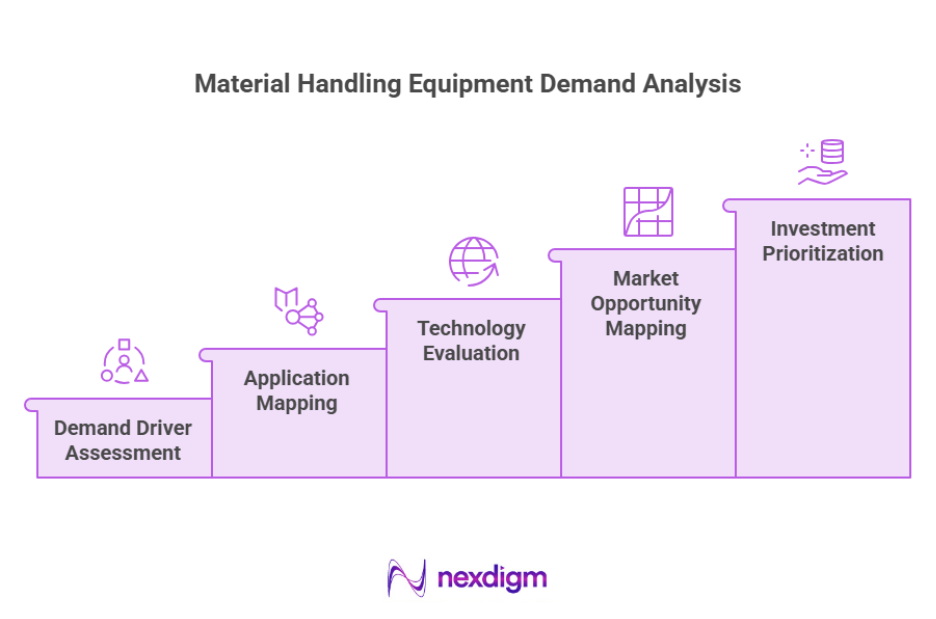
- Demand Driver Assessment: Evaluation of how automation, e-commerce, production expansion, labor availability, and operational efficiency are influencing equipment requirements across facilities.
- Application Mapping: Identifying equipment needs across factories, warehouses, and distribution centers based on throughput, storage, handling, and fulfillment requirements.
- Technology Evaluation: Assessing the adoption of conveyors, robotics, automated storage systems, mobile robots, palletizing, and digitally connected handling solutions across applications.
- Market Opportunity Mapping: Identifying high-potential industries, customer segments, and geographies where material handling equipment demand is expanding.
- Investment Prioritization: Connecting demand trends with customer investment patterns to determine which opportunities offer stronger commercial and strategic potential.
This approach helps businesses translate changing material handling requirements into clearer market, investment, product, and expansion decisions.
Nexdigm’s Demand Analysis: Building a Future-Ready Material Handling Strategy
Nexdigm’s insights can help businesses move from understanding equipment demand to shaping a longer-term material handling strategy. By connecting market opportunities with operational requirements, businesses can:
- Modernize in Specific Areas: Prioritize equipment upgrades where aging assets, capacity constraints, or productivity gaps are limiting performance.
- Build for Scalability: Align equipment investments with expected production, storage, and distribution growth to avoid capacity constraints as demand increases.
- Balance Automation and Flexibility: Select solutions that improve efficiency while allowing operations to adapt to changing volumes, products, and workflows.
- Strengthen Market Position: Use market and customer insights to align equipment offerings with emerging requirements and differentiate from competitors.
This enables businesses to develop a more adaptable equipment strategy that supports operational efficiency today while creating capacity for future growth.
Nexdigm’s Case
Nexdigm supported an industrial client in evaluating material handling requirements across manufacturing and distribution operations. The assessment reviewed 30+ equipment applications, identified 6 priority opportunities, and helped streamline the investment shortlist by 28%, enabling more focused automation, modernization, and capacity-planning decisions.
To take the next step, simply visit our Request a Consultation page and share your requirements with us.
Harsh Mittal
+91-8422857704