
Material handling equipment supports the movement, storage and control of goods across warehouses, manufacturing facilities, distribution centres and industrial operations. Forklifts, conveyors, pallet trucks, hoists and lifting systems help businesses move materials efficiently while reducing dependence on manual handling.
However, equipment procurement involves more than comparing purchase prices and technical specifications. Businesses must consider load capacity, operating conditions, safety features, equipment availability, maintenance support and long-term operating costs.
A structured vendor benchmarking exercise helps procurement teams identify suppliers whose equipment and service capabilities match their operational requirements.
Understanding the Material Handling Equipment Landscape
Material handling requirements vary according to facility size, product characteristics, storage arrangements and movement frequency.
The equipment market includes several categories, each designed for specific operational applications.
- Forklifts: Used for lifting, stacking and transporting palletised goods. Available configurations include electric, diesel and LPG-powered models, with different load capacities and lifting heights.
- Conveyor systems: Automate the movement of goods across production lines, warehouses and distribution facilities. Options include belt, roller, chain and overhead conveyors.
- Lifting systems: Include hoists, cranes, scissor lifts and other equipment used for moving materials vertically or handling heavy loads.
- Pallet trucks and stackers: Support short-distance movement and stacking activities, particularly in warehouses with restricted operating spaces.
- Automated material handling equipment: Includes automated guided vehicles, autonomous mobile robots and integrated storage and retrieval systems.
The right equipment category depends on load characteristics, facility layout, movement frequency and the level of automation required.
Comparing Equipment Specifications and Operational Performance
Equipment specifications should be assessed against the actual operating environment rather than manufacturer claims alone.
- For forklifts, procurement teams should examine rated load capacity, lifting height, turning radius, energy source and suitability for indoor or outdoor use.
- For conveyor systems, the assessment should cover throughput capacity, conveyor speed, load dimensions, system configuration and integration with warehouse operations.
Lifting equipment requires particular attention to safe working loads, operating ranges, installation requirements and inspection procedures.
The evaluation should consider whether equipment can operate efficiently under the facility’s floor conditions, aisle dimensions, temperature and workload.
A useful comparison should also account for equipment utilisation. Purchasing high-capacity machinery may not deliver commercial value if actual operating requirements remain significantly below its rated capacity.
Maintenance, Safety and After-Sales Support
Maintenance support can significantly influence equipment availability and operating costs.
A supplier’s service network should be assessed according to workshop coverage, technician availability, spare parts inventory and emergency repair response.
Procurement teams should examine preventive maintenance schedules, warranty conditions, service contracts and the availability of replacement components.
Safety is another essential consideration. For example, the US Occupational Safety and Health Administration’s standard 29 CFR 1910.178 addresses powered industrial trucks, including forklift operation, operator training and equipment requirements. OSHA also recommends regular conveyor inspections, appropriate guarding and procedures for managing equipment stoppages.
Businesses operating in India should assess equipment against applicable Indian occupational safety requirements and relevant technical standards rather than assuming that international certifications alone establish compliance.
Important supplier considerations include equipment inspection records, operator training, emergency stop mechanisms, load limits and maintenance documentation.
Evaluating Commercial Value and Equipment Lifecycle Costs
Equipment procurement should account for total ownership costs rather than initial acquisition prices.
These costs may include purchase or lease payments, energy consumption, maintenance, replacement parts, operator training, insurance and equipment downtime.
For automated systems, additional expenses may include installation, software integration, infrastructure modifications and technical support.
Supplier comparisons should also examine delivery lead times, equipment availability, installation support and the ability to provide additional units when operations expand.
A vendor offering a lower purchase price may become more expensive over time if its equipment requires frequent repairs or has limited service coverage.
Material Handling Equipment Vendor Benchmarking Framework
A structured material handling equipment vendor benchmarking exercise should compare suppliers across technical, operational and commercial requirements.
The assessment can follow six stages:
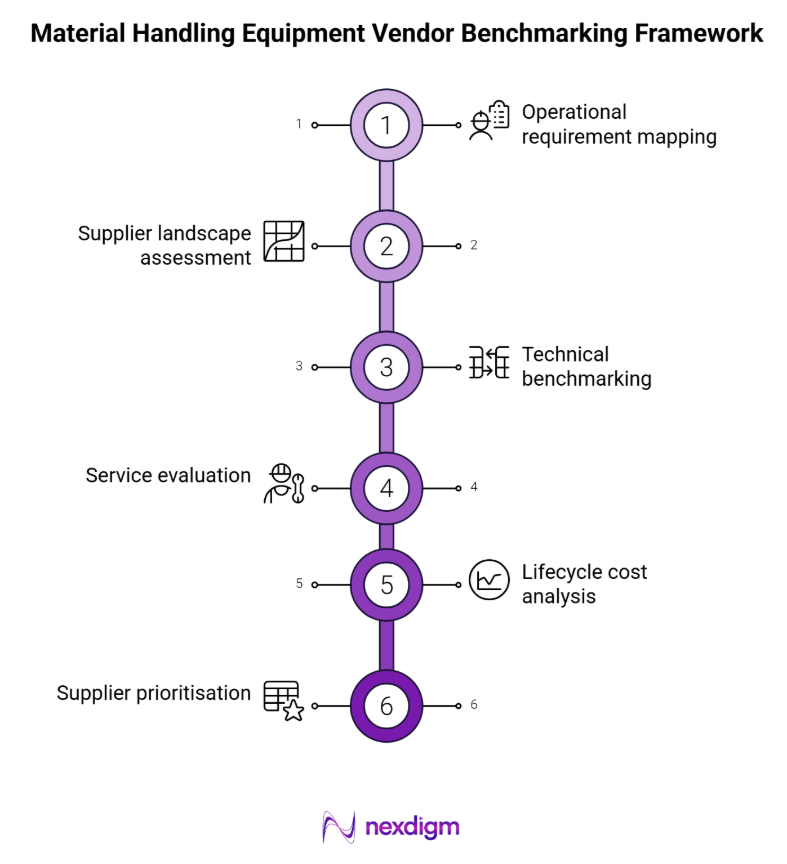
- Operational requirement mapping: Identify material types, load capacities, movement frequency and facility conditions.
- Supplier landscape assessment: Map equipment manufacturers, authorised dealers and specialised system integrators.
- Technical benchmarking: Compare equipment specifications, throughput, energy requirements and safety features.
- Service evaluation: Assess maintenance networks, spare parts availability, warranties and technical support.
- Lifecycle cost analysis: Compare acquisition, installation, energy, maintenance and downtime expenses.
- Supplier prioritisation: Rank vendors based on equipment suitability, operational reliability, service coverage and total cost of ownership.
Nexdigm can support organisations through equipment supplier research, vendor benchmarking, market mapping and commercial assessments. These exercises help procurement teams compare available equipment options, understand supplier service capabilities and identify providers suited to long-term operational requirements.
Nexdigm’s Case Study: Strengthening Equipment Procurement Decisions
Nexdigm benchmarked 11 material handling equipment suppliers across 4 equipment categories, assessing capacity, safety, maintenance and pricing. The research shortlisted 4 vendors, identified a 14% variation in lifecycle costs and established 7 technical and service benchmarks for supplier selection.
To take the next step, simply visit our Request a Consultation page and share your requirements with us.
Harsh Mittal
+91-8422857704