

Media consumption is no longer organised around a single dominant viewing schedule. Audiences move between linear television, streaming platforms, social video, Connected TV and short-form formats, often within the same day.
India’s screen economy is projected at $12.5 billion in 2026, including $6 billion in online-video revenue. Connected TV reaches approximately 65 million households, while retail media has reached $3.1 billion. Streaming accounts for 46% of content spend, compared with 42% for linear television.
The commercial consequence is a fragmented attention market in which audience scale, engagement and monetisation increasingly have to be assessed together.
Viewing Has Become Platform-Agnostic
Television is increasingly an umbrella category rather than a single distribution model. Consumers can watch professionally produced programming through broadcast television, connected devices, streaming applications and mobile platforms.
Connected TV is particularly important because it combines the large-screen experience associated with television with digital targeting and measurement. The estimated 65 million connected-TV households in India therefore represent more than an audience figure. They indicate the emergence of a sizeable viewing environment that sits between traditional television and digital media.
For media companies, this changes how reach should be measured. A platform’s competitive position depends increasingly on which audiences it can retain, what formats those audiences consume and whether advertisers can monetise that attention.
Streaming Is Running Into a Spending Ceiling
The growth of streaming has not eliminated consumer price sensitivity. According to the Deloitte data cited in the report, the average US subscribing household spends approximately $69 per month across streaming services, while 61% of consumers say a further $5 monthly increase could prompt them to cancel their favourite platform.
This creates pressure for streaming companies to diversify monetisation. By 2026, 68% of streaming subscribers maintain at least one ad-supported streaming service.
The result is a hybrid media economy in which subscriptions, advertising and commerce increasingly coexist. A platform’s value therefore depends not simply on how many people watch, but on the revenue that can be generated from each audience segment.
Attention Is Moving Closer to the Transaction
The next structural change is the convergence of media and commerce. Social video, live content and Connected TV increasingly incorporate commercial functionality, allowing discovery, advertising and purchasing to happen within the same digital environment.
India’s $3.1 billion retail media market illustrates the scale of this convergence. E-commerce and quick-commerce platforms can combine advertising exposure with first-party transaction data, allowing advertisers to connect media investment more directly with purchases.
This changes the competitive value of attention. A smaller audience with strong purchase intent may become commercially more valuable than a larger audience that is difficult to monetise.
Building a Media Consumption Assessment Framework
A media consumption trends analysis should therefore examine the movement of attention across platforms and the economics attached to it.
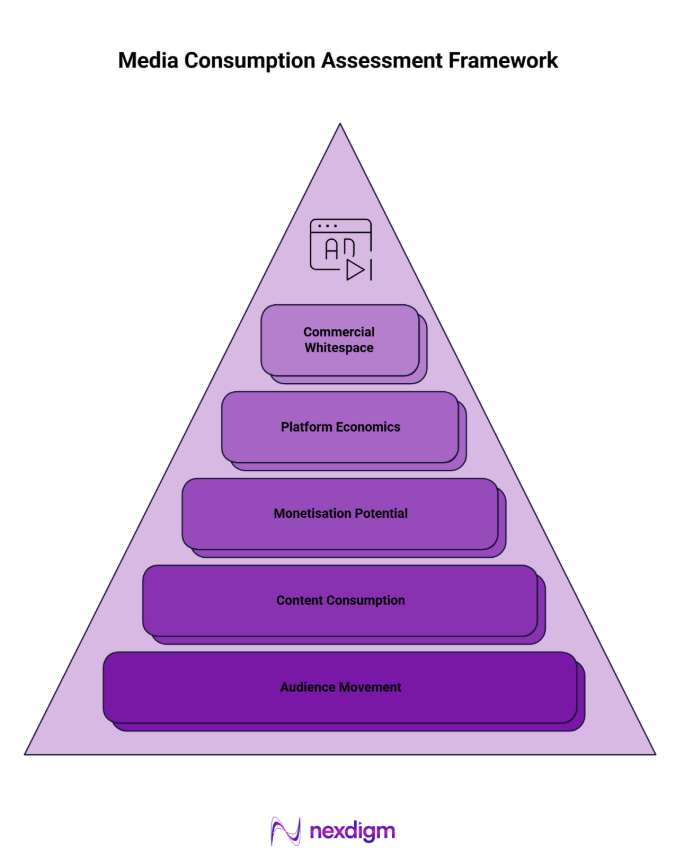
- Map where audiences are moving.
Measure platform penetration, viewing frequency, device usage and demographic differences. This establishes whether audience migration is structural or concentrated within particular consumer groups. - Understand what audiences are consuming.
Long-form programming, short-form video, live content, microdramas and interactive formats serve different consumption occasions. Format-level analysis helps identify where new demand is forming. - Measure the monetisation potential of attention.
Compare subscription willingness, advertising exposure, engagement and commerce behaviour. The most attractive audience segment is not necessarily the largest one. - Assess platform and content economics.
Production costs, customer acquisition, churn, advertising yields and content investment determine whether audience growth can translate into sustainable returns. - Identify the next commercial whitespace.
The final assessment should identify emerging formats, underserved audiences and monetisation models where competition has not yet fully intensified.
The report’s discussion of microdramas illustrates this shift. These mobile-first episodic formats typically use 60-to-90-second episodes and combine advertising, microtransactions and brand integration to monetise fragmented viewing sessions.
Nexdigm Case: Mapping Audience Migration Across Media Platforms
A media company assessed 5 audience segments across 8 cities, surveying 3,000 viewers across television, OTT and digital video. Nexdigm identified streaming and Connected TV as priority channels, with 68% ad-supported usage and 21% higher engagement among the target segment.
Nexdigm’s media consumption trends analysis helps businesses evaluate audience behaviour, platform migration, competitive dynamics, content formats and monetisation opportunities.
To take the next step, simply visit our Request a Consultation page and share your requirements with us.
Harsh Mittal
+91-8422857704