

Medical consumables are among the most frequently purchased products in a hospital, yet their sourcing often receives less strategic attention than major medical equipment or pharmaceutical procurement. Gloves, syringes, IV sets, dressings, catheters and specimen containers may have relatively low individual prices, but shortages can interrupt routine clinical activity across multiple departments. For hospitals, the strongest supplier relationships are therefore built around consistent product availability, dependable replenishment and quality that remains stable across deliveries.
Supplier selection also requires a broader view of the market. Routine disposables may be available from several domestic manufacturers, while specialised consumables can depend on fewer producers, imported inputs or specific technical capabilities. A hospital’s sourcing strategy needs to reflect these differences.
Product Availability Is More Important Than a Long Supplier Catalogue
A supplier may offer hundreds of products but still lack reliable availability in the categories a hospital consumes most frequently. Procurement teams should examine the supplier’s actual product range, manufacturing or distribution model, inventory position and ability to serve the hospital’s locations.
Medical consumables generally fall into several broad groups:
- Injection and infusion products: Syringes, needles, IV cannulas, infusion sets and related accessories.
- Protective and infection-control products: Examination gloves, surgical masks, gowns, caps and protective coverings.
- Wound-care products: Gauze, dressings, bandages, tapes and other products used in routine and post-operative care.
- Urological and respiratory consumables: Catheters, drainage bags, oxygen masks, suction products and related disposables.
- Laboratory and specimen-handling products: Collection containers, tubes, sample-transfer products and other single-use laboratory supplies.
These categories differ in manufacturing complexity, clinical use, and regulatory requirements. A supplier with a strong position in basic disposables may not be equally capable of supplying specialised catheters or products requiring particular material specifications.
Supply Continuity Depends on the Structure Behind the Supplier
The reliability of a consumables supplier is influenced by its manufacturing footprint, upstream material availability, and distribution arrangements. A distributor may have broad customer coverage but depend on a limited number of manufacturers. Similarly, a domestic manufacturer may produce locally while relying on imported polymers, specialised nonwovens or packaging materials.
Hospitals should therefore understand where the products originate and how they move through the supply chain. This is particularly relevant for high-consumption products where even a short interruption can affect several departments.
Assam’s centralised procurement model, documented in the National Health Mission’s 2026 best-practices compendium, offers a useful example of structured supplier coverage. The state reported empanelling approximately 197 manufacturers under a multi-year framework, with L1, L2 and L3 suppliers supporting essential drug procurement and rate contracts covering consumables and surgical items. The model demonstrates the value of maintaining multiple qualified sources rather than relying on a single, lowest-priced vendor.
For hospital buyers, this approach can be adapted by product category. Critical consumables may need a primary supplier and approved alternatives, while less critical products can be sourced through broader competitive purchasing.
Quality Consistency Should Be Evaluated at Product Level
A manufacturer’s general reputation does not establish the suitability of every product it supplies. Hospitals should compare the specifications, packaging, material characteristics, and applicable regulatory documentation for the individual consumable.
For example, glove selection involves material, thickness, fit and intended use. Syringes require attention to size, graduation, sterility, and packaging integrity. Dressings and catheters have their own performance and material requirements.
A supplier assessment should consider product consistency, traceability, batch documentation, applicable licences and the availability of supporting quality records. Where products are regulated as medical devices, the relevant requirements under India’s Medical Devices Rules, 2017 should be considered according to the product’s classification and intended use.
Commercial Competitiveness Includes Replenishment and Inventory Costs
A low unit price can be offset by inconsistent supply, frequent emergency purchases or excessive inventory requirements. Hospitals should compare supplier quotations alongside order fulfilment, lead times, minimum order quantities, delivery frequency, and return arrangements.
The economics also differ between large hospital groups and smaller facilities. A chain may be able to negotiate standardised specifications and consolidated volumes, while an individual hospital may value flexible ordering and local distribution coverage more highly.
A structured medical consumables supplier analysis helps connect these commercial differences with product availability, manufacturing capability and geographic reach. Nexdigm’s procurement research can support supplier identification, product-category mapping, regional market comparisons and assessment of manufacturer and distributor positioning. This gives hospitals a clearer view of potential supply partners before product approval and procurement decisions.
Medical Consumables Supplier Assessment Framework
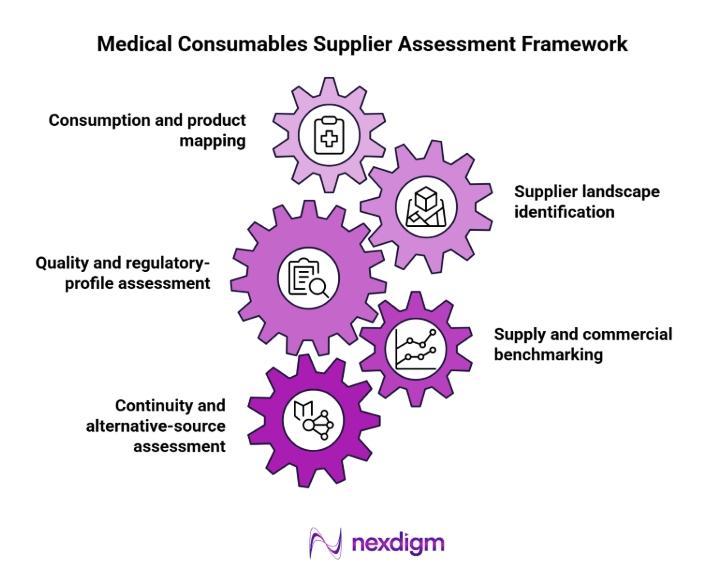
- Consumption and product mapping: Identify high-use products, clinical requirements, specifications, annual demand and criticality.
- Supplier landscape identification: Map manufacturers and distributors by product category, location, portfolio and customer coverage.
- Quality and regulatory-profile assessment: Review product documentation, applicable licences, traceability and relevant quality credentials.
- Supply and commercial benchmarking: Compare manufacturing origins, distribution networks, lead times, order conditions and pricing.
- Continuity and alternative-source assessment: Identify upstream dependencies, geographic concentration, and suitable alternative suppliers.
Case Study: Assessing Hospital Consumables Suppliers
A hospital network reviewing routine consumables needed greater visibility into supplier coverage and product availability. Nexdigm’s research mapped 26 suppliers across five regions, compared product portfolios and distribution footprints, and identified seven vendors for further assessment across priority consumable categories.
To take the next step, simply visit our Request a Consultation page and share your requirements with us.
Harsh Mittal
+91-8422857704