

Medical device trade opportunities emerge where clinical demand, purchasing power and supply capability intersect. A country may import large volumes of devices but offer limited entry potential because established suppliers dominate tenders or local registration takes years. Another market may import less overall yet show stronger prospects in a specific category, such as patient monitoring, diagnostics or surgical instruments.
The key is to assess products and destination markets together. National-level trade totals are useful for orientation, but they rarely reveal which devices have the strongest combination of demand, competitive access and achievable margins.
Why Product-Level Mapping Matters
Medical devices cover a wide range of products, from single-use consumables and orthopaedic equipment to imaging systems and in-vitro diagnostics. Their commercial models differ considerably. Consumables can generate repeat orders linked to procedure volumes, while capital equipment depends on investment cycles, financing and installation capability.
The World Health Organization estimates that around 2 million different types of medical devices are available globally, grouped into more than 7,000 generic device categories. This breadth makes product classification essential. A broad “medical devices” category can conceal growth in one segment and stagnation in another.
A useful trade map should distinguish:
- High-volume consumables: Products whose demand may follow hospital activity, laboratory testing or routine clinical use.
- Capital equipment: Devices requiring substantial upfront investment, installation, training and after-sales service.
- Specialised technologies: Products whose market potential depends on clinical protocols, reimbursement, regulatory approval and specialist expertise.
- Replacement components: Parts and accessories tied to the installed base, maintenance schedules and product compatibility.
This segmentation helps companies identify the appropriate route to market, whether through distributors, direct hospital sales, service partners, or local manufacturing.
Where Import Data Signals an Opportunity
India’s medical-device trade illustrates why both sides of the market need attention. Government figures show that medical-device imports reached ₹137,088 crore in FY2024–25, while exports stood at ₹42,360 crore. In April to December of FY2025–26, imports were ₹94,664 crore and exports were ₹28,106 crore. The partial-year figures should not be treated as full-year forecasts, but the scale of imports highlights the importance of understanding which product categories remain dependent on overseas supply.
For manufacturers, import dependence can signal room for domestic production or export substitution. For international suppliers, it may indicate established demand, but it also implies competition from existing exporters and domestic producers. The next step is to isolate the products driving the trade gap, rather than assume every imported device is a viable target.
Country-level opportunities also need to be tested against installed infrastructure. WHO’s medical-equipment indicators track the availability of technologies such as CT scanners, MRI units, PET systems and radiotherapy equipment per million population. Low equipment density can point to unmet infrastructure needs, although affordability, staffing and operating budgets may prevent those needs from translating into near-term orders.
Selecting Medical Device Markets
Effective medical device trade analysis combines import trends, supplier competition and market-access conditions to identify commercially viable opportunities. Import growth can signal demand, but companies must also assess regulatory requirements, purchasing readiness and the costs of installation, distribution and after-sales support.
For each priority device category, examine:
- Market trajectory: Compare multi-year import value and quantity to distinguish volume expansion from price effects.
- Supplier position: Identify leading origin countries, supplier concentration and changes in market share.
- Adoption conditions: Assess hospital investment, reimbursement, public procurement and the clinical infrastructure needed to use the device.
- Regulatory access: Confirm registration pathways, product classification, local representation and tender eligibility.
- Lifecycle economics: Include installation, training, warranties, spare parts and maintenance in the commercial assessment.
The lifecycle test is especially important for equipment. A low purchase price may not be competitive if the device has high maintenance costs or requires unavailable components. Conversely, a supplier with reliable service coverage may win even when its upfront price is higher.
Nexdigm’s Device-Market Prioritisation Framework
Nexdigm can structure a market screen around four connected decisions:
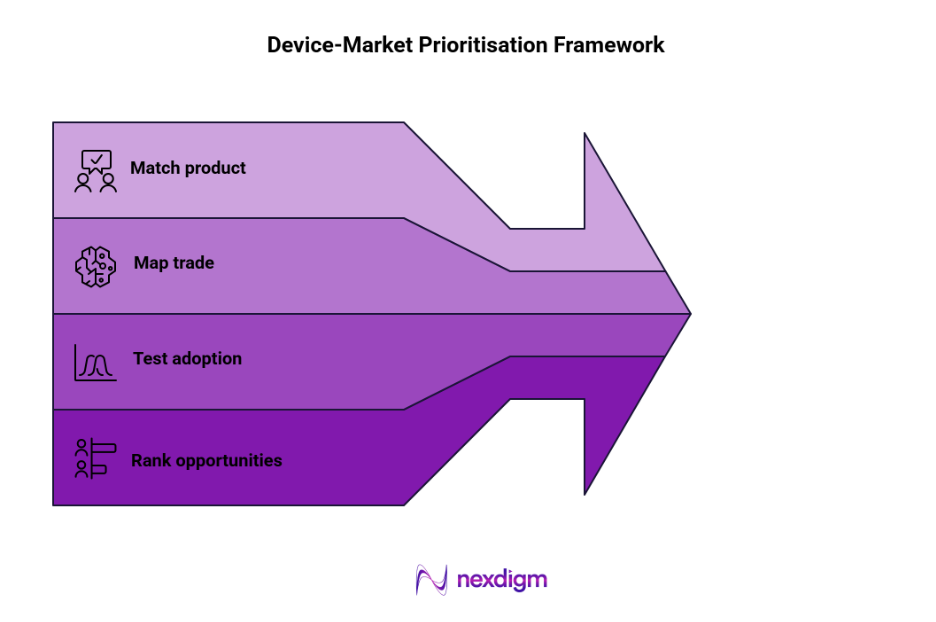
- Match product to need: Identify the device categories linked to local clinical requirements and investment priorities.
- Map trade and competition: Measure import momentum, supplier shares and the extent to which the market depends on external supply.
- Test adoption readiness: Review registration, procurement access, service infrastructure and buyer financing.
- Rank feasible opportunities: Compare landed price, expected demand, distribution requirements and after-sales costs before committing resources.
The result is a product-specific shortlist that distinguishes markets with large import volumes from those where a supplier can realistically compete.
Case Study: Selecting Devices for Export Expansion
A device manufacturer assessed 18 product-market combinations using import trends, supplier shares, registration timelines and service costs. Seven combinations passed the initial screen; commercial analysis narrowed these to three. The company prioritised two markets for distributor due diligence and deferred the third pending regulatory clarification.
To take the next step, simply visit our Request a Consultation page and share your requirements with us.
Harsh Mittal
+91-8422857704