

Medical equipment trade reveals more than which countries are buying scanners, monitoring systems, or laboratory machines. It can show where healthcare systems depend on external suppliers, where equipment investment may be expanding, and where manufacturers could face opportunities to provide products, components, or maintenance services.
Yet import dependence is not automatically a market gap. Some countries import equipment because specialist manufacturing is concentrated overseas. Others lack the financing, technical workforce, or maintenance infrastructure needed to use additional equipment effectively. Identifying commercially viable opportunities requires examining trade flows alongside the conditions that turn equipment purchases into sustained demand.
What Equipment Flows Reveal About Market Structure
Medical equipment differs from medicines and disposable supplies because purchases often involve large capital commitments and long operating lifecycles. Buyers consider the acquisition price, installation, staff training, warranties, spare parts, service response times and future upgrades.
The World Health Organization tracks the availability of technologies including MRI, CT, PET and radiotherapy equipment per million people. These indicators provide a useful way to compare equipment availability across countries and identify potential infrastructure gaps. They should, however, be interpreted alongside equipment utilisation, patient demand, public and private investment, and the ability to operate the machines.
Trade analysis becomes more useful when it separates:
- New installations: Imports associated with hospital construction, diagnostic network expansion or new clinical capacity.
- Replacement demand: Purchases intended to replace ageing equipment or upgrade existing capabilities.
- Service-linked demand: Spare parts, accessories and maintenance-related products tied to the installed base.
- Specialist equipment: Products whose adoption depends on trained personnel, specialised facilities and clinical protocols.
These categories have different commercial implications. New installations may create larger equipment orders but depend on capital budgets. Replacement markets can be more predictable where an established installed base exists. Service-linked products may provide recurring revenue but require access to compatible equipment and a reliable support network.
Reading Import Dependence Against Domestic Supply
India’s medical-device trade illustrates the scale of external sourcing in the sector. Government figures put imports at ₹137,088 crore and exports at ₹42,360 crore in FY2024–25. During April to December of FY2025–26, imports totaled ₹94,664 crore and exports ₹28,106 crore. These partial-year figures should be treated as a snapshot rather than a full-year projection.
The difference between imports and exports suggests that overseas suppliers remain commercially significant in India’s medical-device market. However, the aggregate figures do not identify which equipment categories account for the gap, whether imports are rising in volume or value, or how much demand domestic manufacturers can serve.
That distinction matters for both international exporters and local manufacturers.
Exporters need to identify categories where buyers have established budgets, and supplier access is feasible.
Domestic producers need to determine which imported products can be manufactured competitively, taking account of components, technology, quality standards, and production scale.
Assessing Equipment Imports for Commercial Opportunities
Effective medical equipment trade flows analysis combines import trends, supplier concentration, installed-base requirements and procurement conditions to identify viable market opportunities. By comparing these indicators across countries and equipment categories, businesses can distinguish genuine supply gaps from markets where financing, infrastructure or service limitations may constrain demand.
A focused assessment should test:
- Category-level dependence: Identify equipment types with high import exposure and limited domestic alternatives.
- Supplier concentration: Determine whether imports depend on a small number of source countries or manufacturers, creating scope for diversification.
- Installed-base requirements: Estimate replacement cycles, maintenance needs and demand for compatible components.
- Infrastructure readiness: Assess whether facilities have the staff, power supply, technical support and financing needed to adopt the equipment.
- Procurement feasibility: Review public tender requirements, distributor access, registration and service obligations.
The distinction between need and purchasing capacity is critical. A country may have low diagnostic-equipment density and significant clinical need, but limited near-term demand if hospitals cannot fund procurement or maintain the machines. Conversely, a market with substantial installed capacity may offer attractive replacement and service opportunities.
Nexdigm’s Equipment-Flow Opportunity Framework
Nexdigm can connect trade dependence with the practical economics of equipment supply through four decision stages:
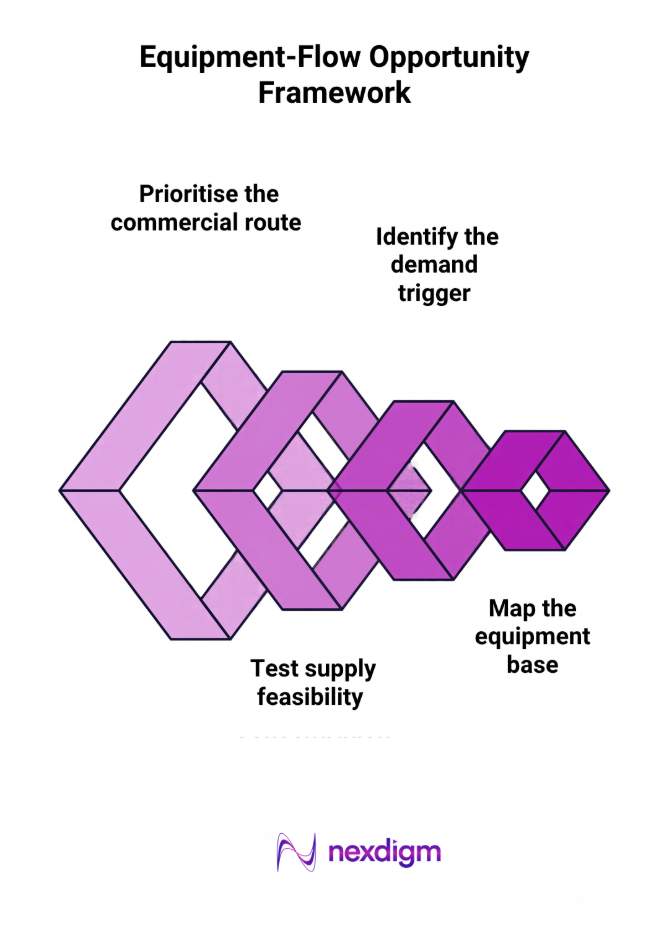
- Map the equipment base: Segment trade by device category, origin country and product type to identify the areas of greatest import exposure.
- Identify the demand trigger: Separate new-capacity investment from replacement cycles, technology upgrades and recurring service needs.
- Test supply feasibility: Assess regulatory access, domestic competition, distribution coverage, installation capability and after-sales support.
- Prioritise the commercial route: Compare export sales, local manufacturing, distributor partnerships and service opportunities against expected returns and execution risk.
This creates a clearer view of whether the strongest opportunity lies in supplying new equipment, replacing incumbent products, or supporting the installed base.
Case Study: Finding a Viable Equipment Entry Point
An equipment supplier screened 12 countries across four product categories using import trends, installed-base indicators, supplier concentration and service requirements.
5 country-category combinations passed the initial screen.
After assessing procurement access and support costs, the company prioritised two markets for distributor evaluation and deferred a third pending service-partner availability.
To take the next step, simply visit our Request a Consultation page and share your requirements with us.
Harsh Mittal
+91-8422857704