

Medical-grade material sourcing sits at the intersection of quality, regulatory compliance, supplier reliability, and cost. The global medical devices market is projected to generate approximately $576.8 billion in revenue in 2026, with a projected 5.54% CAGR from 2026 to 2031. At the supplier level, the market is extensive: the FDA reported 29,178 registered medical device establishments in FY2025, including 13,328 domestic and 15,850 foreign establishments.
This supplier diversity does not necessarily translate into equivalent sourcing options. Medical-device supply chains can be affected by manufacturing and quality problems, geopolitical issues, natural disasters, capacity limitations, and production discontinuations. The FDA maintains a Medical Device Shortage List and, as of October 2026, included shortages across categories such as neurosurgical, biopsy, electrosurgical, and oxygenator devices.
For manufacturers, therefore, the strongest supplier is not automatically the lowest-cost or largest provider. Medical grade material supplier benchmarking can help compare suppliers across quality, certification, manufacturing capability, availability, geographic exposure, and commercial positioning.
Supplier Comparison Requires More Than a Price Benchmark
Medical-grade materials can vary in composition, performance specifications, certifications, manufacturing processes, and intended applications. A supplier offering an attractive price may have longer lead times or limited capacity, while another may provide stronger quality assurance but at a higher cost. Benchmarking needs to bring these dimensions together to understand the overall supplier proposition.
Dimensions That Shape the Supplier Comparability
A practical benchmark can begin with understanding the supplier compatibility. To understand this several questions arise:
- Can the Material Meet Requirements? Compare material specifications, consistency, performance characteristics, testing capabilities, and application suitability across suppliers.
- Is the Supplier Qualified? Examine certifications, quality systems, regulatory readiness, documentation, audit capabilities, and relevant industry experience.
- Can Supply Be Maintained? Assess capacity, lead times, availability, manufacturing locations, logistics, and continuity arrangements.
Together, these dimensions create a more meaningful view of supplier fitness than unit-price comparison alone.
Nexdigm’s Expertise Towards Medical Grade Material Supplier Benchmarking
Nexdigm can combine market intelligence, supplier research, benchmarking, healthcare expertise, and commercial analysis to compare medical-grade material suppliers. Through medical grade material supplier benchmarking, Nexdigm can assess quality systems, certifications, material capabilities, production capacity, availability, geographic footprint, pricing, lead times, and supplier positioning.
Why Medical Grade Material Supplier Benchmarking Is Needed
Through medical grade material supplier benchmarking, Nexdigm can help manufacturers move beyond isolated supplier information and understand how providers compare across the factors that directly influence sourcing decisions:
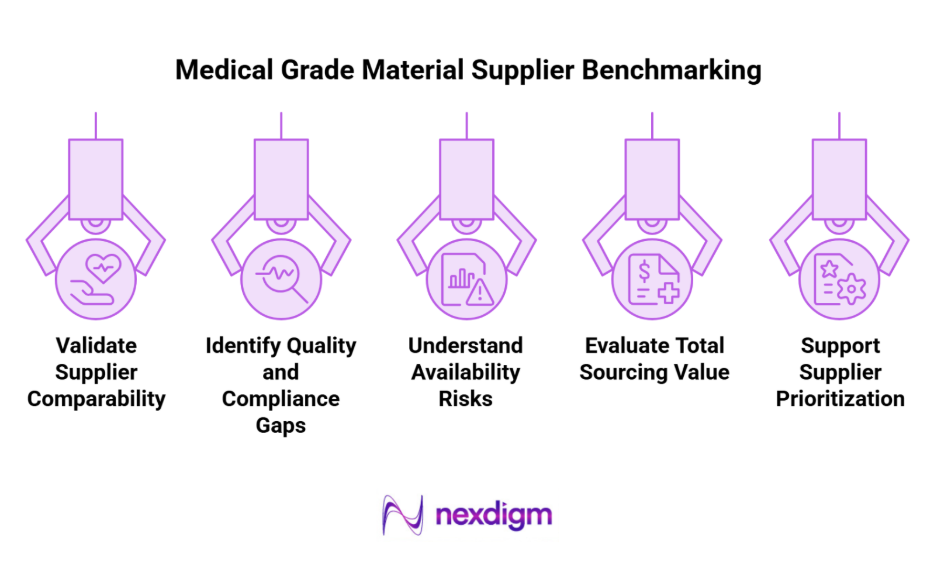
- Validate Supplier Comparability: Determine whether suppliers can consistently meet required material specifications, quality expectations, certifications, and application requirements.
- Identify Quality and Compliance Gaps: Highlight differences in quality systems, certifications, documentation, testing capabilities, and regulatory readiness that may affect supplier qualification.
- Understand Availability Risks: Compare capacity, lead times, manufacturing locations, and supply continuity to identify suppliers that may present greater availability exposure.
- Evaluate Total Sourcing Value: Assess price alongside logistics, minimum orders, qualification requirements, switching costs, and reliability to understand the broader commercial proposition.
- Support Supplier Prioritization: Create a structured basis for distinguishing preferred, secondary, and alternative suppliers for further qualification and commercial engagement.
This makes the assessment valuable because it helps manufacturers understand not only which suppliers are available, but which suppliers offer the strongest combination of quality, compliance, availability, and commercial fit.
How Nexdigm’s Approach Offers Supplier–Material Compatibility
Nexdigm’s approach can help manufacturers assess whether a supplier’s capabilities are genuinely compatible with the material and application requirements being evaluated:
- Material Specification Fit: Compare supplier capabilities against required material composition, performance characteristics, tolerances, testing requirements, and application specifications.
- Manufacturing Compatibility: Examine production processes, technical capabilities, equipment, capacity, and consistency to determine whether suppliers can support the required material standards.
- Quality & Certification Alignment: Evaluate quality systems, certifications, documentation, traceability, and compliance capabilities against the requirements associated with the material and end application.
- Supply Compatibility: Assess lead times, capacity, minimum order quantities, geographic location, and continuity capabilities to determine whether the supplier can support operational requirements.
This approach helps Nexdigm distinguish between suppliers that can provide material and those whose capabilities, quality standards, and supply models are genuinely compatible with the manufacturer’s requirements.
Nexdigm’s Case
Nexdigm supported a medical-device manufacturer in screening 46 medical-grade material suppliers across quality credentials, certifications, material specifications, production capacity, and supply readiness. The assessment shortlisted 16 suppliers for detailed evaluation, identified 9 requiring additional documentation or qualification, and highlighted 7 suppliers with stronger diversification potential, supporting a more focused sourcing strategy.
To take the next step, simply visit our Request a Consultation page and share your requirements with us.
Harsh Mittal
+91-8422857704