

Medical imaging is becoming an increasingly important part of healthcare infrastructure, with demand spanning MRI, CT, X-ray, ultrasound, nuclear imaging, and related technologies. The global medical imaging market was valued at approximately $43.5 billion in 2025 and is projected to reach $64.7 billion by 2033, growing at a CAGR of 5.1%. Hospitals represented 42% of the market by end use in 2025, underlining their importance as a major buyer group.
Technology is also becoming a stronger differentiator. Recent industry analysis highlights the growing integration of AI, advanced visualization, and digital solutions into imaging workflows. In India, the diagnostic imaging equipment market was estimated at INR 15,836 crore in 2023 and is projected to reach INR 20,968 crore by 2026, reflecting a 9.8% CAGR.
As equipment decisions increasingly involve technology performance, service support, lifecycle economics, and future readiness, medical imaging equipment supplier research can help organizations compare vendors on the factors that matter beyond the initial purchase.
The Best Supplier Depends on the Buying Context
There is rarely one supplier that leads across every imaging modality and procurement requirement. A vendor may have strong MRI technology but a different position in ultrasound or CT. Another may offer competitive commercial terms but have a narrower service network. The more useful approach is to assess suppliers against clinical and technical performance, service capability, commercial value, scalability, and strategic fit for the intended application.
How Nexdigm Prioritizes Imaging Supplier Choices
Once technology, service, and commercial factors are considered together, the challenge is determining which criteria should carry the most weight. Nexdigm can help organizations translate these findings into a more focused supplier decision:
- Define What Matters Most: Align evaluation priorities with modality, clinical needs, facility requirements, and procurement objectives.
- Differentiate Critical From Secondary Factors: Separate requirements that directly affect clinical and operational performance from those with lower decision impact.
- Compare Supplier Strengths: Identify where each vendor delivers the greatest value against the prioritized criteria.
- Highlight Decision Gaps: Flag areas where available supplier information requires additional validation, technical review, or commercial due diligence.
- Create a Focused Shortlist: Narrow the supplier universe to vendors that demonstrate the strongest alignment with the defined priorities.
This enables medical imaging equipment supplier research to progress from broad market information to a more focused, requirement-driven supplier selection process.
Medical Imaging Supplier Research: Adding a Strategic Value
A structured supplier assessment can strengthen decisions at several points in the imaging procurement cycle:
- Sharper Shortlisting: Reduce a broad supplier universe to vendors that best match clinical, operational, and commercial requirements.
- Stronger Negotiations: Use comparative supplier insights to identify areas for discussion around pricing, service terms, warranties, and lifecycle costs.
- Lower Selection Risk: Identify capability or support gaps before committing to a long-term equipment relationship.
- Better Technology Planning: Compare current capabilities with future technology requirements to support replacement and investment decisions.
For organizations making significant imaging investments, medical imaging equipment supplier research can therefore provide a stronger evidence base for supplier selection, negotiation, technology planning, and long-term equipment strategy.
Nexdigm’s Medical Imaging Supplier Assessment
Nexdigm can conduct a structured assessment to compare imaging suppliers against the factors most relevant to the organization’s procurement objectives:
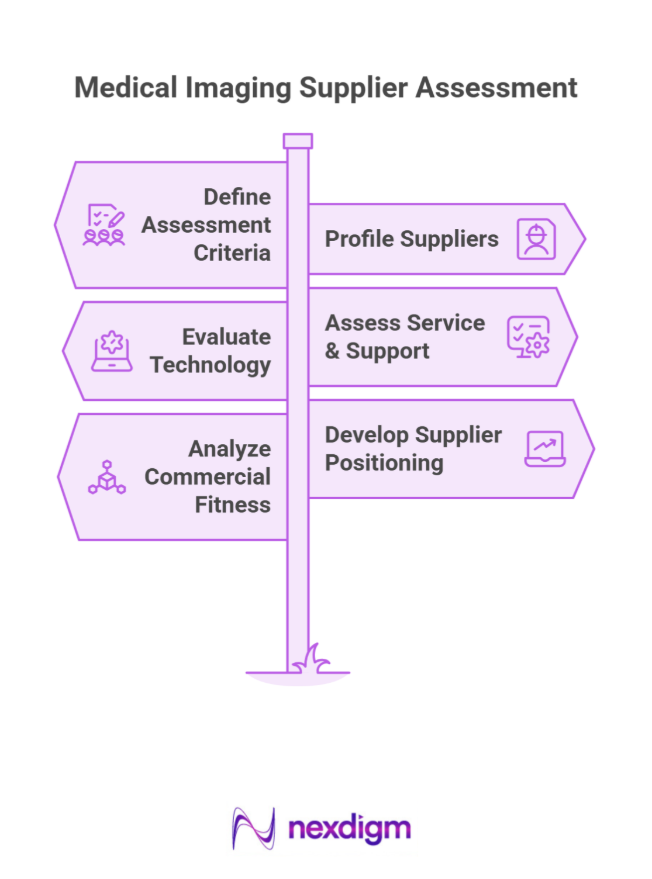
- Define Assessment Criteria: Establish modality-specific requirements covering technology, clinical performance, service, commercial terms, geographic coverage, and future readiness.
- Profile Suppliers: Collect and validate information on product portfolios, manufacturing capabilities, installed base, service infrastructure, and market presence.
- Evaluate Technology: Compare suppliers on imaging capabilities, workflow integration, innovation, reliability, digital features, and modality-specific strengths.
- Assess Service & Support: Examine installation, maintenance, technical response, training, spare-parts availability, warranties, and service-network coverage.
- Analyze Commercial Fit: Evaluate acquisition costs, lifecycle economics, financing structures, service contracts, upgrades, and other ownership considerations.
- Develop Supplier Positioning: Consolidate findings to highlight relative strengths, gaps, trade-offs, and suppliers that demonstrate the strongest overall fit.
The assessment gives organizations a structured basis for moving from supplier research to a focused shortlist and more informed procurement decision.
Significant Impact of Nexdigm’s Supplier Assessment
Nexdigm’s assessment can help organizations move beyond fragmented supplier information toward a clearer, evidence-based view of imaging vendors. By connecting technology, service, commercial, and market considerations, the assessment can support more focused shortlisting, stronger supplier comparisons, better negotiation preparation, and reduced selection risk while providing a structured basis for long-term imaging procurement decisions.
Nexdigm’s Case
A healthcare organization assessed medical imaging suppliers across three markets using Nexdigm’s medical imaging equipment supplier research approach. The assessment helped improve supplier comparison coverage by 30%, while 22% of shortlisted vendors demonstrated stronger service-network capabilities and 16% offered more favorable lifecycle economics. The findings supported a more focused supplier shortlist and strengthened the basis for technical and commercial discussions.
To take the next step, simply visit our Request a Consultation page and share your requirements with us.
Harsh Mittal
+91-8422857704