

Medical supplies cross borders through complex networks of manufacturers, contract producers, distributors and regional trading hubs. A hospital may purchase a product from a domestic distributor even when the underlying material or finished item was manufactured overseas. Tracking these flows helps procurement teams understand where supplies originate, how supplier relationships are changing and where a disruption could affect availability.
Trade intelligence is particularly useful for products purchased repeatedly, including syringes, gloves, dressings, diagnostic reagents and other hospital or laboratory consumables. Because these products may be sourced from multiple countries and intermediaries, national import totals alone rarely show how concentrated the underlying supply chain is.
What Trade Data Reveals About Medical Supplies
Customs statistics can show the value and quantity of imports, the reported country of origin, the exporting partner and changes in trade over time. Shipment records may provide additional information about transaction frequency, consignees, consignors and transport routes, depending on the country and data source.
The first challenge is classification. Medical supplies are not a single customs category. Products may fall under different Harmonized System (HS) headings depending on their material, intended use and technical characteristics. Diagnostic reagents, protective equipment, medical instruments and disposable consumables can therefore appear in different parts of the classification system.
The World Trade Organization’s medical-goods analysis separates pharmaceuticals, medical equipment, orthopaedic equipment, personal protective equipment and other medical supplies. This is a useful reminder that combining broad product groups can hide differences in trade concentration and purchasing behaviour.
Mapping Supplier Concentration and Cross-Border Dependencies
Effective medical supply trade flows analysis tracks products, origin countries, intermediaries and destination markets together. The purpose is to distinguish a genuinely diversified supply chain from one that appears diverse only because goods pass through several distributors or trading hubs.
Four indicators deserve particular attention.
- Origin concentration: Measure the share of imports supplied by each origin country. A high share held by one country can expose buyers to production interruptions, export restrictions or logistics disruptions.
- Supplier persistence: Identify whether the same exporters appear repeatedly across reporting periods. Recurring flows may indicate established supply relationships, while abrupt changes warrant further investigation.
- Route complexity: Compare the country of export with the reported origin and, where possible, manufacturer information. A shipment routed through a third country does not necessarily represent production diversification.
- Quantity and value changes: Rising import values alongside stable quantities may reflect price changes rather than increased physical availability. Quantity trends can be more informative for standardised consumables, although reporting units must be consistent.
These indicators should be interpreted at product level. A country can be diversified in gloves but highly dependent on a narrow group of origins for a particular diagnostic reagent or specialised component.
Detecting Supply Risks Before They Affect Procurement
Trade flows can provide early warning signals, but they are not a substitute for supplier qualification or inventory monitoring. A decline in imports might indicate supply disruption, a change in purchasing contracts, seasonal demand or incomplete reporting. It should trigger investigation rather than an automatic conclusion.
Procurement teams can compare current flows with historical baselines to flag unusual changes in shipment frequency, import quantities or supplier shares. They can then cross-check these signals against supplier performance, lead times, inventory cover, product approvals and contractual obligations.
A further limitation is visibility into upstream production. Customs records may identify the exporter or country of origin but not the manufacturer of a raw material or component. Where traceability matters, trade data should be combined with supplier declarations, product documentation and direct due diligence.
Classification changes also affect long-term comparisons. In January 2026, the World Customs Organization announced an update to the Harmonized System that will introduce 38 dedicated codes for vaccines and other essential health goods from 1 January 2028. Companies maintaining multi-year trade datasets will need to account for such changes when comparing products over time.
Nexdigm’s Medical Supply Flow Monitoring Framework
Nexdigm can organise supply-flow intelligence into four stages:
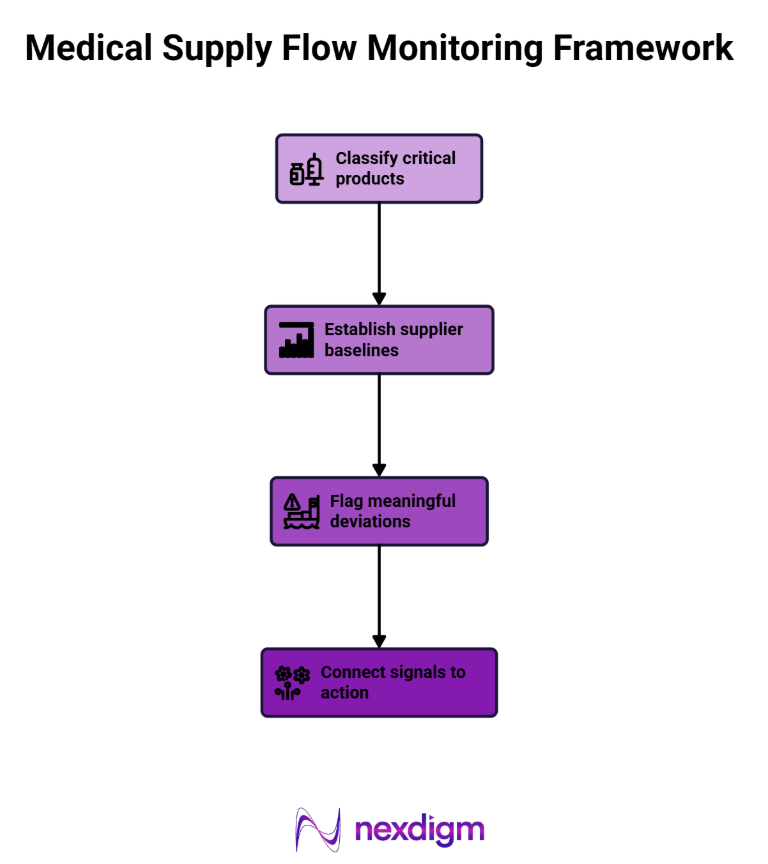
- Classify critical products: Map relevant HS codes and separate consumables, equipment, diagnostic inputs and other product groups.
- Establish supplier baselines: Measure import quantities, values, origin shares and recurring trade relationships.
- Flag meaningful deviations: Identify unusual shifts in volumes, supplier concentration or trading routes, then test alternative explanations.
- Connect signals to action: Prioritise supplier checks, contingency sourcing and inventory reviews according to product criticality and switching time.
The result is a more evidence-based view of cross-border supply exposure, with clear distinctions between a trade-data signal and a confirmed operational risk.
Case Study: Reviewing Consumables Exposure
A hospital-products distributor examined 16 consumable categories across six origin countries. The review found that four categories depended on one dominant origin and that two had experienced sustained changes in shipment frequency. The distributor initiated alternative-supplier checks for those categories and reviewed inventory cover for critical items.
To take the next step, simply visit our Request a Consultation page and share your requirements with us.
Harsh Mittal
+91-8422857704