

The global semiconductor memory market has entered a different demand cycle. Growth is increasingly being driven by AI infrastructure, hyperscale data centers, advanced smartphones, and software-defined vehicles, creating sharp differences in memory intensity, pricing power, qualification requirements, and supply risk. The memory category reached $294.82 billion in 2026, expanding 39.4% year over year, while DRAM revenue increased from $102.8 billion in 2025 to $110.6 billion in 2026.
AI is changing the economics of memory most visibly through high-bandwidth memory (HBM). HBM accounted for roughly 5% of global DRAM bit shipments in 2024 but generated more than 20% of DRAM industry revenue, reflecting its substantially higher ASPs and advanced packaging requirements. HBM revenue is projected to increase from $35 billion in 2025 to $60 billion in 2026, before reaching $170 billion by 2031.
AI Is Pulling Capacity Toward HBM
The expansion of AI training and inference clusters is increasing memory requirements per accelerator while shortening technology transition cycles. Hyperscale deployments involving hundreds of thousands of GPUs can consume tens of petabytes of HBM capacity across a single architectural buildout.
The transition from HBM3E to HBM4 adds another layer of supply-chain complexity. HBM4 doubles the interface width from 1,024 bits to 2,048 bits and introduces advanced logic base dies fabricated on advanced process nodes. Memory manufacturers therefore increasingly depend on specialized foundry and advanced-packaging capabilities alongside their own wafer capacity.
For buyers, the implication is significant. Memory availability can no longer be assessed purely through aggregate DRAM production. A more useful memory chip market opportunity analysis must examine which technologies are absorbing wafer capacity, where packaging constraints exist, and how rapidly demand is shifting between generations.
Data Centers Are Reshaping NAND Demand
AI infrastructure is also changing the composition of storage demand. NAND Flash revenue reached approximately $87 billion in 2025 after growing strongly, while hyperscale operators are increasingly deploying high-capacity QLC enterprise SSDs for AI datasets, vector databases, and other data-intensive workloads.
This creates a different demand profile from traditional client storage. Enterprise buyers prioritize capacity density, endurance, performance, power efficiency, and total cost of ownership. As AI-generated data volumes rise, storage requirements increasingly depend on the economics of moving, processing, and retrieving data rather than simply storing it.
At the same time, advanced-memory allocation creates potential pressure on conventional segments. Capacity directed toward HBM can influence the availability and pricing of standard server DRAM, while consumer electronics manufacturers remain more exposed to demand elasticity and inventory cycles.
Smartphones and Automotive Are Following Different Paths
Smartphone memory remains a large-volume market, particularly for LPDDR5 and LPDDR5X. These technologies account for approximately 60% of smartphone DRAM shipments, but OEMs face a difficult pricing environment when memory costs rise faster than consumer willingness to pay.
Automotive memory has a different economic structure. Software-defined vehicles, ADAS Level 2+ and Level 3 systems, digital cockpits, connected platforms, and increasingly centralized computing architectures are increasing memory content per vehicle. Combined DRAM and NAND content reached approximately 90 GB per vehicle in 2025.
Automotive qualification requirements also create higher barriers to substitution. AEC-Q100 validation, extended testing cycles, temperature requirements, and long vehicle-platform lifecycles make automotive memory less exposed to short-term demand swings. For suppliers, this can create more durable revenue streams, although it also makes capacity planning and second-source qualification more important.
The Key Question Is Where Capacity Creates the Most Attractive Economics
Memory opportunities should be evaluated by combining demand growth with pricing power and supply constraints. HBM offers exceptional growth but carries advanced-packaging and yield risks. Server DRAM benefits from AI infrastructure expansion but remains exposed to hyperscaler investment cycles. Mobile DRAM provides scale but faces consumer pricing resistance. Enterprise NAND is gaining from AI data infrastructure, while automotive memory combines increasing content with lengthy qualification cycles.
The most useful assessment therefore compares each segment across five dimensions:
- Demand intensity: Memory content per accelerator, server, smartphone, vehicle, or storage system.
- Pricing power: ASP trajectory, customer concentration, contract structures, and ability to pass input costs through the value chain.
- Capacity dependency: Exposure to wafer allocation, advanced packaging, TSV yields, and technology migration.
- Qualification resilience: Switching barriers created by automotive, industrial, reliability, or performance requirements.
- Supply concentration: Geographic and supplier exposure across South Korea, Taiwan, Japan, the United States, and other semiconductor manufacturing locations.
Nexdigm Memory Market Opportunity Assessment Framework
Nexdigm’s memory market opportunity assessment can structure the opportunity assessment around the economics and supply constraints specific to each memory segment:
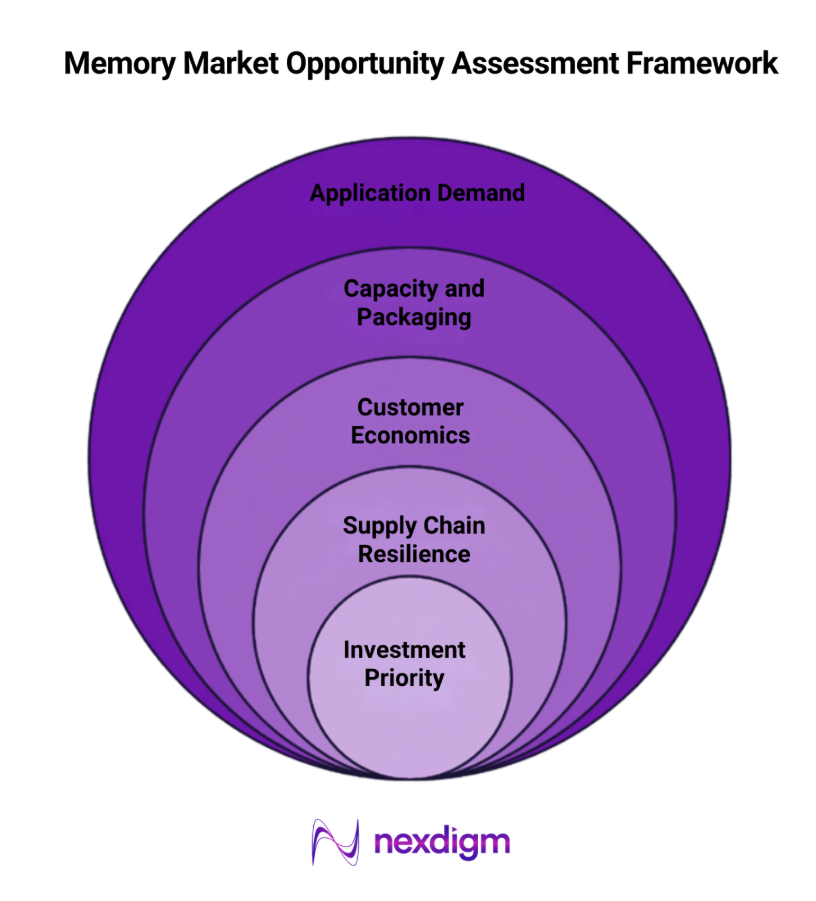
- Technology attractiveness: Compare HBM, DDR5, LPDDR, NAND, and emerging architectures by growth, ASP, performance requirements, and adoption trajectory.
- Application demand: Map memory intensity across AI accelerators, hyperscale servers, smartphones, automotive electronics, and enterprise storage.
- Capacity and packaging exposure: Assess wafer allocation, advanced packaging, TSV requirements, yield constraints, and supplier concentration.
- Customer economics: Benchmark purchasing volumes, contract structures, switching costs, and pricing sensitivity across OEM and hyperscale customers.
- Supply-chain resilience: Evaluate geographic concentration, qualification requirements, alternative suppliers, and geopolitical exposure.
- Investment priority: Rank opportunities according to market growth, margin potential, capital requirements, technology readiness, and time to commercialization.
Nexdigm Case: Automotive Procurement and Cost Benchmarking
Nexdigm supported an automotive component manufacturer across 40 suppliers in six regions. The assessment identified 8–10% component cost variance and 5% freight and duty leakage. Supplier renegotiation and sourcing realignment reduced procurement costs by 7% and improved landed-cost visibility by 30% within two quarters.
To take the next step, simply visit our Request a Consultation page and share your requirements with us.
Harsh Mittal
+91-8422857704