

Merchant payment providers compete on more than their ability to accept a transaction. Their services can include payment gateways, point-of-sale technology, QR acceptance, acquiring connections, settlement management, refunds and merchant reporting. For businesses operating across online and physical channels, the choice of provider can influence transaction costs, checkout performance and day-to-day financial operations.
A meaningful comparison should therefore consider three connected dimensions: technology, transaction economics and merchant support. Evaluating only the advertised processing fee can conceal costs and service limitations that become more significant as transaction volumes increase.
Mapping the Merchant Payments Provider Landscape
The market includes several types of providers, each with a different role in payment acceptance.
- Payment gateways connect merchant websites and applications with payment processors or acquiring institutions. Their capabilities often include checkout integration, payment-method support, transaction status updates and reporting.
- Payment aggregators and acquiring providers facilitate merchant access to payment acceptance infrastructure. Their services may include merchant onboarding, payment processing, settlement and dispute-related workflows, subject to their regulatory permissions and operating model.
- POS and QR technology providers support in-store acceptance through terminals, mobile devices and QR-based interfaces. Some focus on hardware, while others provide integrated software and merchant management tools.
- Payment orchestration platforms connect merchants with multiple payment service providers and enable routing, performance monitoring and consolidated reporting.
A supplier comparison should establish which function each provider performs. Vendors that appear similar in marketing materials may have different responsibilities, dependencies and commercial arrangements.
Technology: Comparing Acceptance and Transaction Management
Technology fit begins with the merchant’s payment mix. A digital marketplace may require cards, UPI, wallets, recurring payments and refunds. A physical retailer may prioritise POS terminals, QR acceptance and reliable connectivity. Businesses operating across both channels may need unified reporting and reconciliation.
Vendor evaluation should consider payment-method coverage, checkout integration, API documentation, transaction routing, retry mechanisms and support for refunds or recurring payments.
Performance should be assessed using comparable transaction data. Approval rates, latency and failure rates can vary by payment method, issuing institution, customer authentication and network conditions. Providers should therefore be compared using consistent transaction categories rather than a single overall success-rate figure.
Reporting capabilities also matter. Merchants need to identify successful transactions, failed attempts, refunds, settlement status and unresolved exceptions without relying on multiple disconnected dashboards.
Transaction Economics: Understanding the Full Cost
Payment costs are shaped by the merchant’s business model, transaction mix, average ticket size, settlement requirements and service usage. A provider’s headline rate may represent only one part of the commercial arrangement.
A complete merchant payment solution vendor comparison should examine:
- Percentage-based processing fees and fixed transaction charges.
- Charges that vary by payment method or card category.
- Refund, chargeback and dispute-related costs.
- Settlement, payout and reconciliation charges.
- Setup, integration and recurring platform fees.
- Additional costs for international payments, currency conversion or specialised services.
The economics should be modelled at different transaction volumes. A provider with a higher base fee may offer more favourable pricing at scale, while a low-cost option may involve additional charges for support or reporting.
Merchants should also consider the financial impact of delayed settlements, failed transactions and manual reconciliation. These costs may not appear on the vendor’s price sheet, but they can influence the overall value of the arrangement.
Merchant Support: An Often-Overlooked Differentiator
Payment issues are time sensitive. Merchants need clear escalation routes when transactions fail, settlements are delayed or payment systems become unavailable.
Support evaluation should cover service hours, response commitments, escalation procedures, account management, technical documentation and the availability of implementation assistance. Larger merchants may require dedicated support, while smaller businesses may depend more heavily on self-service tools and accessible troubleshooting.
The quality of merchant reporting and dispute support should also be assessed. A provider that helps merchants identify transaction exceptions and understand settlement differences can reduce the operational burden on finance teams.
Nexdigm’s Merchant Payment Solution Vendor Comparison Framework
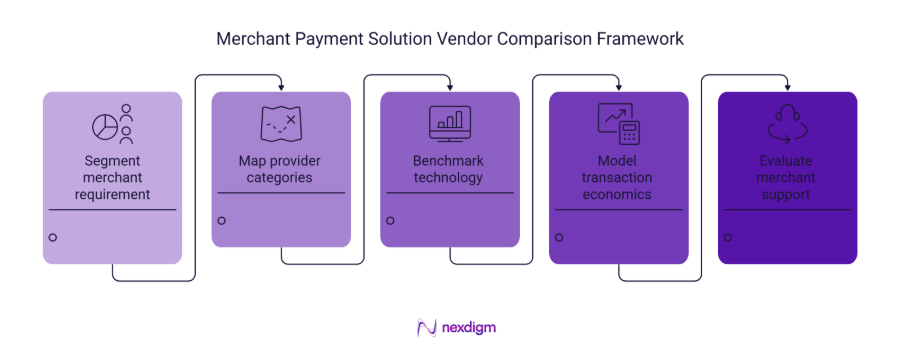
- Segment merchant requirements: Define sales channels, payment methods, transaction volumes, average values and settlement needs.
- Map provider categories: Identify gateways, aggregators, acquirers, POS providers and orchestration platforms according to their role.
- Benchmark technology: Compare payment coverage, integration options, routing, transaction performance and reporting capabilities.
- Model transaction economics: Calculate costs across realistic volume scenarios, including fees, settlement charges and operational expenses.
- Evaluate merchant support: Compare onboarding, technical assistance, dispute handling, escalation and service continuity before creating a shortlist.
Case Study: Merchant Payments Provider Comparison
A multi-category retailer reviewing payment providers needed to understand cost differences across online and in-store transactions. Nexdigm compared 16 providers across acceptance capabilities, pricing structures and merchant support, identifying five candidates with stronger alignment to the retailer’s channel mix and transaction requirements.
To take the next step, simply visit our Request a Consultation page and share your requirements with us.
Harsh Mittal
+91-8422857704