

The metaverse is increasingly being evaluated as a technology stack rather than a single virtual destination. Consumer gaming environments, enterprise collaboration platforms, spatial computing systems, digital marketplaces, and immersive training applications are developing along different commercial paths. This fragmentation matters for companies entering the market because demand depends on the underlying use case, user economics, hardware accessibility, and infrastructure requirements.
The strongest opportunities are emerging where immersive environments solve a specific engagement, collaboration, training, or commerce problem. Platform scale alone does not establish commercial viability.
The Metaverse Is Becoming a Multi-Layer Technology Stack
A functional metaverse platform typically combines several layers: applications and virtual experiences, identity and monetization services, spatial engines, distributed computing infrastructure, and physical access devices.
At the application layer, virtual worlds, digital showrooms, immersive training environments, and collaborative spaces create the user experience. Platform services manage identity, permissions, digital assets, and transactions. Spatial engines provide rendering and physics, while cloud and edge infrastructure support real-time interaction. Browsers, mobile devices, headsets, and smart glasses determine how users access these environments.
This architecture creates multiple points of commercial value. A company does not necessarily need to operate a complete virtual world to participate in the market. Opportunities can exist in rendering infrastructure, identity, digital asset management, enterprise applications, developer tools, or specialized hardware.
Adoption Is Driven by Utility and Engagement
Consumer adoption has concentrated around platforms that combine social interaction, user-generated content, gaming, and recurring digital events. Roblox, Fortnite, and Minecraft demonstrate the importance of persistent communities and continuous content in maintaining engagement.
Enterprise adoption follows a different pattern. Demand is more concentrated in applications where spatial environments replace costly or inefficient physical processes. Engineering teams can review 3D models remotely, architects can collaborate around virtual designs, and companies can conduct immersive training without repeatedly assembling employees at physical locations.
The commercial distinction is therefore the frequency and value of interaction. A platform that users visit once for novelty has limited recurring revenue potential. A platform embedded in gaming, collaboration, design, training, or commerce can generate repeated usage and stronger monetization opportunities.
Monetization Determines Platform Viability
Consumer platforms have increasingly moved toward virtual goods, creator economies, subscriptions, advertising, and branded experiences rather than relying primarily on speculative virtual real estate. These models generate revenue from recurring user activity and transactions.
Enterprise platforms can monetize at significantly lower user volumes through software subscriptions, rendering charges, implementation services, and integration fees. Seat-based pricing of approximately $30–$120 per active user per month provides a fundamentally different economic model from consumer platforms that depend on millions of users and low single-digit paid conversion rates.
A metaverse platform market demand analysis should therefore connect user activity directly to revenue. For consumer platforms, relevant metrics include monthly active users, engagement hours, paid conversion, ARPU, creator activity, and transaction volume. For enterprise platforms, seat penetration, contract value, utilization, deployment costs, and renewal rates become more important.
Infrastructure Can Become the Hidden Cost
Immersive experiences require considerably more infrastructure than conventional web applications. Real-time 3D rendering, spatial audio, high concurrent-user density, and low-latency interaction can increase cloud, bandwidth, and edge-computing requirements.
Latency is particularly important. Motion-to-photon latency above approximately 20 milliseconds can contribute to visual discomfort and reduce the quality of immersive experiences. Platforms serving large concurrent populations must also manage substantial rendering and data-transfer requirements.
Interoperability presents another constraint. Proprietary identity systems, avatars, digital assets, and entitlements can lock users into individual platforms. This fragmentation can restrict network effects and increase switching friction for both users and enterprise customers.
Hardware Accessibility Shapes the Addressable Market
Hardware remains a significant adoption variable. High-end spatial computing devices can deliver sophisticated experiences but impose greater costs, physical discomfort, and usage constraints. Lightweight smart glasses and browser-accessible experiences can potentially broaden the addressable audience by reducing the need for dedicated headsets.
This creates different market opportunities across hardware tiers. Enterprise training, industrial design, and specialized simulation can justify expensive hardware when the workflow generates measurable savings. Consumer applications require a stronger balance between price, comfort, accessibility, and frequency of use.
For platform providers, hardware strategy should therefore be evaluated alongside application demand. A technically superior immersive experience may have limited commercial potential if the required device creates excessive friction.
Nexdigm Metaverse Opportunity Assessment Framework
Nexdigm can evaluate metaverse opportunities across five decision areas:
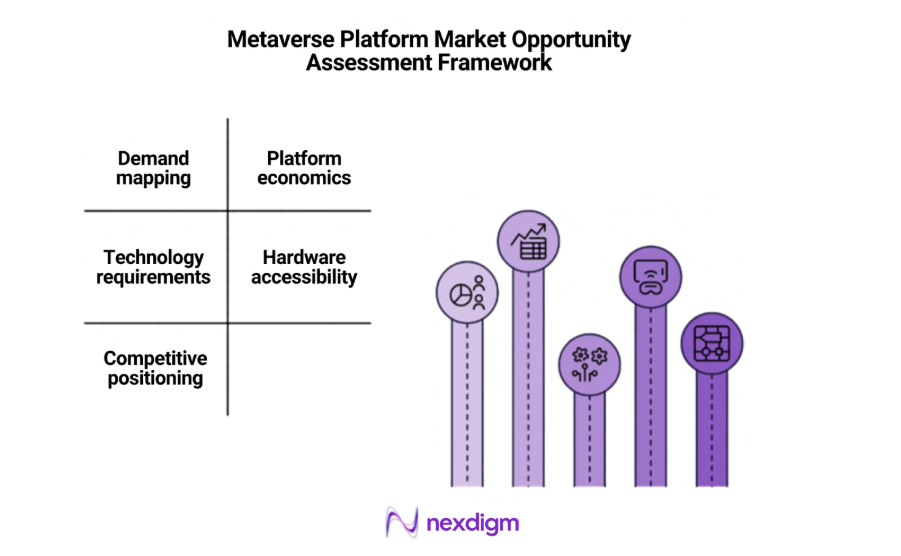
- Demand mapping: Segment consumers and enterprises by use case, adoption stage, engagement frequency, and willingness to pay.
- Platform economics: Model MAU, engagement, paid conversion, ARPU, enterprise seats, transaction revenue, and customer acquisition costs.
- Technology requirements: Assess rendering, latency, bandwidth, spatial computing, identity, and interoperability requirements.
- Hardware accessibility: Compare browsers, mobile devices, smart glasses, VR, and MR hardware against target-user needs.
- Competitive positioning: Map platforms, infrastructure providers, application developers, and monetization models to identify defensible market gaps.
Nexdigm Metaverse Commercialization Lens
A technology client engaged Nexdigm to assess XR market opportunities across enterprise and consumer segments. The assessment quantified revenue opportunities, improved sales forecasting accuracy by 30%, and identified growth segments representing 25% opportunity expansion, helping prioritize high-potential segments and strengthen go-to-market decisions.
To take the next step, simply visit our Request a Consultation page and share your requirements with us.
Harsh Mittal
+91-8422857704