

Microfinance competitors help evaluate how microfinance institutions are supporting financial inclusion across emerging markets. It focuses on understanding how different MFIs serve low-income borrowers, women entrepreneurs, rural households, and microbusinesses through small loans, savings, insurance, and digital financial services.
With competitive intelligence, this study compares outreach models, interest rates, product offerings, repayment practices, technology adoption, and customer support. These insights help institutions identify market gaps, improve borrower access, and strengthen their financial inclusion strategies. It also supports better decision-making for expanding microfinance services in underserved communities.
Recent data shows why microfinance remains important for emerging markets. Around 1.4 billion adults globally are still unbanked, making access to small loans, savings, and digital financial services essential. In developing economies, 40% of adults saved through a financial account, showing rising formal financial participation. Group lending also supports inclusion, with women forming nearly 85% of group loan borrowers, highlighting microfinance’s role in empowering underserved communities
Microfinance Product Benchmarking analysis using Competitive Intelligence
Microfinance Product Benchmarking Analysis using Competitive Intelligence means comparing loan products, interest rates, repayment terms, savings options, insurance, and digital services across MFIs to identify gaps, improve offerings, and support financial inclusion.
-
Interest Rate Benchmarking
Analyzes competitor interest rates, fees, and charges to assess affordability and improve pricing competitiveness.
-
Repayment Term Analysis
Reviews repayment frequency, flexibility, grace periods, and collection models used by different microfinance institutions.
-
Savings Product Benchmarking
Compares savings accounts, recurring deposits, and small-value savings products offered to underserved borrowers.
-
Digital Service Comparison
Benchmarks mobile apps, digital payments, e-KYC, and online repayment options used to improve borrower convenience.
-
Customer Segment Analysis
Compares products designed for women, rural households, farmers, micro-entrepreneurs, and low-income borrowers.
Nexdigm’s Pricing and Repayment Benchmarking for Microfinance Products
Nexdigm’s Pricing and Repayment Benchmarking for Microfinance Products helps MFIs compare interest rates, fees, repayment schedules, grace periods, and collection models against competitors. This enables institutions to assess affordability, improve borrower-friendly repayment options, reduce default risk, and design microfinance products that remain competitive while supporting financial inclusion across underserved and emerging market communities.
How Can Nexdigm Support Microfinance Market Expansion Strategies?
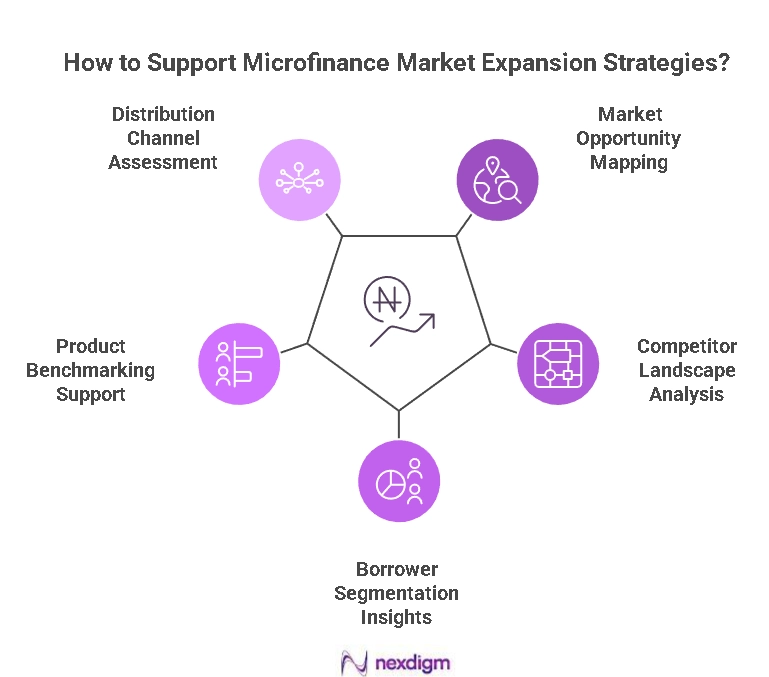
Nexdigm can support MFIs through market research, competitor analysis, borrower segmentation, product benchmarking, and growth opportunity mapping to expand reach in underserved and emerging markets:
-
Market Opportunity Mapping
Identifies underserved regions, borrower segments, and demand pockets where microfinance institutions can expand services effectively.
-
Competitor Landscape Analysis
Studies competing MFIs, banks, and fintech lenders to understand market positioning, products, pricing, and outreach strategies.
-
Borrower Segmentation Insights
Analyzes customer groups such as women entrepreneurs, rural households, farmers, and microbusinesses for targeted expansion planning.
-
Product Benchmarking Support
Compares microloans, savings, insurance, and digital products to identify gaps and improve market-fit offerings.
-
Distribution Channel Assessment
Evaluates branch networks, field agents, digital platforms, and partnerships to improve borrower access in new markets.
Nexdigm’s case:
Nexdigm assisted a BFSI client to improve market expansion by benchmarking 11 leading competitors, identifying digital maturity gaps, redesigning onboarding journeys, and optimizing pricing. The engagement reportedly reduced onboarding time by 38% and improved new-to-bank customer conversions by 24%. For microfinance institutions, this approach can support stronger borrower outreach, better product fit, and wider financial inclusion across emerging markets.
To take the next step, simply visit our Request a Consultation page and share your requirements with us.
Harsh Mittal
+91-8422857704