

Financial inclusion has expanded basic banking, but productive credit remains constrained and geographically skewed.
India’s Financial Inclusion Index rose from 54 in 2021 to 67 in 2025, supporting 7.3 crore microfinance borrowers across a ₹3.25 to 3.5 lakh crore portfolio. However, roughly 60% of exposure is concentrated in the East, Northeast, and South.
Future expansion cannot rely on simply targeting lender-sparse districts. Instead, it requires identifying areas where households possess the economic activity and repayment capacity to absorb capital productively.
The Credit Gap Is Not the Same Everywhere
Low microfinance penetration signals two distinct realities:
- Financially active, underserved areas: Households sustain steady cash flows from dairy, horticulture, retail, or livestock, but lack access to formal lenders.
- Economically constrained areas: Low borrowing stems from volatile single-crop agriculture, poor connectivity, and weak market access that hinder productive credit use.
While both markets look identical on a penetration map, their repayment potential is vastly different. Successful expansion outside established corridors depends on targeting economically resilient communities rather than chasing low penetration alone.
Income Diversification Changes the Lending Case
Low-income households rarely have a single source of income. A household might combine agricultural wages with livestock, a small shop, seasonal employment, remittances, or a home-based enterprise.
That makes the composition of income more important than income alone.
A household dependent on one rain-fed crop carries a different repayment risk from one generating income through dairy and retail throughout the year.
Similarly, a borrower operating a small food-processing activity may have more predictable cash generation than one dependent entirely on seasonal agricultural labour.
For microfinance institutions, understanding these differences can influence both market selection and product design. Short-cycle credit may work differently for agricultural households than for businesses generating regular daily or weekly cash flows.
Saturated Markets Can Hide a Different Problem
The opposite of an underserved market is not necessarily a healthy market.
In heavily penetrated districts, borrowers can hold loans across multiple NBFC-MFIs, small finance banks, and commercial lenders. The research indicates that some borrowers may have active relationships with four to six institutions. New credit in these markets can consequently become another layer of household leverage rather than incremental productive financing.
Repayment stress can emerge before aggregate credit growth appears problematic. PAR 30, PAR 60, and PAR 90 trends provide a more useful indication of whether additional lending is being absorbed comfortably.
A market with fewer lenders per borrower, diversified household income, and stable repayment performance can therefore be more attractive than a larger market where institutions are already competing for the same borrowers.
The Most Interesting Borrowers May Be Existing Ones
Microfinance expansion does not have to depend entirely on acquiring new borrowers.
Customers who have demonstrated several years of positive repayment behaviour can become candidates for larger individual enterprise loans. A borrower who originally required a small group-based loan may eventually need capital for livestock, inventory, equipment, or business expansion.
This creates a potential progression from group lending toward individual micro-enterprise finance. It also gives lenders an advantage that new-market acquisition does not: an established record of borrower behaviour.
The commercial opportunity is consequently two-dimensional. Institutions can identify new geographic markets while also increasing the value of established borrowers through appropriately sized productive credit.
Regulation Is Changing Where Growth Makes Sense
Microfinance expansion is increasingly constrained by household-level affordability rather than simply institutional lending capacity. India’s regulatory framework places a 50% ceiling on household monthly debt obligations relative to verified household income for microfinance borrowers.
Daily reporting to credit information companies also gives lenders greater visibility into multiple borrowing. Requirements around transparent Key Fact Statements and recovery practices add further operating discipline.
These measures make market intelligence more important. A district with strong headline demand may have limited room for additional lending if household leverage is already high. Conversely, a market with moderate existing penetration and stronger repayment headroom may support healthier expansion.
Nexdigm’s Microfinance Opportunity Assessment
Nexdigm’s Microfinance market opportunity analysis assesses markets across demand, repayment capacity, saturation, and operating feasibility.
The analysis examines:
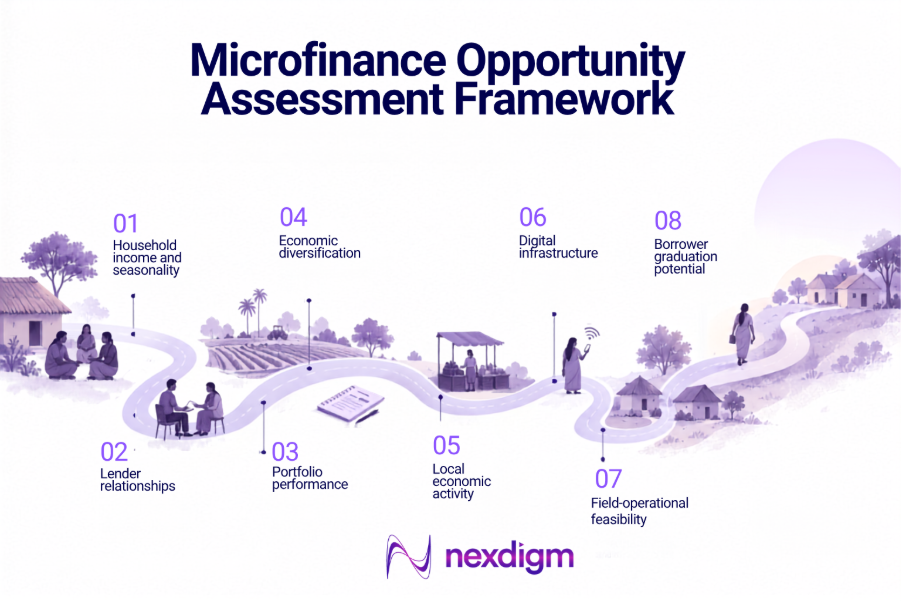
- Household income and seasonality: Income sources, volatility, and cash-flow resilience.
- Lender relationships: Existing lender penetration, multiple borrowing, and borrower concentration.
- Portfolio performance: PAR 30, PAR 60, and PAR 90 trends to identify repayment stress.
- Economic diversification: Dependence on agriculture versus dairy, retail, services, food processing, and other activities.
- Local economic activity: Enterprise density and productive uses for additional credit.
- Digital infrastructure: Digital payment and repayment adoption and its potential to improve lending efficiency.
- Field-operational feasibility: Borrower density, village clustering, collection networks, and servicing costs.
- Borrower graduation potential: Scope to move established borrowers from group-based lending into larger individual enterprise loans.
Together, these factors help determine whether a market is genuinely underserved, capable of absorbing additional credit, and commercially viable for expansion.
How Nexdigm Identifies the Microfinance Markets Worth Entering
A microfinance institution assessed 24 districts with below-average borrower penetration and identified eight potential expansion markets.
Four recorded PAR 30 below 3% alongside diversified household income sources. Nexdigm prioritized these districts after evaluating borrower leverage, economic activity, collection feasibility, and potential for enterprise-loan graduation.
The next microfinance opportunity is not simply the population that has borrowed the least. It is the population where formal credit can be introduced without creating a repayment burden that the local economy cannot support.
To take the next step, simply visit our Request a Consultation page and share your requirements with us.
Harsh Mittal
+91-8422857704
[email protected]