

Mid-size SUV price benchmarking is essential for identifying competitive opportunities in one of the fastest-growing automotive segments. This category attracts both premium and value-focused buyers, making pricing decisions highly sensitive to competitor movements and perceived value. Through pricing analysis, automakers can evaluate competitor pricing structures, feature positioning, and regional demand differences to uncover pricing gaps and optimize market strategy.
Mid size SUV price benchmarking helps brands understand whether their models are overvalued or underpriced relative to competition, enabling better segmentation, improved profitability, and stronger positioning in high-growth vehicle markets. It also supports strategic decision-making in discounting, feature bundling, and market expansion planning across diverse regions.
Global automotive markets show strong demand for mid-size SUVs, which account for a significant share of high-growth vehicle segments, with SUVs contributing nearly 50% of total passenger vehicle sales globally and mid-size variants forming a major portion in emerging economies. Industry trends indicate annual SUV demand growth driven by urbanization, premiumization, and preference for versatile vehicles.
Using Pricing Analysis to Optimize Mid Size SUV Pricing Strategy
Pricing analysis helps optimize mid size SUV pricing by evaluating competitor prices, demand trends, and customer value perception. It improves positioning, competitiveness, and profitability across high-growth automotive markets:
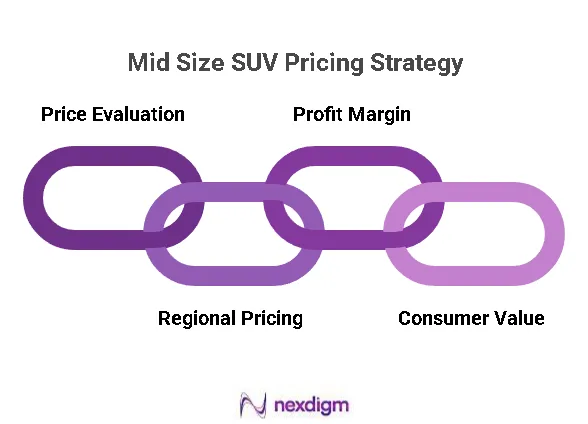
- Price Evaluation: Aligns vehicle features with pricing to ensure strong customer value perception and competitiveness.
- Regional Pricing Review: Assesses geographic price differences to optimize SUV pricing across multiple markets.
- Profit Margin Optimization: Balances pricing competitiveness with profitability to ensure sustainable revenue growth.
- Consumer Value Perception: Studies how buyers perceive pricing versus features to refine pricing strategy.
Nexdigm Competitive Benchmarking for Mid Size SUV Pricing Strategy
Nexdigm competitive benchmarking for mid size SUV pricing strategy helps automakers compare competitor pricing, features, and positioning across high-growth markets. Using pricing analysis, Nexdigm identifies gaps, evaluates demand trends, and optimizes pricing structures to improve competitiveness, strengthen market positioning, and enhance profitability in the mid-size SUV segment.
Nexdigm Pricing Analysis for Identifying SUV Segment Revenue Opportunities
Nexdigm pricing analysis identifies SUV segment revenue opportunities by evaluating competitor pricing, demand trends, and customer value perception. It optimizes pricing strategy, improves profitability, and enhances market positioning.
- Revenue Gap Identification: Detects underpriced or overpriced SUV models to uncover missed revenue opportunities.
- Competitor Pricing Benchmarking: Compares SUV pricing across brands to identify gaps and optimize strategy.
- Demand Trend Analysis: Evaluates customer demand patterns to support revenue-focused pricing decisions.
- Feature Value Mapping: Aligns SUV features with pricing to maximize perceived customer value and revenue.
Nexdigm’s case:
Nexdigm helped an automotive company identify revenue opportunities in the SUV segment across 12 markets and 65 models. Through pricing analysis, Nexdigm detected a 9% revenue leakage due to misaligned pricing and under-optimized mid-range variants. By refining SUV pricing strategy and aligning it with demand trends and competitor benchmarks, the company increased segment revenue by 10%, improved pricing efficiency, and strengthened overall SUV portfolio profitability within one fiscal year.
To take the next step, simply visit our Request a Consultation page and share your requirements with us.
Harsh Mittal
+91-8422857704