

Demand for gas pipelines, storage, and terminals depends on supply locations, demand growth, and network connectivity, with each asset type driven by distinct commercial factors. According to the IEA, global gas demand grew under 1% in 2025 but should accelerate in 2026 as LNG supply expands, led by China and emerging Asian markets. However, rising LNG production can depress utilization and heighten competition for existing terminals.
For investors, the most viable opportunities lie in markets where rising demand translates into concrete capacity requirements and reliable revenue.
Asia’s Growth Creates Opportunities for Pipelines and Import Terminals
Asia offers several potential sources of midstream demand, although the investment case varies by country.
China combines domestic production, pipeline imports and LNG purchases. Infrastructure requirements depend on industrial demand, seasonal consumption, domestic supply and the relative cost of imported gas. India presents opportunities linked to fertiliser production, refining, city gas distribution, industrial clusters and power generation. In Southeast Asia, declining output from mature gas fields can increase the need for imported gas, new interconnections and floating or land-based LNG terminals.
National consumption forecasts alone are insufficient to establish whether new infrastructure is needed. A market may consume more gas while retaining spare capacity in its transmission network. Elsewhere, a smaller increase in consumption can justify a major investment because existing pipelines cannot connect new customers to supply.
A demand assessment should examine four areas:
- Transmission pipelines: Production commitments, industrial demand, power-sector requirements, competing routes and available network capacity.
- LNG import terminals: Forecast imports, regasification utilisation, shipping access, downstream pipeline connections and delivered gas costs.
- Storage facilities: Seasonal demand variation, import dependence, withdrawal requirements and the cost of alternative supply.
- Export terminals: Available feed gas, pipeline access, liquefaction capacity, contracted offtake and exposure to international price spreads.
The objective is to identify where infrastructure is commercially necessary, rather than where a project has simply been announced.
Europe’s Storage Requirements Reveal the Value of Flexibility
Europe demonstrates how changes in supply security can create demand for storage and import infrastructure. Following the 2024-25 heating season, European Union gas inventories were approximately 42% below their year-earlier level, a difference of roughly 25 billion cubic metres. Storage injections increased by around 36% year on year in the second quarter of 2025 as the region worked to rebuild inventories.
The episode illustrates why storage demand cannot be measured by working-gas capacity alone. Investors must also assess injection and withdrawal rates, seasonal price spreads, import availability and the ability of pipelines to move gas into storage and deliver it during peak demand.
LNG terminals face a similar challenge. Additional regasification capacity creates value only when import requirements, shipping access and downstream connections support utilisation. A terminal with substantial nameplate capacity can still generate weak returns if customers have access to cheaper alternatives or competing facilities.
For storage developers, the revenue model matters as much as the physical requirement. Long-term capacity contracts can provide greater visibility than revenues dependent on seasonal trading spreads. For terminal operators, contracted capacity and throughput commitments can help distinguish a bankable project from one relying on uncertain future demand.
North American LNG Expansion Creates a Different Investment Case
North America is generating substantial demand for pipelines that connect gas-producing regions to export terminals. The IEA reported that more than 90 billion cubic metres per year of LNG liquefaction capacity received final investment approval globally in 2025, including more than 80 billion cubic metres per year in the United States.
The scale of this expansion creates opportunities for gathering connections, processing facilities and long-distance transmission pipelines. However, approved liquefaction capacity does not automatically guarantee that every supporting pipeline will achieve its expected throughput.
Projects must secure feed gas, transportation access, permits and commercial agreements. Several developments may also compete for the same production basin or export corridor. If capacity additions exceed available supply or contracted demand, pipeline utilisation and tariff economics can deteriorate.
A credible investment assessment therefore tests expected throughput under different production, price and commissioning scenarios. It should also distinguish contracted volumes from uncommitted capacity and examine whether customers can support the asset over the period required to recover capital.
Midstream Demand Assessment Framework
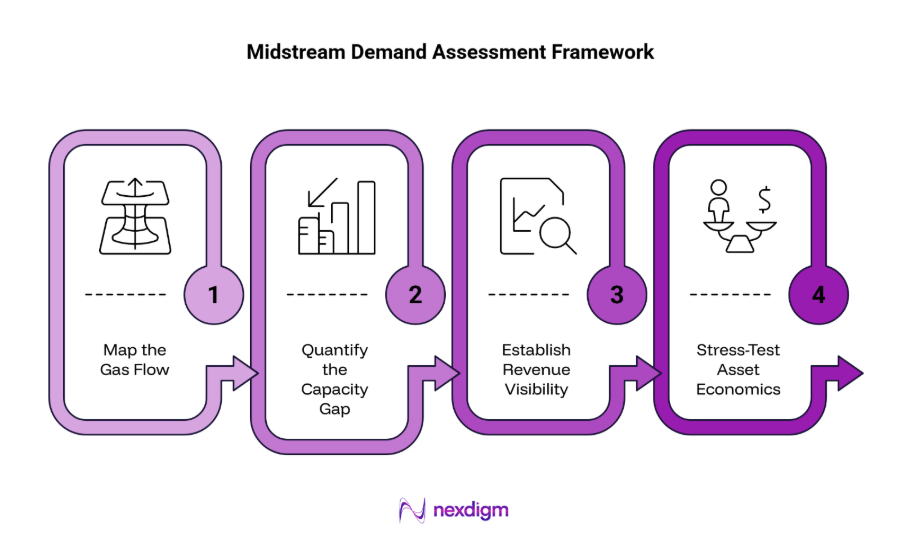
- Map the Gas Flow
Identify production sources, existing pipelines, LNG terminals, storage sites and major consumption centres. Establish where supply and demand are changing and which routes connect them. - Quantify the Capacity Gap
Compare forecast throughput with operational, committed and planned infrastructure. Account for seasonal peaks, network congestion and competing projects to establish whether additional capacity is genuinely required. - Establish Revenue Visibility
Assess shipper commitments, minimum-volume agreements, terminal bookings, storage contracts and counterparty credit quality. Separate contracted revenue from assumptions about future spot demand. - Stress-Test Asset Economics
Model utilisation, tariffs, construction costs, commissioning delays, competing infrastructure and commodity-price exposure. Test whether the project remains viable under slower demand growth and lower throughput.
For midstream demand assessment services, Nexdigm can combine regional gas-demand forecasts, infrastructure mapping, capacity analysis and commercial modelling to identify investable opportunities across pipelines, storage and terminals.
Nexdigm Case Study: Prioritising Pipeline and Terminal Investments
Nexdigm assessed three gas-import corridors and a proposed 1.8-million-tonne-per-year LNG terminal for an infrastructure investor. The team modelled demand across 14 industrial and power-sector customers, mapped competing pipeline capacity and tested utilisation under three gas-price scenarios. Two corridors supported projected utilisation above 80%, while the terminal reached only 61% without additional contracted demand. Nexdigm recommended prioritising the pipeline connections and deferring terminal expansion until firm offtake commitments improved the investment case.
To take the next step, simply visit our Request a Consultation page and share your requirements with us.
Harsh Mittal
+91-8422857704