

A map full of pipeline gaps can make a market look attractive, but infrastructure earns returns through contracted throughput, network position and reliable service. Midstream feasibility starts with production and consumption nodes, then tests whether existing systems can move the relevant commodity at the required pressure, quality and timing. The proposed asset must solve a bottleneck that customers will pay to relieve.
For each node, reconstruct current and forecast flows, pipeline capacity, utilisation, directionality, interconnections and seasonal peaks. Storage should be measured by working gas or usable inventory, injection and withdrawal rates, location and access rules. LNG and crude terminals need berth constraints, unloading schedules, tankage, regasification or blending capacity and connections to downstream networks. Nominal capacity can materially exceed effective capacity if maintenance, peak constraints or nominations limit service.
Compare Network Economics With Alternatives
Pipeline transport is usually capital intensive and can offer low variable cost at high, stable utilisation. Truck and rail may suit smaller, flexible or temporary flows, but costs rise with distance, transfers and return logistics. Terminals can create optionality between import sources and customers, though utilisation may be seasonal or exposed to spot-price arbitrage. Compare delivered costs at the same destination and quality, including tariffs, fuel, losses, storage, handling and congestion charges.
Contract structure changes risk allocation. Long-term ship-or-pay commitments support financing but may leave a buyer paying for unused capacity if production or demand disappoints. Merchant volumes can increase upside and expose the owner to price and utilisation risk. Assess anchor shippers, credit quality, minimum volume commitments, renewal periods, tariff escalators and the ability to serve alternative users. Permitting, land acquisition, environmental approvals, local opposition and cross-border rules can lengthen the schedule beyond the engineering estimate.
Published regulatory datasets provide an important, jurisdiction-specific evidence base. For example, the U.S. Federal Energy Regulatory Commission tracks approved major natural-gas pipeline projects with capacity and completion information. Such records reveal not only additions but also competing supply routes and the time between approval and operation. Equivalent local regulator data should be used elsewhere rather than transplanting U.S. assumptions.
Test the Network Before You Size It
The commercial case should be built around throughput rather than infrastructure capacity. Model flows under production, demand, outage and price scenarios, then calculate the utilisation required to cover operating costs and debt service. Compare that threshold with credible contracted volumes and competing infrastructure.
This can change the recommended project design. A smaller pipeline may produce stronger returns if anchor customers cover the initial capacity. Storage may need to be positioned at a particular junction rather than simply added wherever land is available. A terminal may become more attractive when it can serve multiple customer groups instead of relying on one seasonal demand source.
For a midstream market feasibility study, Nexdigm can connect flow forecasts, network constraints, customer commitments and alternative transport economics to determine whether a proposed asset is commercially supportable. The assessment can also test route, diameter, storage configuration and phasing before capital is committed.
Midstream Network Feasibility Framework
A midstream investment can be screened through four linked tests:
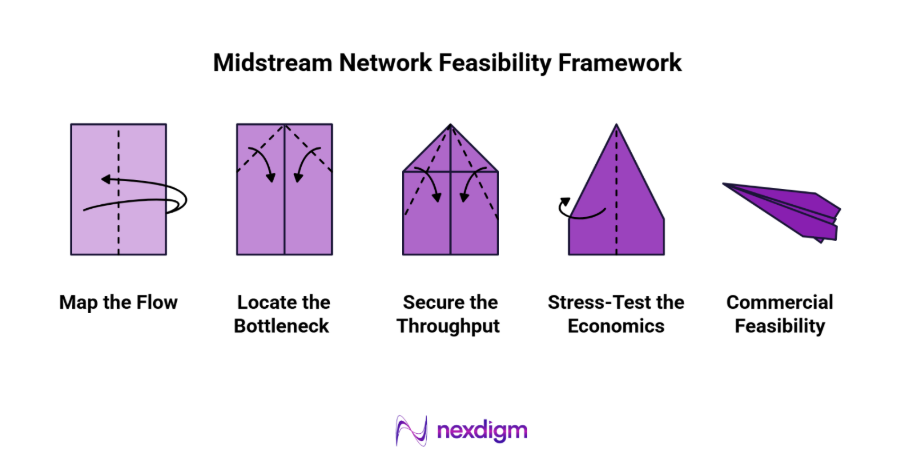
- Map the Flow
Identify production and consumption nodes, current routes, capacity utilisation, seasonality and expected changes in commodity movement. - Locate the Bottleneck
Determine where existing infrastructure creates a genuine constraint and whether the proposed asset would materially improve reliability, capacity or delivered cost. - Secure the Throughput
Test anchor customers, contracted volumes, ship-or-pay commitments, credit quality and alternative users to establish how much utilisation can realistically be secured. - Stress-Test the Economics
Compare tariffs, CAPEX, operating costs, competing infrastructure and alternative transport under downside production, demand and timing scenarios.
Nexdigm can use this framework to distinguish infrastructure that is simply needed in theory from infrastructure that has a credible path to utilisation and investment returns.
Nexdigm Case Study
Nexdigm evaluated a proposed 450-kilometre pipeline with storage at two junctions, mapping producer volumes, seasonal demand and competing routes. The assessment found that the full-build configuration would fall below its debt-service threshold. A shorter first phase backed by two contracted producers remained financeable, preserving expansion capacity for later demand growth.
To take the next step, simply visit our Request a Consultation page and share your requirements with us.
Harsh Mittal
+91-8422857704