

Processing a mineral can increase its commercial usefulness, but it also changes the market the producer needs to serve. A concentrate, refined product or industrial-grade mineral may have different buyers, quality specifications, transport requirements and pricing mechanisms from the raw material. The distribution strategy must reflect those differences.
For producers, the key decision is which customers and channels can generate the strongest net realisation from the processed product, while maintaining dependable sales volumes and manageable working-capital requirements.
Processed Products Serve More Specific Industrial Markets
Processing can improve grade, remove impurities, reduce moisture or create a product with more consistent physical and chemical properties. Those changes can expand the number of eligible buyers, but they can also introduce new technical requirements and additional costs.
Industrial buyers generally evaluate products against the needs of their own processes. A smelter may focus on metal content and penalty elements. A ceramics or glass manufacturer may prioritise chemical purity and consistency. A battery-materials producer may require tighter impurity limits and documented quality controls. A construction-materials buyer may focus on particle size, availability and delivered cost.
The producer must therefore define the product precisely before estimating market size. Broad demand for a mineral does not necessarily translate into demand for every processed grade.
Identify the Buyer Segments and Their Purchasing Logic
A useful market map separates buyers by end use, processing requirements, volume and procurement behaviour.
- Industrial end users: Purchase for direct use in manufacturing and may value consistent supply, technical support and long-term relationships.
- Smelters and refiners: Evaluate recoverable content, impurities, treatment requirements and the economics of processing the material further.
- Specialist processors: May buy intermediate products for upgrading, separation or conversion into a higher-value material.
- Commodity traders: Connect producers with multiple markets and may offer shipment flexibility, but their margins and contractual terms affect producer returns.
- Distributors: Provide local stock, smaller shipment sizes and access to fragmented customer bases, particularly where local service and availability influence purchasing.
These channels are not interchangeable. Direct industrial sales can strengthen customer relationships but require more internal resources. Traders can broaden reach, while distributors can make smaller markets serviceable. A producer may use several channels, provided that territory rights, customer ownership and pricing policies are clearly defined.
Product Specifications Determine Market Access
The commercial value of processed minerals depends on whether the product meets a buyer’s requirements at a competitive cost. Quality certificates, representative sampling, independent assays and consistent production batches can reduce disputes and support repeat orders.
Producers should establish a product specification sheet that includes the parameters buyers actually use in procurement. Depending on the material, this may include grade, impurity levels, particle-size distribution, moisture, bulk density, packaging and permitted variation between shipments.
Processing economics should be assessed at the same time. Higher purity may command a better price, but the additional recovery losses, energy, reagents, labour and capital required to achieve it may outweigh the premium. The most refined product is not automatically the most profitable product.
Build Distribution Around Delivered Cost and Net Realisation
The phrase mineral processing distribution entry consulting reflects the need to connect product positioning with channel and logistics decisions. Market assessment should calculate the price received after transport, handling, commissions, processing charges, financing and quality deductions.
World Bank commodity analysis has highlighted how quickly metal and mineral price conditions can change. In June 2026, its metals and minerals price index was reported to have risen about 20% since the beginning of the year, reaching a record monthly nominal high in May. Such movements can change the apparent attractiveness of destinations, but they do not remove structural cost disadvantages.
A distribution model should therefore compare several routes under consistent price assumptions. It should include inland freight, port handling, warehousing, insurance, shipment size, customs requirements and payment terms. Where buyers require regular supply, the cost of holding inventory near the customer should also be considered.
Match the Channel to the Commercial Objective
A producer prioritising stable volumes may favour direct industrial contracts or offtake agreements. A company entering a fragmented market may rely on distributors to reduce the cost of serving smaller buyers. Traders may be useful for surplus production, new export destinations or markets where the producer lacks established relationships.
Channel performance should be measured through repeat orders, contribution margin, delivery reliability, receivable days, claims and customer concentration. This helps management distinguish sales growth from profitable, dependable distribution.
Nexdigm’s Processed Mineral Distribution Framework
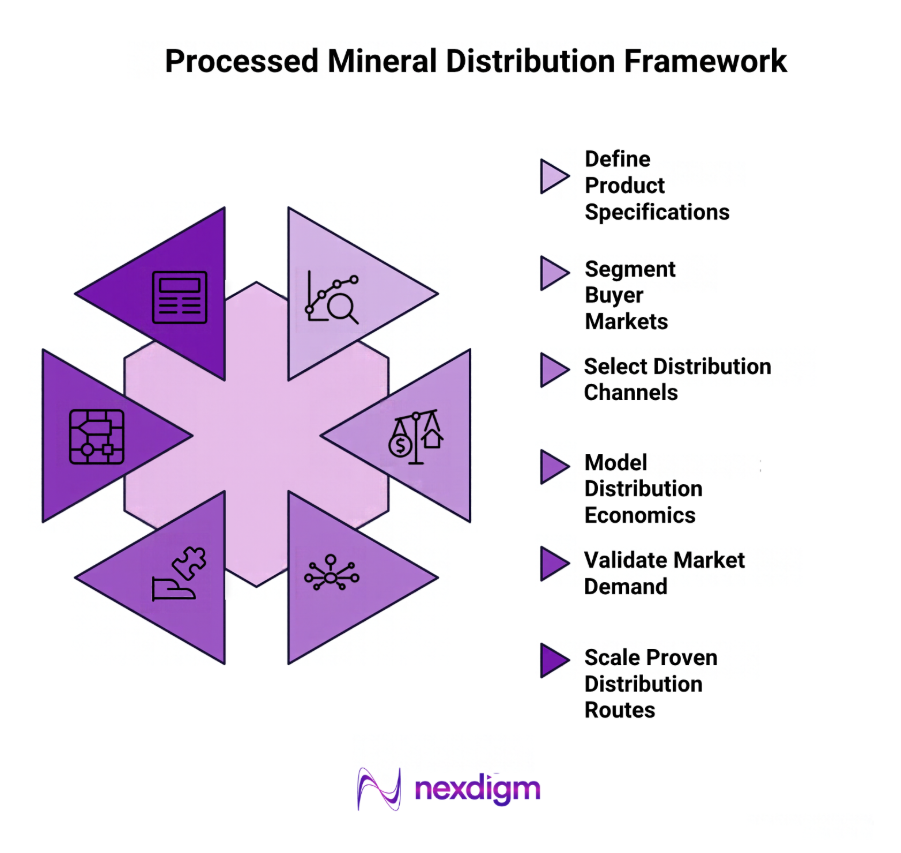
- Define Product Specifications: Establish product grades, purity levels and quality standards based on actual buyer requirements to ensure the processed minerals meet market expectations.
- Segment Buyer Markets: Classify buyers by end use, purchase volumes, qualification requirements and procurement behaviour to identify the most suitable customer segments.
- Select Distribution Channels: Evaluate direct sales, traders, distributors and offtake agreements for each segment based on market access, customer relationships and sales requirements.
- Model Distribution Economics: Calculate delivered costs, channel margins, inventory requirements and payment terms to assess profitability and working capital exposure across distribution routes.
- Validate Market Demand: Test buyer interest through product samples, technical trials and commercial negotiations to confirm product suitability and purchasing intent.
- Scale Proven Distribution Routes: Expand channels that consistently meet quality specifications, margin expectations and service requirements, using defined performance targets to guide further investment.
Nexdigm Case Study
A processed-mineral producer assessed 15 prospective buyers across three product grades. Technical screening reduced the list to eight, while freight and channel-cost modelling identified two buyer segments with stronger net realisation. The company prioritised sample testing and direct negotiations for those segments before expanding its distributor network.
To take the next step, simply visit our Request a Consultation page and share your requirements with us.
Harsh Mittal
+91-8422857704