

Mining investment depends on more than the presence of mineral deposits. A commercially attractive project must connect geological potential with recoverable reserves, production economics, infrastructure, regulatory approvals and a credible route to market. Demand trends matter, but so do the costs and constraints that determine whether a resource can be developed profitably.
A structured assessment helps investors and businesses compare locations, commodities and project stages before committing capital.
Establish Resource and Production Potential
The first step is to distinguish reported mineral occurrences, resources, and economically recoverable reserves. These terms are not interchangeable. Geological evidence may indicate that a deposit exists, while further exploration, technical studies and economic evaluation are needed to establish whether extraction is viable.
Production analysis should examine current output, historical trends, mine capacity, project pipelines, and the position of major producing countries. Concentration matters because a commodity supplied by a small number of regions may be more exposed to operational disruptions, policy changes, or transport constraints.
The International Energy Agency’s critical minerals assessments highlight this issue for energy-related materials, where refining can be more geographically concentrated than extraction.
Connect Demand To End Markets
Mineral demand varies by application. Construction and manufacturing require bulk materials and industrial minerals, while batteries, electricity networks, electronics and other advanced technologies depend on selected critical minerals.
Demand forecasts should therefore be built around end-use industries, not simply broad commodity growth assumptions. Investors should assess technology changes, recycling, substitution, material efficiency and policy developments that could affect future consumption.
For mining analysis, it is also important to separate near-term market conditions from long-term demand expectations. A mineral may have strong projected demand but still face temporary oversupply, falling prices or a delayed customer ramp-up.
Calculate The Full Cost Of Development
Mining economics depends on geology, extraction methods, ore grades, recovery rates, energy and water availability, labour, equipment and transport. Capital costs include exploration, mine development, processing facilities, and supporting infrastructure. Operating costs determine whether production remains competitive across different price conditions.
Environmental and social obligations must also be included. Water management, waste storage, rehabilitation, permitting and engagement with affected communities can influence both costs and project timelines. Infrastructure gaps may require additional investment in roads, railways, power, or processing capacity.
Sensitivity analysis should test how project returns change when commodity prices, production volumes, operating costs, or commissioning dates move away from the base case.
Mining Investment Viability Assessment Framework
A practical mining investment assessment should examine five dimensions:
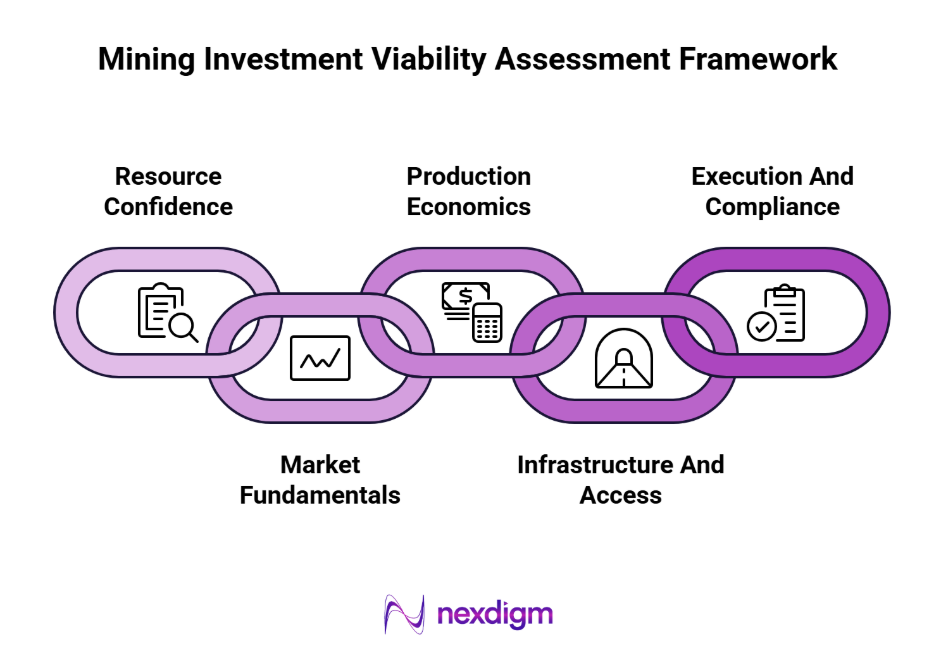
- Resource Confidence: Evaluate geological evidence, reserve estimates, ore quality and remaining exploration requirements. Determine whether further drilling, sampling or feasibility studies are necessary to establish the deposit commercial potential.
- Market Fundamentals: Review demand by end use, current supply, competing projects and potential substitution. Examine whether projected demand can absorb new production or whether oversupply could place pressure on commodity prices.
- Production Economics: Assess capital expenditure, operating costs, recovery rates, and price sensitivity. Include exploration, mine development, processing, energy, labour and transport costs to understand the project’s potential profitability under different market conditions.
- Infrastructure And Access: Examine energy, water, transport, processing facilities and export routes. Determine whether existing infrastructure can support planned production or whether additional investment could materially increase project costs and delay operations.
- Execution And Compliance: Review permitting, environmental obligations, community considerations and project delivery risks. Consider approval timelines, rehabilitation requirements, workforce availability and construction delays that could increase costs or postpone expected revenue.
These factors should be considered together rather than treated as independent checks. A substantial deposit may offer limited commercial value if extraction costs are prohibitive; infrastructure is inadequate, or approvals remain uncertain. Conversely, a smaller resource with favourable grades, established transport links and reliable access to buyers may present a more commercially viable investment.
Make Mining Decisions On More Than Demand
Mining opportunity assessment is strongest when geological evidence, market forecasts, and project economics are evaluated together. This approach helps investors prioritise viable assets, understand supply risks, and identify where infrastructure, processing capacity, or market access could determine commercial success.
Nexdigm’s Case Study
An investor compares two mineral projects with similar projected output. One has stronger resource evidence but requires substantial infrastructure development. The other has a smaller resource base but better transport access and lower estimated operating costs. Testing both projects against price and schedule scenarios clarifies the trade-off between scale, capital exposure and potential returns.
To take the next step, simply visit our Request a Consultation page and share your requirements with us.
Harsh Mittal
+91-8422857704