
Electrification and industrial digitization are accelerating critical mineral demand, but percentage growth obscures the true commercial picture. The IEA’s Stated Policies Scenario projects overall critical mineral demand to nearly double by 2040: lithium leads in relative growth, tripling over the period, while nickel, graphite, and rare earths expand by 50% to 90%. Copper dominates in scale, requiring an additional 7 million tonnes annually.
For investors, absolute volume and supply elasticity matter far more than percentage spikes. Fast-growing niche minerals carry smaller addressable footprints, whereas massive base-metal expansions test real-world supply constraints.
Demand Is Being Driven by Different Technologies
The strongest growth markets are connected to specific technology and infrastructure cycles.
- Copper: Anchored by broad electrification, spanning grids, renewables, EVs, industrial equipment, and data centers, where sheer physical volume drives value.
- Lithium: Driven almost entirely by EV and stationary energy storage rollouts, with total demand tempered by chemistry choices and recycling rates.
- Graphite: Tied to battery anode production, making its market upside contingent on building diversified midstream processing capacity.
- Rare Earth Elements (Nd, Pr, Dy, Tb): Highly concentrated in high-performance permanent magnets for EV traction motors, wind turbines, and industrial automation.
- Nickel: Supported by a steady baseline in stainless steel, with upside geared toward nickel-rich EV cathode chemistries.
- Cobalt: Crucial for select battery chemistries and aerospace superalloys, though vulnerable to thrift and cathode substitution over the long term.
The commercial implications are therefore different for each mineral. A project exposed to rapidly expanding technology demand may still face weak economics if supply can respond quickly or if downstream processing remains concentrated.
Copper’s investment case is defined by scale and structural friction, not just growth rates. Under the IEA’s 2026 outlook, annual demand expands by over 7 million tonnes by 2040 (reaching 34.1 Mt), fueled across the board by grids, renewables, and EVs.
With long lead times, eroding grades, and heavy infrastructure bottlenecks, the current pipeline leaves a projected 25% supply deficit by 2035.
The real upside belongs to operators who can actually bring low-cost tonnes to market against these headwinds.
Lithium Shows Why Demand Growth Needs a Supply Lens
Lithium demand is set to surge, but price swings tell a more complicated story. Under the IEA’s Stated Policies Scenario, total demand jumps from roughly 205 kt in 2024 to 928 kt by 2040, almost entirely driven by clean energy.
Yet fast demand growth doesn’t guarantee high prices. Lithium supply can ramp up much quicker than massive, multi-decade base metal projects, making the sector prone to sharp cycles of oversupply.
Processing Capacity Can Matter as Much as Mining Capacity
Mining capacity alone cannot secure supply chains for graphite and rare earths due to extreme refining concentration. In 2024, the top three refining nations controlled 99% of graphite and 97% of rare earths, meaning new extraction assets still leave buyers dependent on existing processing networks.
The primary bottleneck sits further downstream. For rare earths outside the dominant producer by 2035, the IEA projects nearly 50 kt of mined supply, but planned separation capacity remains below 40 kt and finished magnet capacity drops to just 18 kt. For investors, standalone mines face severe midstream caps; real commercial value lies in integrated projects that couple mining with dedicated refining and direct customer offtake.
The Factors That Should Shape a Mineral Demand Assessment
A useful demand assessment should rank minerals against several commercial variables rather than simply identifying the fastest-growing commodity.
- Technology exposure: How directly is demand linked to EVs, grids, storage, wind power, data centres or advanced manufacturing?
- Demand intensity: How much of the mineral is required as the underlying technology expands?
- Substitution risk: Could technological changes, material efficiency or alternative chemistries reduce demand?
- Supply responsiveness: How quickly can new mines, refineries and processing facilities add capacity?
- Market concentration: How dependent is the market on a small number of producing or refining countries?
- Downstream capacity: Can additional mined material be converted into the products required by end users?
These variables can produce very different conclusions from a simple demand-growth ranking. A mineral with 80% projected growth may be less attractive than one growing at 30% if its supply pipeline is already extensive, substitution risk is high and processing capacity is abundant.
Conversely, a moderate-growth mineral can become strategically important when new supply is difficult to develop, refining is concentrated and customers have limited alternatives.
Nexdigm’s Approach to Mineral Demand Assessment
Nexdigm can combine commodity forecasting with technology adoption, supply-chain analysis and competitive intelligence to identify where demand growth is most likely to translate into commercially attractive opportunities.
The assessment can examine:
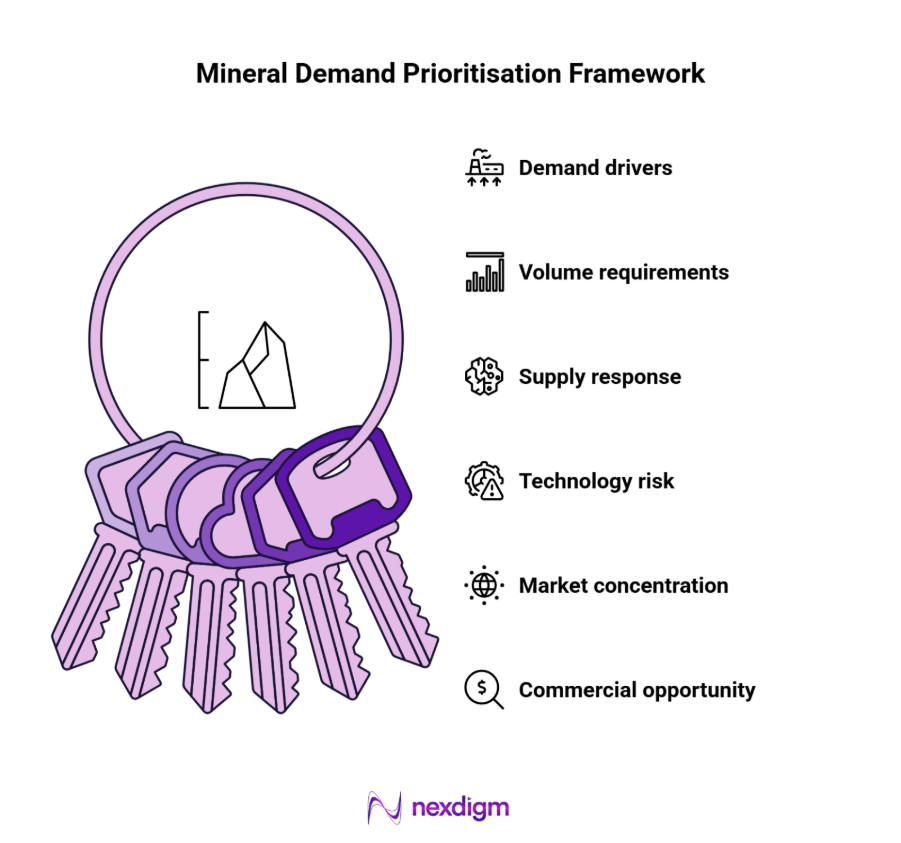
- Demand drivers: Identify the technologies, industries and infrastructure investments responsible for future consumption.
- Volume requirements: Quantify incremental demand and distinguish percentage growth from absolute market expansion.
- Supply response: Map announced mines, expansions, refining capacity and expected project timelines.
- Technology risk: Assess substitution, material efficiency, recycling and changes in technology design.
- Market concentration: Identify geographic dependencies across mining, refining and downstream manufacturing.
- Commercial opportunity: Determine where supply shortages, processing bottlenecks or customer requirements create opportunities for new investment.
This approach allows mining demand assessment consulting to move beyond forecasting how much of a mineral the world may need. The more important question is whether the market can supply that material competitively, where the constraints will emerge and which parts of the value chain are positioned to capture the resulting opportunity.
Nexdigm Case: Mineral Demand Prioritisation
A diversified mining group screened 10 minerals across 18 end-use markets. Nexdigm evaluated demand growth, technology exposure, supply concentration, substitution risk and downstream capacity, identifying five minerals with the strongest combination of demand growth and supply constraints through 2035.
To take the next step, simply visit our Request a Consultation page and share your requirements with us.
Harsh Mittal
+91-8422857704