
For a mining company, commercialisation begins well before a product reaches a customer. The grade and quality of the material determine who can use it, processing requirements influence the saleable specification, and transport costs can determine whether the product remains competitive after leaving the mine.
This is particularly important for bulk and intermediate commodities. An iron ore producer is not addressing one undifferentiated market. Grade, impurities, moisture and beneficiation requirements determine which steelmakers can process the material efficiently. Coal presents a similar problem, with calorific value, ash, sulphur and coking properties affecting both suitability and price.
The commercial model therefore needs to be designed around the product and its route to market, rather than beginning with a generic list of potential customers.
The Product Determines the Market
The first step is to establish exactly what can be sold.
For an iron ore project, this could mean determining whether the operation can produce a concentrate, pellet feed or another specification and how its chemistry compares with competing supply.
For a copper project, concentrate grade, impurities and treatment requirements influence the smelters willing to accept the material.
In lithium, the distinction between spodumene concentrate, carbonate and hydroxide creates entirely different customer and processing requirements.
That assessment should establish:
- Product grade and specification
- Expected consistency over the mine life
- Recoverable and saleable volumes
- Processing or beneficiation requirements
- Quality premiums or penalties
- Potential customer qualification requirements
This is where market research becomes directly relevant to project economics. A technically recoverable resource may have a much smaller addressable market once product specifications and customer requirements are applied.
Then Comes the Route to Customer
The next question is geographical. Where can the product be sold at a competitive delivered cost?
A mine-gate price provides only part of the commercial picture. Depending on the commodity and destination, the final economics can include inland transport, storage, port handling, ocean freight, insurance, customer-side processing and quality adjustments.
Recent disruption has demonstrated how quickly this calculation can change. S&P Global’s 2026 scenario analysis projected a 5.1% increase in global copper mining costs under disruption conditions, with higher reagent, fuel, electricity and transportation costs contributing to the increase.
For a new project, logistics should therefore be evaluated under normal and stressed conditions rather than treated as a fixed line item.
The analysis can compare alternative routes:
- Mine to processing facility
- Mine to rail or road terminal
- Mine to port
- Port to customer
- Direct delivery versus intermediate processing
The lowest-cost route is not necessarily the best one if it depends on congested infrastructure or a single transport corridor.
Customer Concentration Changes the Commercial Risk
The customer base also matters. A project selling 80% of its output to one steelmaker has a very different risk profile from one with several geographically diversified customers.
Customer segmentation should distinguish between:
- End users, such as steelmakers, utilities and industrial manufacturers.
- Processors, including smelters, refiners and beneficiation facilities.
- Traders, which can provide market access but may introduce greater exposure to spot-market conditions.
- Strategic customers, which may be willing to enter long-term offtake agreements in exchange for supply security.
For newer or strategically important commodities, the route to customer can be particularly demanding because buyers may require qualification, technical testing and consistent product specifications before committing to commercial volumes.
This is increasingly reflected in the structure of mining deals. Long-term offtakes, processing agreements and strategic partnerships can help projects secure demand while reducing the financing risk associated with uncertain future sales.
Commercialisation Needs to Be Modelled With the Mine
A go-to-market strategy is most useful when it feeds directly into the project model. The objective is not simply to identify buyers, but to understand how customer requirements affect realised prices, logistics costs, working capital and investment returns.
Nexdigm can assess this through a connected commercial model:
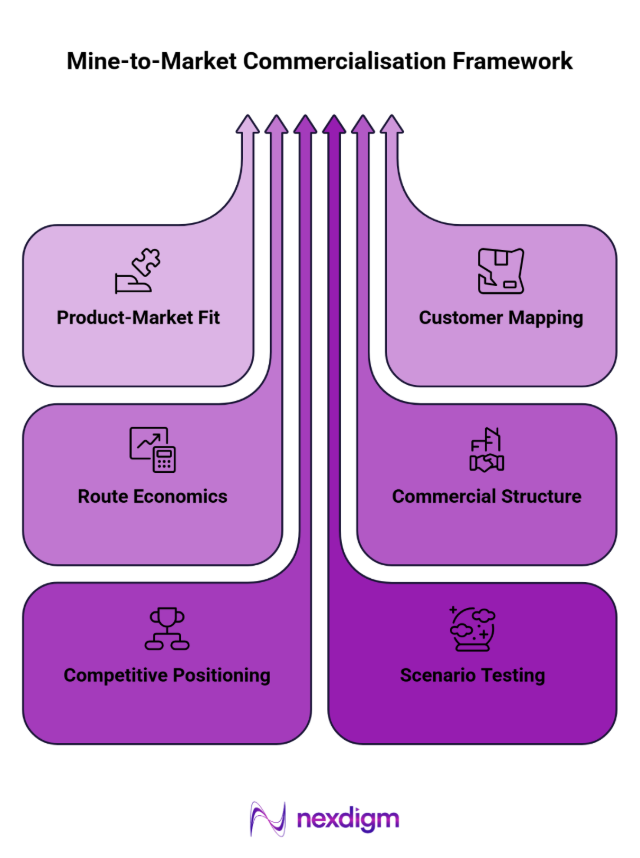
- Product-market fit: Define the saleable product, specifications and quality position.
- Customer mapping: Identify target customers by geography, application, purchasing volume and qualification requirements.
- Route economics: Calculate freight, handling, processing and other costs between the mine and customer.
- Commercial structure: Compare spot sales, indexed pricing, benchmark-linked contracts and long-term offtake arrangements.
- Competitive positioning: Benchmark delivered cost, quality and reliability against alternative suppliers.
- Scenario testing: Assess the impact of freight increases, customer loss, price changes and supply disruptions.
This is the practical role of a mining go-to-market assessment consulting exercise. It establishes not only who could buy the output, but whether the product can reach those customers at a price and margin that support the underlying mining investment.
Nexdigm Case: Mining Commercialisation Assessment
A mining company evaluated three export routes for a 4.2 Mtpa iron ore project. Nexdigm compared product specifications, 17 potential customers, freight costs and offtake structures, identifying a preferred route that improved projected delivered margins by 11%.
To take the next step, simply visit our Request a Consultation page and share your requirements with us.
Harsh Mittal
+91-8422857704