

Mining producers can increase output without improving commercial performance if they cannot secure suitable buyers or deliver products at competitive prices. Market selection therefore needs to happen alongside production planning. The most attractive customer may not offer the highest headline price, and the largest market may not generate the best return once transport, handling, payment terms and product requirements are considered.
A practical go-to-market strategy links product characteristics to buyer needs, then compares the routes through which sales can be developed and fulfilled.
Start With the Product Buyers Can Actually Use
Mineral buyers purchase against defined specifications. Grade, impurities, moisture, particle size, consistency and delivery schedules can determine whether a product is accepted, discounted or rejected. Producers should first establish the saleable product available from the mine or processing plant and identify which industries can use it without costly additional treatment.
The buyer universe may include industrial manufacturers, smelters, refiners, processors, traders and commodity distributors. Each group has different priorities. An industrial consumer may value consistent quality and supply reliability, while a trader may prioritise liquidity, resale opportunities and flexible shipment sizes. A processor may require a particular composition to maintain plant performance.
Market mapping should identify not just potential buyers, but the conditions under which they would purchase.
Demand Signals Need to Be Translated Into Qualified Buyers
Global market growth is useful context, but it does not substitute for customer-level demand evidence. The World Bank’s October 2025 Commodity Markets Outlook projected metals and minerals prices to remain broadly stable in 2026 before edging up by 2% in 2027, reflecting modest demand growth and tightening supply conditions. Its June 2026 update subsequently reported that the metals and minerals price index had risen about 20% since the start of 2026, reaching a record monthly nominal high in May.
These changing conditions show why market entry plans should not depend on a single price forecast. A producer must establish whether buyers need the specific product, what alternatives they can source and how its delivered cost compares with competing supply.
Buyer qualification should examine annual purchase volumes, technical specifications, procurement cycles, creditworthiness, contract duration and willingness to enter offtake arrangements. Interviews and trial shipments can test assumptions before the producer commits to a larger sales network.
Choosing Between Direct Sales, Traders and Distributors
The appropriate sales route depends on product complexity, shipment scale, customer concentration and the producer’s internal capabilities.
- Direct industrial sales: Can improve customer insight and reduce intermediary margins, but require technical sales resources, contract management and reliable fulfilment.
- Commodity traders: May provide access to multiple buyers, market intelligence and flexible transactions, although their margins and contractual terms affect net realisation.
- Distributors: Can extend geographic reach and manage local inventory, particularly where buyers are fragmented or require frequent smaller deliveries.
- Offtake agreements: Can improve volume visibility and support financing, but may restrict flexibility or expose the producer to unfavourable pricing terms.
- Export agents and logistics partners: Can help navigate documentation, customs and shipment execution, but do not replace direct verification of buyer demand.
A mining go-to-market strategy consulting assessment should compare these options against the product’s commercial requirements and the producer’s ability to manage customers directly.
Logistics Can Change the Ranking of Markets
A market with strong demand may become unattractive when freight, handling or inland transport absorbs the price premium. Producers should calculate net realisation for each viable route, starting with the expected customer price and deducting transport, port charges, insurance, storage, commissions, financing and quality-related deductions.
The model should also account for operational constraints. Rail availability, port capacity, seasonal road access, shipment size and storage facilities can limit sales even where the economics appear attractive on paper. For bulk minerals, transport capacity may be as important as mine output because disruptions can create stockpiles and delay cash conversion.
Payment terms matter as well. A customer offering a higher price but paying slowly may create more working-capital pressure than a lower-priced buyer with reliable settlement.
Prioritise Markets in Stages
Producers should avoid launching into every plausible market at once. An initial screen can identify buyers and destinations with clear product fit. A second stage compares netback economics, route reliability and payment risk. The final stage validates commercial assumptions through samples, customer trials, tenders or offtake discussions.
The resulting plan should distinguish immediate sales opportunities from markets requiring product qualification, infrastructure investment or additional regulatory work.
Mining Go-to-Market Prioritisation Framework
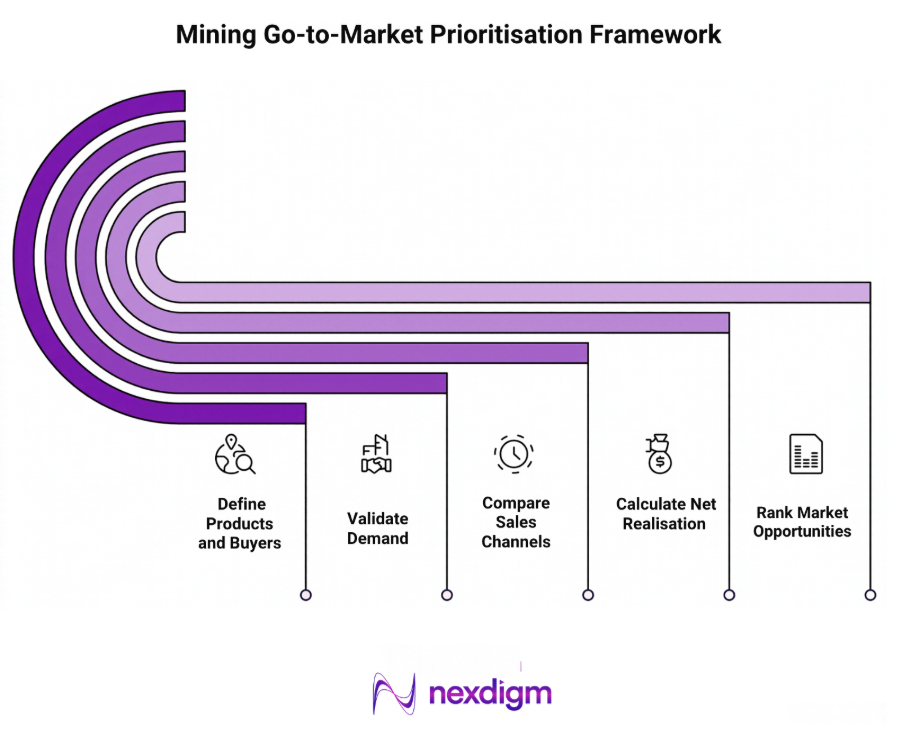
- Define Products and Buyers: Establish saleable product specifications, quality requirements and eligible buyer segments to identify the markets and customers best suited to the output.
- Validate Demand: Assess customer purchase volumes, product requirements, procurement cycles and expected demand to determine the reliability and scale of potential sales.
- Compare Sales Channels: Evaluate direct sales, traders, distributors and offtake agreements based on market access, pricing flexibility, buyer relationships and sales commitments.
- Calculate Net Realisation: Estimate route-specific selling prices after transportation, handling, commissions and other costs, while assessing payment terms and working capital requirements.
- Rank Market Opportunities: Prioritise markets based on expected commercial returns, buyer creditworthiness, execution readiness and the reliability of sales channels to determine where go-to-market resources should beallocated.
Nexdigm Case Study
A mineral producer assessed nine potential buyers across three export markets. Initial qualification removed four prospects with incompatible specifications or weak payment profiles. Netback modelling and shipment-route analysis identified two priority buyers, with commercial negotiations linked to minimum volumes, quality tolerances and settlement terms.
To take the next step, simply visit our Request a Consultation page and share your requirements with us.
Harsh Mittal
+91-8422857704