

International mineral trade links resource-producing countries with industrial economies that require ores, metals and mineral-based inputs. These flows influence manufacturing costs, infrastructure development, and access to materials used in energy systems and industrial production. For mining companies, processors and buyers, trade analysis helps identify where supply originates, which markets depend on imports and how competition changes across destinations.
However, extraction, processing and consumption often occur in different countries. Understanding those connections is essential to interpreting mineral trade patterns accurately.
Extraction Does Not Tell The Whole Story
A country with substantial mineral resources is not necessarily the leading exporter of processed materials. Some countries specialise in extraction, while others import raw minerals for refining, smelting or further manufacturing. As a result, trade flows can reveal dependencies that production statistics alone do not capture.
Mineral analysis should distinguish ores and concentrates from refined metals and processed mineral products. These categories may have different trade values, transport requirements and end markets. Consistent product classifications are important when comparing countries or tracking changes over time.
Data from UN Comtrade and the U.S. Geological Survey can help establish the relationship between reported trade, domestic production and the broader supply position of individual commodities.
Follow Import Demand To Its Industrial Sources
Mineral demand is driven by the industries that consume each material. Iron ore is closely linked to steelmaking, copper serves electrical and industrial applications, and selected critical minerals are used in batteries, electronics and energy technologies. Construction and infrastructure development also influence demand for several bulk materials.
For mining industry trade analysis, import growth should be examined alongside industrial output, investment plans and domestic production. Increasing imports may indicate expanding consumption, but they may also reflect declining local production, temporary supply interruptions or a shift toward different material grades.
Demand forecasts should account for competing projects, recycling, substitution and changes in manufacturing technology. A market with strong long-term demand can still experience periods of oversupply or falling prices when new production enters service.
Understand Competition Between Export Hubs
Export competitiveness depends on more than resource availability. Production costs, processing capacity, mineral quality, freight, port access and trade policy can all influence a supplier’s position. Established exporters may benefit from scale and reliable logistics, while emerging suppliers may need to invest in infrastructure or processing to compete.
Concentration is another consideration. When a commodity’s supply or processing is concentrated in a small number of countries, disruptions can affect multiple importing markets. Buyers may therefore consider alternative sources even when those sources initially carry higher costs.
Build A Mineral Trade Assessment Framework
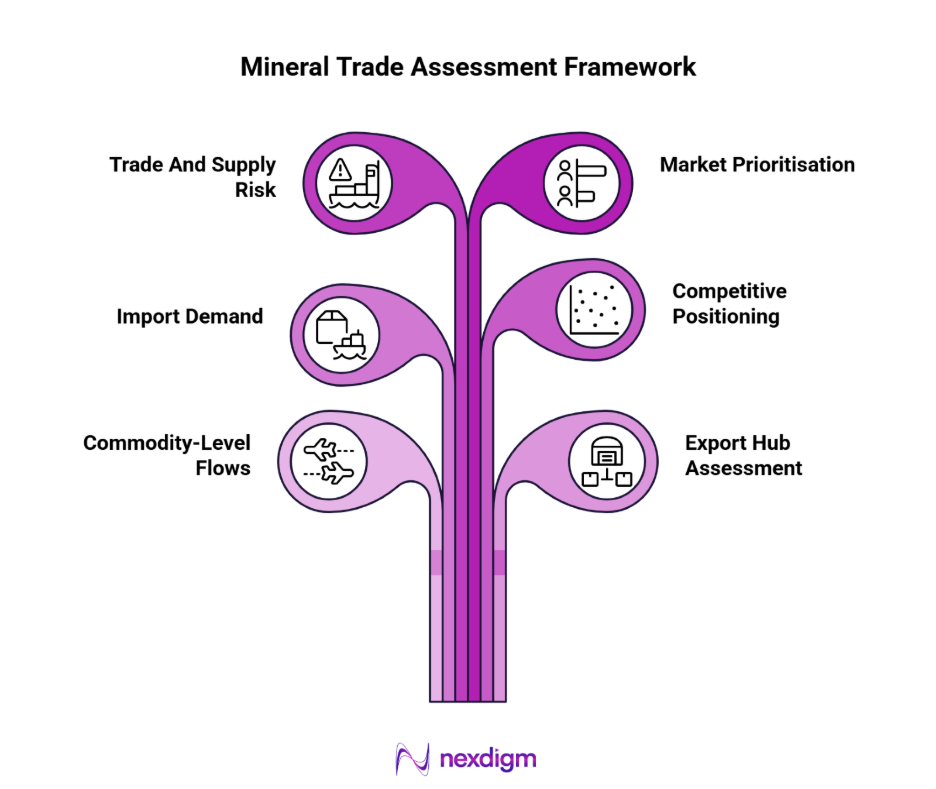
- Commodity-Level Flows: Track imports and exports by mineral, product classification, trading partner and reporting period to identify shifts in market size, direction and supplier share.
- Export Hub Assessment: Compare mineral production, processing capacity and export volumes to distinguish resource-producing countries from major refining, processing and redistribution centres.
- Import Demand: Examine downstream industrial output, infrastructure investment and import dependence to identify markets where mineral consumption may support sustained commercial opportunities.
- Competitive Positioning: Compare leading suppliers on product quality, production costs, freight, delivery reliability and market access to assess their relative advantages in each destination.
- Trade And Supply Risk: Review export restrictions, tariffs, supplier concentration, transport constraints and geopolitical exposure to identify vulnerabilities in mineral sourcing and distribution.
- Market Prioritisation: Rank destinations and sourcing locations by demand potential, supply gaps, competition, logistics and commercial feasibility before allocating resources to market development.
The framework should be applied separately to each mineral and product stage. A major ore importer may offer limited opportunity for refined materials if its domestic processing industry is already well supplied, while a smaller market may need specific grades or more dependable delivery arrangements.
From Mineral Flows To Commercial Strategy
Trade analysis helps mining companies evaluate export destinations, industrial buyers compare sourcing options and investors understand where processing capacity or supply dependence may create opportunities. Combining trade statistics with production and end-use data provides a stronger basis for decisions than ranking markets by import value alone.
Nexdigm’s Case Study
A mineral exporter compares two destination markets with rising imports. One offers larger volumes but has established suppliers and high freight costs. The other has a smaller market, a growing industrial base and fewer competing sources. Comparing demand, logistics, product requirements and market access helps determine which destination offers the stronger commercial fit.
To take the next step, simply visit our Request a Consultation page and share your requirements with us.
Harsh Mittal
+91-8422857704