

A mineral deposit can attract investment interest without being commercially mineable. Geological evidence may indicate a substantial resource, but the project can still fail because grades are inconsistent, extraction is expensive, infrastructure is inadequate or buyers will not pay enough to cover production and transport costs. Mining feasibility requires these variables to be evaluated together.
For investors and mining companies, the critical task is to determine whether a resource can support a technically achievable, legally permitted and financially resilient operation. That means progressing from geological evidence to an operating plan, a market assessment and a project economics model.
Resource Potential Is Only the First Stage
The distinction between a mineral occurrence, a resource and an economically mineable reserve is fundamental. Exploration establishes what may exist. Further drilling and geological interpretation improve confidence in its size, continuity and quality. Engineering studies then estimate how the deposit could be extracted and processed, while economic analysis tests whether expected revenues can cover the costs and risks.
India’s Indian Minerals Yearbook 2024 estimated the value of mineral production, excluding atomic, fuel and minor minerals, at ₹1,41,803 crore in FY2023–24, compared with ₹1,23,317 crore in FY2022–23. The increase indicates the scale and economic significance of the sector, but aggregate production value does not establish the viability of an individual deposit.
The Indian Bureau of Mines describes mineral assessment through geological, feasibility and economic-viability dimensions. Its classification distinguishes levels of geological confidence and separates preliminary assessments from detailed feasibility work. This is commercially important: a large inferred resource should not be valued as though it were a proven, economically recoverable reserve.
Four Tests That Determine Mining Feasibility
- Resource confidence and recoverability
The assessment must establish the quantity, grade, depth, continuity and physical characteristics of the deposit. Sampling quality, drilling density, geological variability and the reliability of resource estimates influence how much confidence can be placed in future production. Recovery assumptions must also reflect the characteristics of the ore and the proposed processing method. - Extraction and processing economics
Mining costs depend on the extraction method, depth, stripping ratio, equipment, labour, energy, consumables and maintenance. Processing adds further variables, including crushing, grinding, separation, reagent consumption, tailings management and recovery rates. A project can have attractive grades but poor economics if recovery is low or processing requires expensive infrastructure. - Infrastructure, logistics and market access
Roads, railways, ports, electricity, water and processing facilities can determine whether a deposit is commercially accessible. Transport costs are particularly important for lower-value, bulk commodities. The project must also identify buyers, product specifications, achievable prices, contract terms and the costs of moving output to the customer. - Permitting, land and execution risk
Land access, environmental clearances, water availability, community engagement and mining rights affect the schedule and cost of development. Delays can increase financing costs before production begins. Closure obligations, rehabilitation and waste management must be included in the economic model rather than treated as distant operational concerns.
Why Capital Requirements Need Scenario Testing
Mining projects are capital-intensive and exposed to commodity-price cycles. The International Energy Agency’s Global Critical Minerals Outlook 2025 estimated that new mining investment of around US$500 billion would be required between 2025 and 2040 under its stated policy scenario for the minerals it assessed. Its analysis also identified a potential 30% copper supply shortfall by 2035 if the announced project pipeline fails to meet projected demand. These estimates relate to critical minerals, not the entire mining industry, but they illustrate the investment scale and development constraints associated with bringing new supply online.
A mining market feasibility study consulting assessment should therefore model capital expenditure, operating costs, production ramp-up, commodity prices, recovery, financing and delays under multiple scenarios. It should establish the break-even price, minimum viable throughput and the assumptions that most affect project value.
Sensitivity analysis is especially important when a project depends on a narrow margin between expected revenue and total delivered cost. A small deterioration in grade, recovery or transport economics can materially change the investment case.
Signals That an Opportunity Needs More Work
Before advancing to a major capital commitment, investors should investigate warning signs such as:
- Resource estimates based on limited drilling or inconsistent sampling.
- Recovery assumptions that have not been tested at representative scale.
- Dependence on infrastructure that is not funded or approved.
- No credible buyer specification, offtake pathway or delivered-price estimate.
- Permitting, land or community risks that could delay development.
- Returns that depend on unusually favourable commodity prices.
These signals do not automatically invalidate a project. They identify the evidence required before a decision can be made responsibly.
A Mining Feasibility Decision Framework
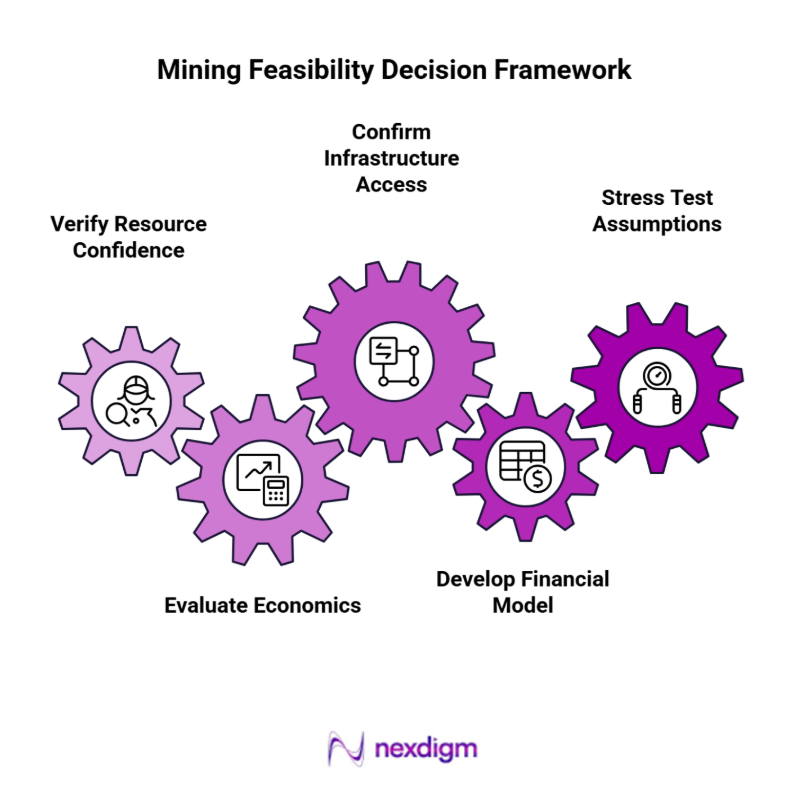
- Verify Resource Confidence and Recoverability: Assess resource estimates, grade distribution, geological confidence and recoverable reserves to establish the deposit’s potential to support commercially viable production.
- Evaluate Extraction and Processing Economics: Compare suitable extraction methods, processing technologies, expected recovery rates and production costs to determine whether the resource can be mined and processed efficiently.
- Confirm Infrastructure and Market Access: Examine transport connectivity, power and water availability, logistics costs, permitting requirements and access to target markets to identify potential operational constraints.
- Develop an Integrated Project Financial Model: Estimate capital expenditure, operating costs, production schedules, expected revenues and cash flows to evaluate project economics across the development and operating lifecycle.
- Stress Test Key Feasibility Assumptions: Model the impact of commodity price fluctuations, lower recovery rates, development delays, cost overruns and financing constraints on project returns and financial resilience.
Nexdigm Case Study
A mining investor evaluated four mineral opportunities using resource data, indicative processing costs, infrastructure mapping and demand scenarios. Two projects were removed from the shortlist because transport and development requirements weakened their economics. The remaining opportunities progressed to detailed technical validation and sensitivity modelling before capital allocation.
To take the next step, simply visit our Request a Consultation page and share your requirements with us.
Harsh Mittal
+91-8422857704