

Mining investment is defined by the gap between robust demand and the challenge of deploying low-cost supply. Even with favorable long-term fundamentals, projects falter when declining grades, weak infrastructure, or complex metallurgy push costs up the curve.
With the top 30 miners deploying a decade-high $121.6 billion in 2026 capex—primarily targeting copper and electrification minerals—success hinges on backing assets where resource quality, delivered economics, and downstream demand align.
Diverging Demand Across Critical Minerals
The demand outlook varies substantially across commodities. Under the International Energy Agency’s (IEA) Stated Policies Scenario, total demand for critical minerals is projected to nearly double by 2040:
- Lithium: Demand is forecast to more than triple.
- Copper: Expected to add approximately 7 million tonnes by 2040, the largest absolute volume increase among tracked minerals.
- Nickel, graphite and rare earth elements: Demand is projected to grow by approximately 50% to 90%.
These figures establish the scale of future demand, but they do not by themselves determine which mining projects will be commercially attractive.
The timing, cost and quality of new supply remain critical variables.
Demand Growth vs. Project Profitability: The Copper Case
Copper illustrates why strong structural demand does not automatically translate into attractive project returns.
- Projected deficit: The IEA’s 2026 assessment projects a potential 25% copper supply deficit by 2035 based on the existing project pipeline.
- Pipeline realities: The projected gap has narrowed as new projects have advanced, but substantial additional mine supply remains necessary.
- Investment implication: Projects capable of delivering competitive new copper supply could become strategically important as demand from electrification and energy infrastructure expands.
The broader market presents a more mixed picture. Gold producers continue to benefit from exceptionally strong operating margins, while lithium and nickel have experienced significant pricing pressure following additional supply.
A 2026 assessment found that:
- 47% of global lithium chemical production was operating at a loss.
- 14% of global nickel production was operating at a loss.
The implication is straightforward: headline demand growth needs to be assessed alongside the supply pipeline and cost position. A high-growth commodity facing substantial near-term oversupply can offer weaker project economics than a slower-growing market where competitive supply remains constrained.
The Cost Curve Separates Resources from Viable Mines
The economic value of a mineral resource depends on more than the size of the deposit. Grade, mine depth, strip ratio, geological complexity and metallurgy can materially affect the amount of material that needs to be extracted and processed.
Several factors determine whether a resource can translate into competitive production:
- Resource quality: Grade, tonnage, recoverability and geological confidence determine the underlying production potential.
- Mining complexity: Depth, strip ratios and geological conditions influence material movement and operating costs.
- Processing requirements: Complex metallurgy can require specialised beneficiation, higher reagent consumption, additional energy and significant water infrastructure.
- Operating costs: Energy, labour, equipment, consumables and sustaining capital can materially change project economics over the mine life.
Recent cost movements demonstrate why these variables cannot be treated as static. Copper mining costs increased by 5.1%, while iron ore mining costs rose by 11.3% in the period assessed by S&P Global.
These increases reinforce the need to test project economics across multiple cost and commodity-price scenarios rather than relying on a single base case.
Infrastructure: Mine-Gate vs. Delivered Competitiveness
A project’s cost position can change substantially once transportation and infrastructure requirements are incorporated.
- Logistical bottlenecks: Long haulage routes, constrained rail capacity and port congestion can erode otherwise attractive mine-gate economics.
- Infrastructure access: Established power grids, rail networks, roads and deep-water ports can materially improve project competitiveness.
- Processing proximity: Access to nearby processing or refining facilities can reduce capital requirements and shorten the route to market.
For this reason, the relevant benchmark is delivered competitiveness to the customer, rather than cost at the mine gate alone.
Downstream Demand Determines Whether Production Can Be Monetised
The customer side of the value chain is equally important. Bulk commodities such as iron ore and thermal coal are highly sensitive to transportation costs and the location of steel mills, power plants and other industrial consumers. Critical minerals introduce another consideration because customers may require refined or processed material rather than mined output.
This creates potential opportunities beyond conventional mine development. Countries with significant mineral resources but limited processing capacity may become attractive locations for beneficiation, refining or intermediate-material production. The IEA’s analysis of critical minerals indicates that diversification has progressed more rapidly in mining than in refining, leaving significant concentration further downstream.
A mining opportunity analysis services assessment should therefore examine the entire route from resource to customer, including:
- Mine production profile and expected output.
- Available processing and refining capacity.
- Road, rail, port and power infrastructure.
- Potential customers and offtake partners.
- Competing supply expected to enter the market.
- Delivered cost relative to competing producers.
Nexdigm’s Framework for Assessing Mining Opportunities
An effective mining assessment begins at the deposit, but commercial viability depends on conditions across the value chain. Nexdigm integrates commodity market research, project economics, infrastructure feasibility, competitive intelligence and downstream demand analysis to determine where a resource can support a commercially viable investment.
The evaluation centres on five commercial questions:
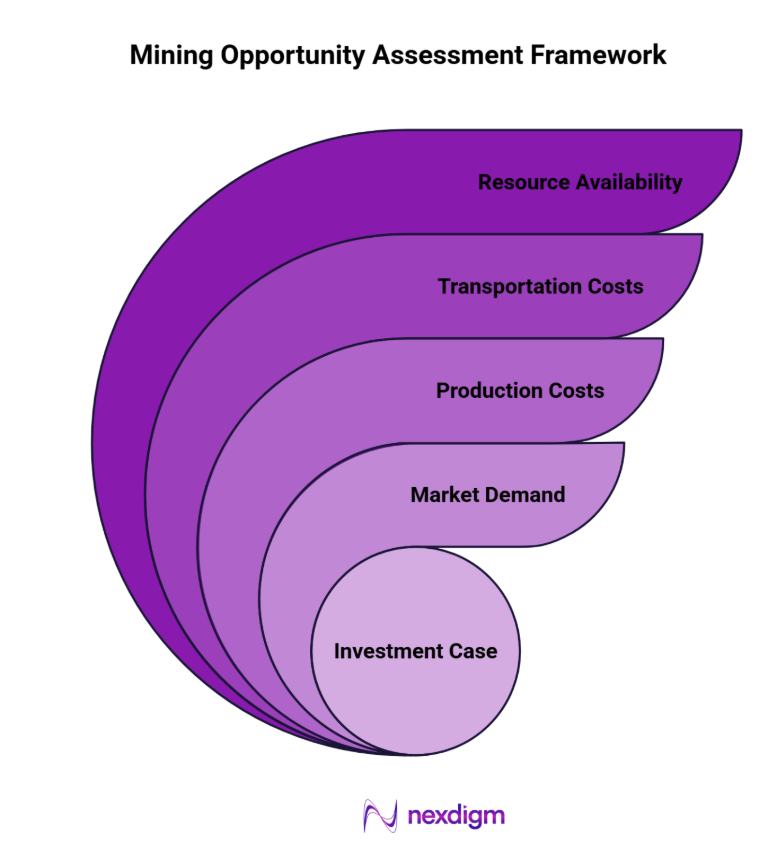
- What is actually in the ground?
Evaluate grade, tonnage, geological confidence, recoverability, mine life and overall resource quality. - What will it cost to produce?
Model mine design, capital intensity, metallurgy and processing requirements, energy, labour, consumables and sustaining capital expenditure, then benchmark the resulting cost profile against competing producers and global cost curves. - What will it cost to reach the customer?
Analyse road, rail, port, power access, processing requirements and freight logistics to determine total delivered competitiveness rather than relying solely on mine-gate economics. - Who will buy the output?
Map downstream industrial end-users, smelters, refiners, processors and traders while assessing customer concentration, product specifications and potential offtake arrangements. - How robust is the investment case?
Stress-test financial returns against commodity-price volatility, operating-cost inflation, permitting delays, infrastructure constraints and prospective competing supply before capital is deployed.
This integrated framework separates resources that are strategically interesting from those that are commercially investable, while identifying where the strongest opportunity lies across extraction, processing, infrastructure or downstream integration.
Nexdigm Case: Mining Portfolio Screening
Nexdigm helped a mining company evaluate 14 prospective projects across five commodities. By benchmarking resource quality, cost dynamics, infrastructure, downstream demand and capital intensity, the screening narrowed the portfolio to four high-conviction opportunities with projected IRRs above 16%.
To take the next step, simply visit our Request a Consultation page and share your requirements with us.
Harsh Mittal
+91-8422857704