

Mining companies operate across supply chains that can span extraction, processing, refining, transport, and international distribution. Moving minerals across borders requires more than finding a buyer. Exporters and importers must understand product classification, customs documentation, applicable duties, origin requirements, and restrictions affecting particular commodities or destinations.
A compliance failure can delay shipments, increase costs, trigger penalties, or prevent a transaction from proceeding. These risks make trade compliance a commercial consideration, not simply an administrative responsibility.
Determine Which Rules Apply
Mineral products may be subject to different customs classifications depending on their composition, processing stage, and intended form. Ores, concentrates, refined metals, and processed mineral products should not automatically be treated as interchangeable for customs purposes.
Companies must identify the applicable product codes and verify the requirements in both the exporting and importing jurisdictions. These may include export permits, customs declarations, certificates of origin, product documentation, and additional controls for specific materials.
The relevant requirements can vary by country and commodity. A compliance review should therefore be conducted for each product-market combination rather than relying on a single checklist for all mineral shipments.
Understand Duties And Rules Of Origin
Tariffs can affect the competitiveness of mineral exports and the cost of imported inputs. Preferential trade agreements may reduce applicable duties, but eligibility can depend on product classification and rules of origin.
For mining trade compliance analysis, businesses should verify whether a shipment qualifies for preferential treatment and whether the required supporting records are available. The country from which a product is shipped is not necessarily the country that determines its origin for customs purposes.
Exporters should also monitor changes in trade restrictions, sanctions, licensing requirements, and other applicable controls. These measures can affect whether a transaction is permitted, which documentation is needed, and how quickly goods can move through customs.
Manage Documentation Across The Shipment
Compliance responsibilities extend across commercial invoices, packing lists, transport documents, origin records, permits, and customs declarations. Inconsistent descriptions, incorrect quantities, or mismatched product codes can create delays and additional scrutiny.
Businesses operating through multiple intermediaries should establish clear responsibility for preparing, reviewing, and retaining documents. Records should be consistent across the exporter, freight forwarder, customs broker, importer, and relevant authorities.
A repeatable documentation process reduces avoidable errors and makes it easier to respond to customs enquiries or audits.
Build A Mining Trade Compliance Framework
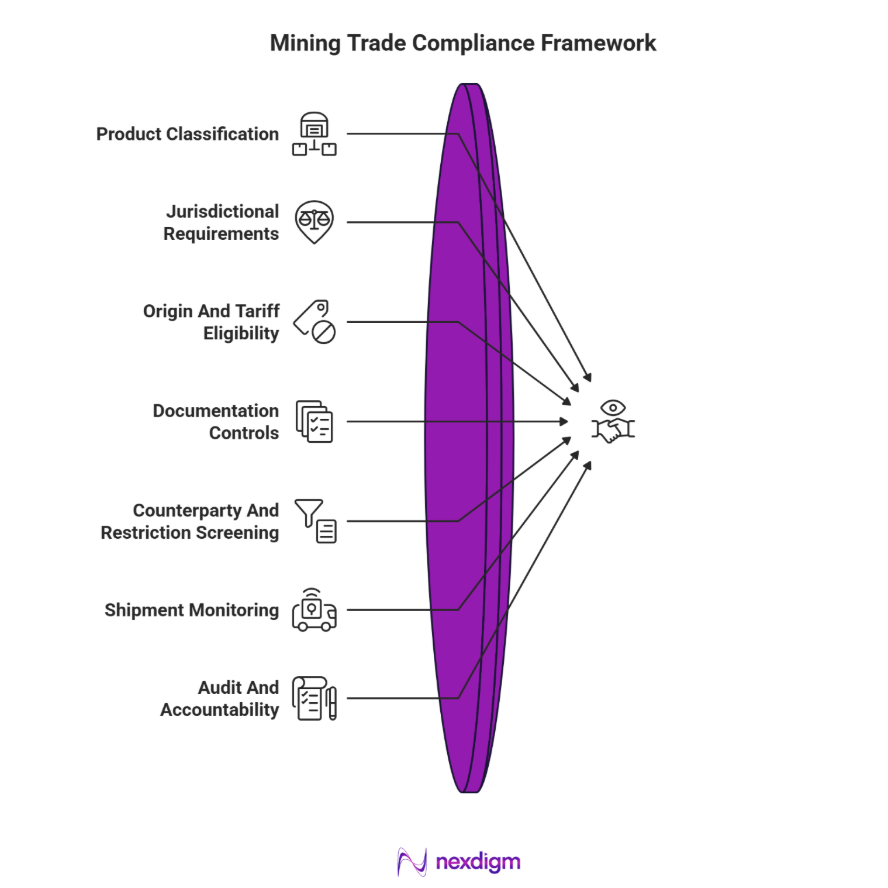
- Product Classification: Confirm the correct customs classification for each mineral product, taking account of its composition, processing stage, and form before calculating duties or preparing declarations.
- Jurisdictional Requirements: Identify the export and import rules applying to each route, including licences, permits, customs procedures, and commodity-specific restrictions.
- Origin And Tariff Eligibility: Verify country-of-origin requirements, preferential trade agreement conditions, applicable duty rates, and the supporting records needed to claim tariff benefits.
- Documentation Controls: Establish consistent procedures for invoices, packing lists, transport records, permits, certificates, and customs declarations, with clear ownership for review and approval.
- Counterparty And Restriction Screening: Check relevant trading parties, destinations, and transactions against applicable sanctions, export controls, and other legal restrictions before shipment.
- Shipment Monitoring: Track regulatory changes, customs queries, documentation discrepancies, and shipment delays to identify recurring problems and improve future compliance procedures.
- Audit And Accountability: Maintain accessible records, assign compliance responsibilities, and periodically review procedures to ensure that the organisation can demonstrate how trade requirements were assessed and fulfilled.
These controls should reflect the commodity, destination, shipment value, and applicable legal requirements. Standardised procedures can improve consistency, but they should not replace jurisdiction-specific legal or customs advice when a transaction involves complex restrictions.
Make Compliance Part Of Market Planning
Early compliance assessment helps mining businesses estimate landed costs, evaluate export destinations, and avoid committing to routes that are difficult to serve. Integrating customs and regulatory requirements into commercial planning also improves shipment reliability and helps companies identify documentation or licensing issues before contracts are finalised.
Nexdigm’s Case Study
A mineral exporter plans 24 shipments annually, each valued at ₹2 crore. Documentation discrepancies delay six shipments by an average of 10 days. If each delayed shipment incurs ₹1.5 lakh in additional storage, handling, and administrative costs, the annual avoidable expense could reach ₹9 lakh. A revised compliance process covering product classification, origin records, permits, and pre-shipment checks helps the exporter target fewer documentation-related delays and more predictable delivery schedules.
To take the next step, simply visit our Request a Consultation page and share your requirements with us.
Harsh Mittal
+91-8422857704