

Minerals move through international supply chains that connect extraction sites, processing facilities, ports, industrial buyers, and manufacturers. Mapping these flows reveals which countries supply particular commodities, where imports are concentrated, and how changes in production or logistics can affect availability.
Unlike a simple ranking of exporters, mineral flow analysis examines the relationships between trading partners and the stages through which materials pass before reaching their final users.
Start With The Commodity’s Route
A mineral’s trade journey may involve several countries. Ore can be extracted in one location, processed in another, and incorporated into manufactured products elsewhere. Analysing only the initial export or final import can therefore overlook important dependencies.
Researchers should define the product being tracked and distinguish raw materials from concentrates, refined products, and downstream materials. Customs classifications and reporting periods need to be consistent so that changes in product mix are not mistaken for changes in trade volume.
For mining trade flow analysis, this product-level view provides the basis for tracing origins, destinations, intermediate processing locations, and the markets ultimately dependent on those flows.
Measure Import Dependence And Supplier Concentration
Import dependence can indicate where domestic production is insufficient to meet industrial demand. However, dependence alone does not establish that a market is vulnerable. The risk also depends on the number of available suppliers, the substitutability of the material, inventory levels, and the time required to switch sources.
A country purchasing most of a particular mineral from one origin may face greater exposure to a disruption than a market with several qualified suppliers. Similarly, dependence on a single processing hub may create a bottleneck even when the raw mineral is sourced from several countries.
Trade statistics should therefore be combined with information on production capacity, processing facilities, logistics, and alternative sources.
Follow Changes Across Time
A single year’s trade figures offer only a snapshot. Comparing several periods can reveal whether supplier relationships are stable, whether new exporters are gaining share, and whether import demand is moving toward different origins.
Changes should be interpreted in context. A sudden rise in imports might reflect stockpiling before an anticipated disruption, while a fall in exports could result from maintenance, weather, regulatory changes, or reduced output. Price movements can also alter trade values without producing equivalent changes in physical quantities.
Build A Mineral Flow Analysis Framework
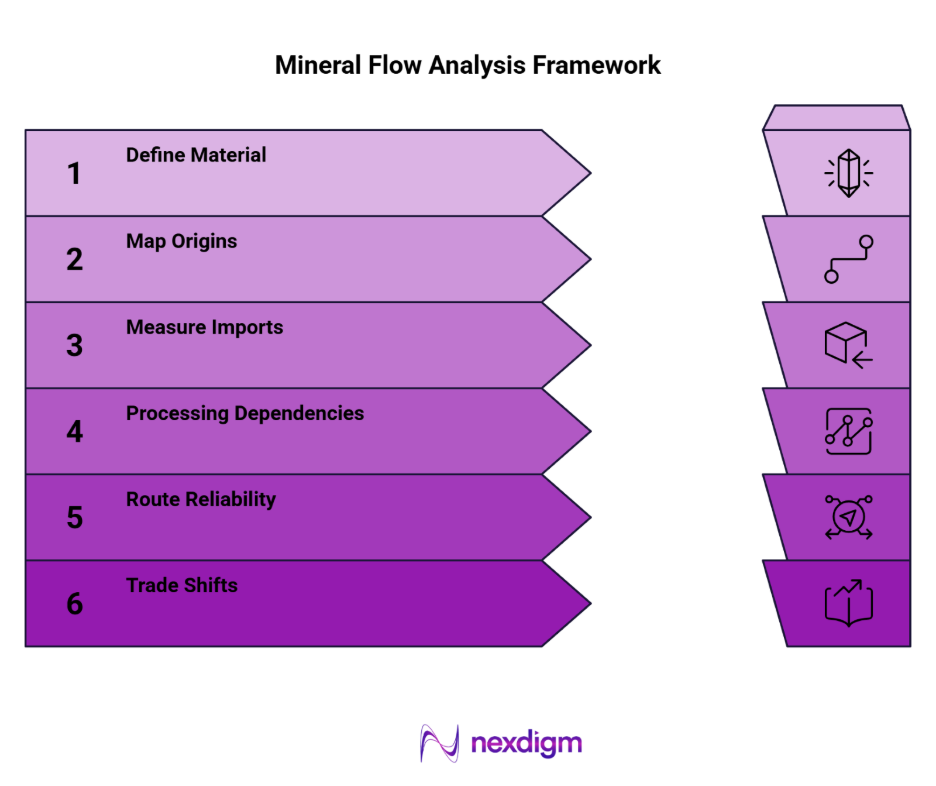
- Define The Material: Establish the exact commodity, product form, customs classification, and reporting period to ensure that trade flows can be compared consistently.
- Map Origins And Destinations: Identify leading exporting and importing countries, major bilateral relationships, and changes in supplier or buyer shares over time.
- Measure Import Dependence: Compare import requirements with domestic production and available alternatives to determine how strongly each market relies on external supply.
- Identify Processing Dependencies: Trace where minerals are concentrated, refined, or otherwise processed to reveal supply-chain stages that may create bottlenecks.
- Assess Route Reliability: Examine ports, transport corridors, shipping times, infrastructure constraints, and disruption exposure affecting the movement of materials.
- Investigate Trade Shifts: Compare changes in volumes, values, prices, and supplier participation to distinguish structural changes from temporary fluctuations or inventory adjustments.
- Evaluate Strategic Alternatives: Identify potential suppliers, alternative routes, and substitution options, then compare their cost, capacity, qualification requirements, and reliability.
These steps help organisations distinguish between high trade volumes and genuine supply-chain exposure. The most important risk may lie in a specialised processing stage or transport corridor rather than in the country exporting the largest quantity of raw material.
Turn Mineral Flow Mapping Into Action
Mineral flow analysis can support procurement planning, export-market research, and supply-risk assessment. Understanding how materials move between extraction, processing, and consumption markets allows businesses to identify dependencies more precisely and evaluate alternatives before disruptions affect production or trade.
Nexdigm’s Case Study
An industrial buyer purchases 50,000 tonnes of a critical mineral annually. Although it sources from four exporting countries, 75% of its material passes through a single processing hub. The buyer identifies an alternative processing route capable of handling 10,000 tonnes annually, subject to technical qualifications. The proposed change could reduce dependence on the existing hub from 75% to 55%, creating a measurable diversification target while preserving the current supply arrangements for the remaining volume.
To take the next step, simply visit our Request a Consultation page and share your requirements with us.
Harsh Mittal
+91-8422857704