

Mobility services expansion is accelerating as shared transportation markets grow globally, driven by rising urbanization, congestion, digital adoption, and demand for flexible travel options. Ride-hailing, car-sharing, bike-sharing, subscription mobility, and last-mile transport platforms are reshaping how people access transportation without relying only on private vehicle ownership.
Strong market entry strategy helps mobility companies evaluate customer demand, local regulations, pricing models, fleet requirements, technology readiness, and partnership opportunities before entering new cities. Effective Mobility services market entry strategy enables businesses to scale shared transportation models while improving convenience, affordability, and operational efficiency in competitive urban markets.
The global shared mobility market is estimated at USD 405.78 billion in 2026 and is projected to reach USD 954.65 billion by 2033, growing at 13.0% CAGR. Ride-hailing services alone were valued at USD 47.6 billion in 2025 and are expected to reach USD 181.5 billion by 2033, reflecting rising demand for flexible urban transport.
Evaluating Local Regulations and Licensing Requirements for Mobility Services
Evaluating local regulations involves reviewing permits, transport licenses, fleet rules, driver requirements, insurance obligations, safety standards, data compliance, and city-level operating restrictions before launching mobility services:
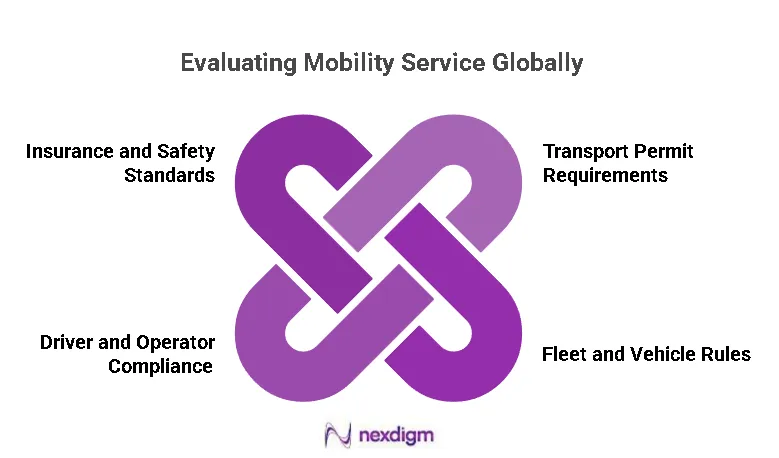
- Transport Permit Requirements: Review city-level permits needed for ride-hailing, car-sharing, bike-sharing, shuttle services, or last-mile mobility operations.
- Fleet and Vehicle Rules: Assess vehicle registration, inspection standards, emission norms, fleet size limits, and operating conditions for shared mobility services.
- Driver and Operator Compliance: Evaluate driver licensing, background checks, training requirements, working hour rules, and platform responsibilities.
- Insurance and Safety Standards: Review passenger insurance, vehicle coverage, accident liability, safety protocols, emergency support, and customer protection requirements.
Nexdigm’s Operational Readiness Assessment for Mobility Services Launch
Nexdigm’s operational readiness assessment helps mobility service providers prepare for launch by reviewing fleet availability, driver onboarding, licensing, technology systems, pricing workflows, customer support, safety protocols, and city-level operating requirements. This assessment helps identify launch gaps, improve service reliability, reduce operational risks, and support smoother entry into shared transportation markets.
Nexdigm’s Market Research Support for Shared Transportation Growth Markets
Nexdigm’s market research support helps mobility companies assess shared transportation demand, customer preferences, competitor activity, pricing trends, regulatory conditions, fleet needs, and growth opportunities in target markets.
- Shared Transportation Demand: Nexdigm assesses demand for ride-hailing, car-sharing, bike-sharing, shuttle services, and last-mile mobility across target markets.
- Customer Preference Analysis: Nexdigm studies user preferences around price, convenience, safety, travel frequency, booking channels, and service reliability expectations.
- Competitor Activity Review: Nexdigm evaluates existing mobility platforms, pricing models, service coverage, fleet size, customer experience, and market gaps.
- Pricing Trend Assessment: Nexdigm reviews fare structures, subscription models, discounts, peak pricing, affordability levels, and revenue opportunities in shared mobility.
- Regulatory Condition Mapping: Nexdigm assesses permits, transport rules, city restrictions, insurance requirements, driver regulations, and platform compliance needs.
Nexdigm’s case:
Nexdigm supported a shared mobility platform evaluating launch potential across congested urban corridors. The study assessed commuter density, trip frequency, fare sensitivity, fleet availability, regulatory requirements, and competitor coverage. Nexdigm helped the company identify 8 high-demand operating zones, estimate 25–30% stronger utilization potential in priority corridors, map over 40 fleet and parking partners, and refine its launch model for faster mobility services market entry.
To take the next step, simply visit our Request a Consultation page and share your requirements with us.
Harsh Mittal
+91-8422857704