

A chemical manufacturer entering a new market must decide how much of the business it needs to own, how quickly it needs to establish a presence and which capabilities it can obtain from local partners. A greenfield facility provides operational control but requires substantial investment and time. An acquisition offers an existing platform, although integration can be difficult. A joint venture shares resources and risks, while a distributor-led model can establish market access with a smaller initial commitment.
The right entry model depends on the company’s product economics, customer requirements, regulatory exposure and investment horizon. Choosing the wrong structure can leave a business with excess capacity, limited customer access or insufficient control over product quality.
The Entry Decision Starts with the Commercial Objective
Companies should define what they need from the target market before comparing entry modes. A business seeking export revenue may need a reliable distributor and technical sales coverage. A manufacturer targeting customers that require local production, specialised handling or rapid delivery may need a more substantial operating presence.
India’s chemical trade illustrates the scale of the international opportunity and the importance of competitiveness. Industry statistics published in 2025 indicate that chemicals and chemical products, excluding pharmaceuticals and fertilisers, accounted for 10.6% of India’s total exports in FY2024–25, compared with 10.3% in FY2023–24. Over FY2020–21 to FY2024–25, exports in this category recorded a compound annual growth rate of 8.9%, while imports grew at 14%.
These figures suggest expanding trade activity, but they do not establish which entry structure will succeed in a particular country. Product-level demand, import competition, landed costs and customer qualification requirements still determine the commercial case.
Four Chemical Market Entry Models and Their Trade-Offs
- Greenfield investment gives the company control over production processes, staffing, quality systems and capacity. It can be attractive when local manufacturing is necessary for customer access or supply security. The trade-off is a longer development period, upfront capital expenditure and exposure to underutilised capacity if demand develops slowly.
- Joint ventures combine local market knowledge or distribution access with the entrant’s technology, capital or product portfolio. They can reduce the burden of entering an unfamiliar market, but require clear agreement on governance, intellectual property, investment obligations, pricing and future expansion.
- Acquisitions provide access to existing facilities, customer relationships, qualified products and experienced teams. They are most compelling when these capabilities would take too long to build organically. However, the acquisition premium, environmental liabilities, customer concentration and integration costs can undermine expected returns.
- Distributor-led entry offers a lower-commitment route to test demand. A capable distributor can provide local relationships, inventory and sales coverage without requiring the manufacturer to establish a full operating entity. The limitations are reduced control over customer relationships, dependence on partner performance and potentially weaker visibility into end-user demand.
What Determines the Best Route?
The decision should be based on the capabilities required to compete, not a generic preference for owning assets or limiting investment.
Five considerations deserve particular attention:
- Customer access: Do buyers require local approvals, technical service, established relationships or a domestic supply base?
- Investment and payback: How much capital is needed before revenue begins, and how quickly can the business reach viable utilisation?
- Operating control: How important are process consistency, intellectual property protection, product handling and customer service?
- Regulatory requirements: Do product registration, environmental approvals, foreign ownership rules or local-content requirements favour one structure?
- Demand uncertainty: Can the company validate sales through exports or distribution before committing to a facility or acquisition?
These factors should be weighted differently by product. A specialised formulation with demanding customer qualification may justify acquiring a technically capable local supplier. A standardised product with manageable freight costs may be better served through distribution.
Comparing the Economics Before Committing Capital
A useful mode of entry advisory consulting for chemicals sector assessment compares each route using the same demand forecast and financial assumptions. Otherwise, management may compare a distributor’s low initial cost with a greenfield facility’s full long-term revenue potential, producing a misleading result.
The model should include initial investment, operating costs, taxes and duties, logistics, working capital, expected margins, time to first sale and the cost of scaling. It should also test slower customer acquisition, price pressure, foreign exchange movements and lower capacity utilisation.
Entry structures should be assessed over comparable time horizons. An acquisition may generate revenue sooner but carry a higher purchase price. Greenfield investment may offer better long-term operating economics but require a longer ramp-up. Distributor-led entry may be less profitable per unit while reducing the downside if demand fails to materialise.
Chemical Market Entry Decision Framework
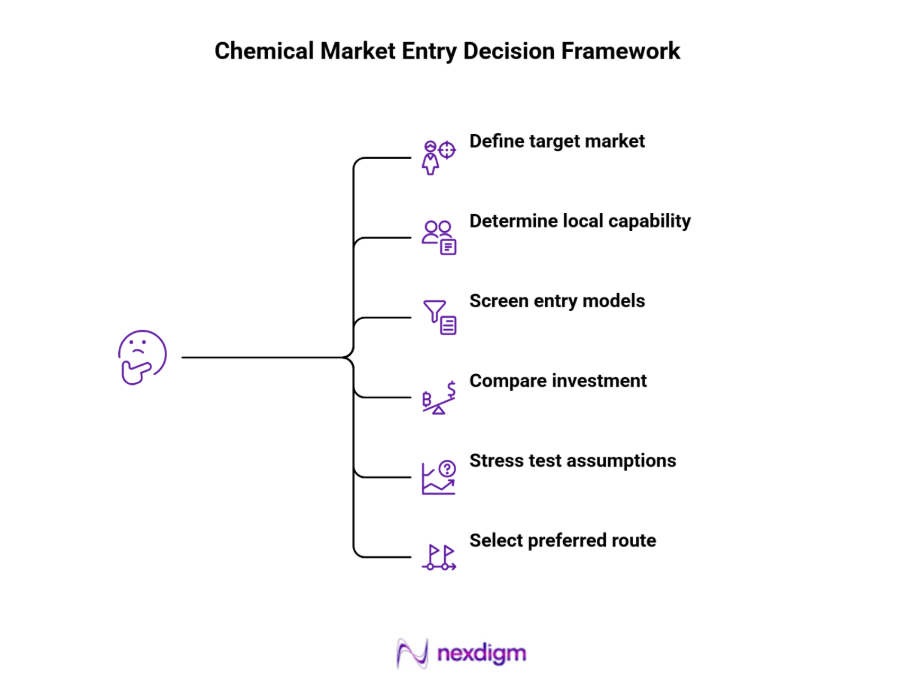
- Define the Target Market and Commercial Objective: Identify the target customer segments, product specifications, application requirements and commercial goals to establish the opportunity the business intends to pursue.
- Determine Local Capability and Partnership Requirements: Assess which capabilities, such as manufacturing, technical support, distribution and regulatory compliance, must be developed locally and which can be accessed through strategic partners.
- Screen Entry Models for Feasibility: Evaluate potential entry routes against regulatory obligations, operational requirements and market access conditions, eliminating options that cannot meet essential requirements.
- Compare Investment and Commercial Returns: Assess capital expenditure, expected margins, working capital requirements, operating costs and time to revenue to understand the financial implications of each viable entry model.
- Stress Test Key Market Assumptions: Evaluate how changes in demand, selling prices, production utilisation and input costs could affect profitability and the resilience of the business case.
- Select the Preferred Entry Route and Define Milestones: Choose the model that best balances commercial returns, operational feasibility and risk, with clear milestones for implementation, performance review, expansion or reconsideration.
Nexdigm Case Study
A chemical manufacturer assessed four entry models across three target markets. Screening identified distribution as the lowest-commitment route in one market, a joint venture as the preferred option in another and local acquisition as the strongest route where customer qualification was the main barrier. The phased plan linked additional capital to validated sales and operating milestones.
To take the next step, simply visit our Request a Consultation page and share your requirements with us.
Harsh Mittal
+91-8422857704