

Strong housing demand is not the same as viable mortgage demand. Even where household formation is rising and housing needs are significant, formal lenders may find limited opportunity if prices outpace incomes, borrowers cannot demonstrate earnings, or property titles are difficult to enforce.
Mortgage markets therefore need to be assessed at a more granular level. An Mortgage lending market feasibility study can connect housing demand with affordability, borrower quality, property documentation, interest-rate sensitivity, and the economics of originating and servicing long-duration loans.
Housing Demand and Mortgage Demand Can Diverge
Mortgage penetration remains relatively low in several emerging economies. India, for example, has a mortgage-to-GDP ratio of approximately 12.3% to 13.3%, considerably below developed markets such as the United States and United Kingdom, where mortgage debt exceeds 60% to 70% of GDP.
The gap reflects more than housing supply. Undocumented household income, fragmented property records, limited formal credit histories, and affordability constraints can prevent potential homeowners from becoming viable mortgage borrowers.
For lenders assessing expansion markets, this distinction is critical: a large base of prospective homebuyers becomes commercially relevant only when enough of them can qualify for appropriately structured mortgage financing.
Affordability Defines the Addressable Market
Housing affordability varies substantially between major metropolitan areas and smaller urban markets. In the research, Tier-1 markets show price-to-income ratios of roughly 8.5x to 12x, creating substantial pressure for median-income households. Tier-2 and Tier-3 markets typically show ratios closer to 4x to 6x, creating a broader potential borrower pool.
Interest rates add another layer of sensitivity. Higher floating mortgage rates increase monthly repayment obligations and can push otherwise eligible households beyond comfortable debt-service levels. Lower rates can have the opposite effect, expanding purchasing capacity while also increasing refinancing and prepayment activity.
Accordingly, lenders need to examine affordability through multiple lenses—property prices, household income, loan size, interest rates, and expected tenure—rather than relying on headline housing demand alone.
Credit Quality Changes the Economics of Expansion
Prime salaried borrowers generally offer stronger repayment profiles, but competition among banks can compress lending spreads. More specialized lenders can access higher-yield opportunities among self-employed and informal-income borrowers, provided they have the capabilities to underwrite these customers effectively.
Serving these segments demands more operational depth: verifying business activity through site visits, assessing informal income, conducting detailed property due diligence, and maintaining conservative loan-to-value ratios.
The trade-off is clear: higher lending yields can compensate for additional underwriting and servicing costs, but only where the underlying borrower and collateral risks remain manageable.
Property Quality Matters as Much as Borrower Quality
Because a mortgage is secured against property, recoverability depends not only on the borrower but also on the asset’s legal and economic quality. Weak documentation can quickly dilute the appeal of an otherwise promising market.
Lenders entering new markets need visibility into:
- Property title and ownership records.
- Construction and municipal approvals.
- Existing encumbrances.
- Local foreclosure and recovery processes.
- Property liquidity and resale conditions.
- Typical loan-to-value levels.
Markets with strong housing demand but lengthy recovery processes or uncertain property rights can produce substantially weaker economics than their demand indicators suggest.
Interest Rates Can Alter Portfolio Economics
Mortgage portfolios introduce a further dimension: funding. Since loans can remain outstanding for decades, non-bank housing finance companies may face margin pressure when long-duration assets are funded through shorter-term borrowing.
Falling interest rates create a different issue. Prime borrowers may refinance with competitors, accelerating prepayments and reducing the expected life of existing loans. Lenders must therefore assess both funding stability and borrower prepayment behaviour when evaluating market entry.
The most attractive market is not necessarily the one offering the highest mortgage yield. It is one where borrower affordability, funding costs, credit losses, operating expenses, and expected portfolio duration can support sustainable returns.
Nexdigm’s Mortgage Market Feasibility Framework
Mortgage markets therefore need to be assessed at a more granular level.
Nexdigm evaluates residential mortgage opportunities across affordability, property-market conditions, borrower quality, legal enforceability, funding structures, and competitive economics.
The assessment examines:
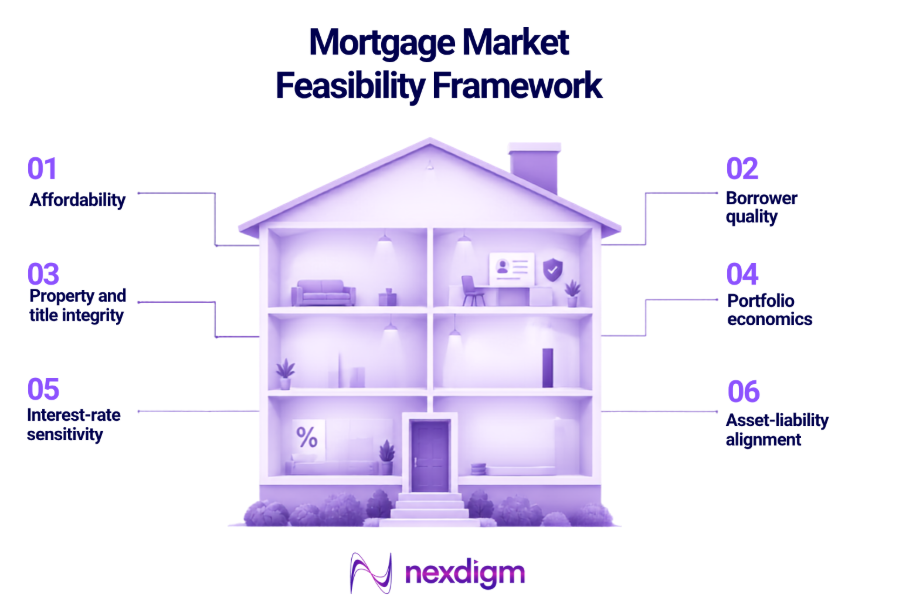
- Affordability: household income relative to property prices, loan sizes, and expected repayments.
- Borrower quality: employment stability, income verification, existing obligations, and credit history.
- Property and title integrity: ownership records, approvals, encumbrances, and enforceability.
- Portfolio economics: lending yields relative to funding, servicing, and expected credit losses.
- Interest-rate sensitivity: potential changes in origination, refinancing, and prepayment behaviour.
- Asset-liability alignment: whether available funding structures are appropriate for long-duration mortgage assets.
An Mortgage lending market feasibility study can connect housing demand with affordability, borrower quality, property documentation, interest-rate sensitivity, and the economics of originating and servicing long-duration loans.
Together, these inputs create a market-level view of whether housing demand can realistically translate into a sustainable lending portfolio.
How Nexdigm Distinguishes High-Demand Housing Markets From Viable Lending Markets
A mortgage lender screened 18 urban markets and found that seven Tier-2 and Tier-3 markets combined affordability ratios below 5.5x with stronger projected borrower demand. Nexdigm assessed income verification, property titles, funding costs, and competitive intensity to identify markets suitable for phased expansion.
A feasibility assessment gives lenders and investors a clearer basis for deciding where mortgage demand can support profitable growth, which borrower segments warrant specialized underwriting, and where market-entry risks outweigh the opportunity.
To take the next step, simply visit our Request a Consultation page and share your requirements with us.
Harsh Mittal
+91-8422857704
[email protected]