

MRO demand is generated by assets that already exist.
That makes it fundamentally different from many equipment markets. New machinery depends on capital expenditure and capacity expansion. MRO demand depends on the size, age, utilization, condition and maintenance strategy of the installed base.
For suppliers, distributors and service providers, understanding that installed base can be more valuable than simply tracking new equipment sales.
The Installed Base Is the Starting Point
Every operating asset creates some level of maintenance requirement.
Pumps, compressors, motors, conveyors, machine tools, production lines and plant infrastructure require parts, consumables, inspections, repairs and technical services throughout their operating lives.
IMARC estimates the global MRO market reached $699.4 billion in 2025 and projects continued expansion through 2034.
The headline number, however, tells only part of the story. MRO demand is distributed across asset classes with very different replacement cycles and service requirements.
Four Variables Determine the Maintenance Requirement
- Asset age: Older equipment generally creates greater requirements for replacement parts, repairs and refurbishment, although age alone does not determine maintenance expenditure.
- Utilization: A highly utilized asset accumulates operating hours faster and can generate more frequent maintenance requirements.
- Criticality: Failure of a non-critical auxiliary asset may have limited commercial consequences, whereas failure of a production bottleneck, compressor or critical process machine can interrupt an entire operation.
- Maintenance strategy: Preventive, predictive and reactive maintenance models generate different patterns of demand for parts and services.
The same installed base can therefore produce very different MRO expenditure depending on how assets are operated and maintained.
Why New Equipment Sales Are an Incomplete Indicator
A decline in new machinery purchases does not necessarily mean weaker MRO demand.
An existing plant may defer capital expenditure while extending the operating life of current equipment. That can increase spending on repairs, refurbishment and replacement components.
The reverse is also possible. Newer equipment may require fewer corrective interventions but create demand for specialised software, sensors, OEM service contracts and predictive-maintenance systems.
MRO forecasting therefore needs to connect equipment sales with asset survival and maintenance behaviour.
The Aftermarket Opportunity Is Becoming More Data-Driven
Industrial manufacturers are increasingly looking at aftermarket services as a recurring revenue stream.
BCG’s research on industrial aftermarket performance highlights installed-base penetration, spare-parts capture, maintenance-contract uptake, contract renewal and first-time-fix rates as important indicators of service performance. Its analysis found leading companies achieved spare-parts sales capture rates 16 percentage points higher than other companies.
This makes installed-base visibility commercially important.
A supplier that knows which assets are operating, how old they are, what parts they use and when maintenance is due can estimate addressable aftermarket demand much more precisely.
Where MRO Demand Can Expand
- Aging industrial assets
Longer operating lives can increase repair and refurbishment requirements. - High-utilization production
Greater operating intensity can accelerate wear and maintenance cycles. - Critical production equipment
High downtime costs can increase preventive and predictive maintenance spending. - Complex equipment
Specialised machinery can increase dependence on OEM parts and technical service. - Modernized maintenance strategies
Predictive maintenance can shift demand from reactive repairs toward sensors, diagnostics and planned interventions.
These demand pools should be evaluated separately because their economics and buying behaviour differ.
Nexdigm’s Installed-Base-to-MRO Demand Framework
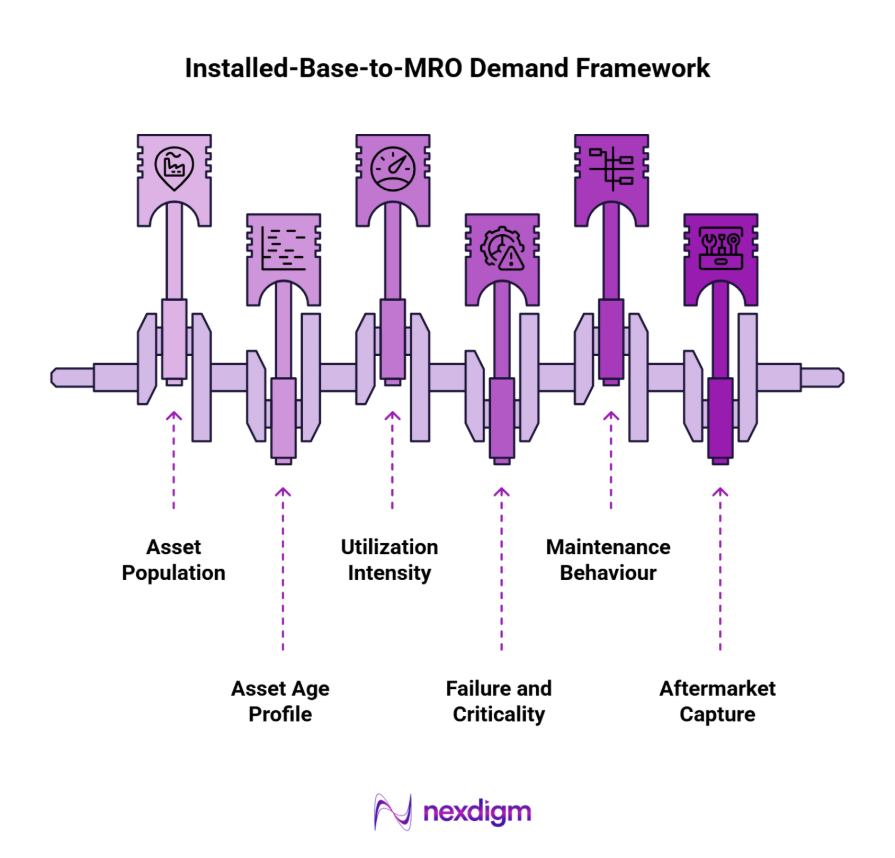
- Asset Population
Map installed equipment by industry, asset class, manufacturer, location and operating environment. - Asset Age Profile
Estimate equipment age and identify cohorts approaching major maintenance or replacement cycles. - Utilization Intensity
Assess operating hours, production intensity and utilization to estimate maintenance frequency. - Failure and Criticality
Identify assets where downtime creates material production or financial consequences. - Maintenance Behaviour
Map preventive, predictive and reactive maintenance practices and associated spending patterns. - Aftermarket Capture
Assess parts, service, refurbishment and contract opportunities available to OEMs, distributors and independent providers.
Nexdigm can support MRO demand analysis and forecasting through installed-base mapping, asset-age analysis, utilization assessment, maintenance-spend modelling, competitive benchmarking and aftermarket opportunity assessment.
Nexdigm Case Study: Quantifying Recurring MRO Demand
Nexdigm supported an industrial equipment client assessing aftermarket growth across a $699.4 billion global MRO market. By mapping installed assets, equipment age, utilization and maintenance patterns, the assessment identified asset categories with stronger recurring parts and service requirements.
The analysis helped the client prioritize aftermarket segments, refine its service offering and focus commercial efforts on asset classes with greater long-term MRO potential.
To take the next step, simply visit our Request a Consultation page and share your requirements with us.
Harsh Mittal
+91-8422857704