

Multi-cloud adoption is becoming a strategic priority as enterprises seek flexibility, resilience, cost optimization, and access to specialized cloud capabilities. However, managing multiple cloud environments introduces complexity across governance, security, operations, data movement, and application management, creating new opportunities for cloud management platforms and services.
Recent market indicators show strong multi-cloud momentum. Industry research indicates that more than 80% of enterprises are using or planning to use a multi-cloud strategy, driven by workload optimization, regulatory requirements, and technology flexibility.
The opportunity is shifting from simply adopting multiple cloud providers toward solving operational complexity through automation, governance, interoperability, and managed services.
For cloud providers, cloud management vendors, software companies, infrastructure providers, investors, private-equity firms, enterprise technology leaders, and strategy teams, a Multi cloud market feasibility study helps evaluate market demand, adoption barriers, customer needs and long-term commercial potential.
Why Enterprises Are Investing in Multi-Cloud Strategies
As cloud adoption matures, organizations are increasingly turning to multi-cloud environments to meet evolving business, operational, and regulatory requirements. The shift is driven not only by technology considerations but also by the need for greater flexibility, resilience, and control over enterprise workloads.
- Business Continuity and Resilience: Enterprises distribute workloads across cloud providers to enhance availability, reduce dependency on a single vendor, and strengthen operational resilience.
- Access to Specialized Cloud Capabilities: Different cloud providers offer unique services in AI, analytics, security, and industry-specific solutions, encouraging organizations to leverage multiple platforms.
- Regulatory and Data Sovereignty Requirements: Organizations increasingly adopt multi-cloud architectures to address regional compliance, data residency, and governance requirements.
As enterprises seek greater flexibility, resilience, and innovation, multi-cloud strategies are becoming a key component of modern technology architectures, creating growing demand for solutions that simplify and optimize multi-cloud environments.
Nexdigm’s Multi-Cloud Market Feasibility Expertise
As multi-cloud adoption accelerates, organizations need a clear understanding of market demand, customer requirements, adoption barriers, and emerging opportunities. Nexdigm’s Multi-Cloud Market Feasibility Study helps clients evaluate the commercial potential of multi-cloud solutions, identify high-growth customer segments, and understand the factors shaping enterprise adoption.
By combining market intelligence, customer demand analysis, competitive benchmarking, and ecosystem assessment, Nexdigm helps organizations assess market attractiveness, validate business opportunities, and develop strategies aligned with evolving enterprise cloud requirements.
Why Organizations Choose Nexdigm for Multi-Cloud Market Feasibility Studies
Evaluating the commercial potential of multi-cloud solutions requires more understanding cloud adoption trends. Organizations need a comprehensive view of customer requirements, adoption of challenges, competitive dynamics, and long-term market opportunities. Nexdigm’s Multi-Cloud Market Feasibility Study combines market intelligence, demand analysis, competitive benchmarking, and ecosystem assessment to help clients make informed strategic decisions.
What Differentiates Nexdigm from the Competitors
Market-Driven Insights: Deep analysis of enterprise cloud adoption trends, customer priorities, and evolving multi-cloud requirements.
- Comprehensive Opportunity Assessment: Evaluation of market attractiveness, growth potential, adoption barriers, and commercial viability across multi-cloud segments.
- Competitive Intelligence: Detailed assessment of vendors, solution providers, ecosystem participants, and emerging competitors.
- Customer-Centric Approach: Focus on understanding buyer needs, purchasing behavior, and decision-making factors influencing multi-cloud adoption.
By combining industry expertise and analysis of the following areas, Nexdigm differentiates itself from the competitors by assisting organizations with developed strategies that support sustainable growth and long-term competitive advantage.
Nexdigm’s Multi-Cloud Market Feasibility Approach
To help organizations validate multi-cloud opportunities and assess long-term commercial potential, Nexdigm follows a structured market assessment approach that evaluates demand, adoption readiness, competitive dynamics, and growth opportunities. It involves the following steps:
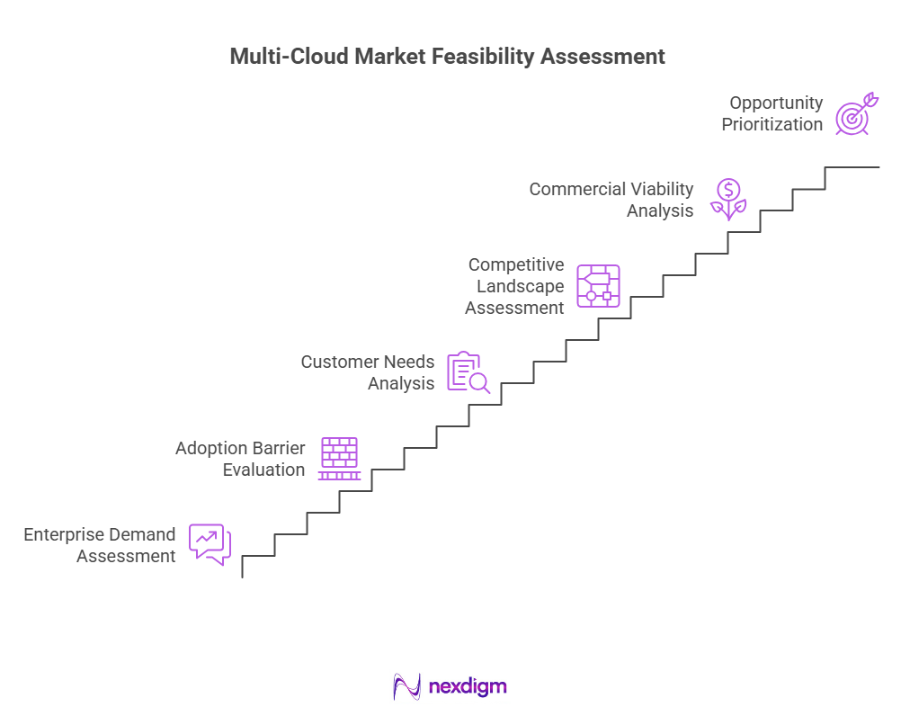
- Enterprise Demand Assessment: Analyze multi-cloud adoption trends, customer requirements, spending priorities, and purchasing behavior to understand current and future market demand.
- Adoption Barrier Evaluation: Assess the technical, operational, security, governance, and integration challenges that may impact enterprise adoption and solution scalability.
- Customer Needs Analysis: Identify key business requirements, unmet needs, decision drivers, and expectations influencing multi-cloud solution selection.
- Competitive Landscape Assessment: Evaluate vendors, service providers, platform ecosystems, market positioning, and competitive differentiation across the multi-cloud market.
- Commercial Viability Analysis: Assess market size, growth prospects, pricing models, revenue potential, and overall market attractiveness to determine commercial feasibility.
- Opportunity Prioritization: Identify high-growth customer segments, attractive use cases, and investment opportunities that align with evolving enterprise cloud requirements.
Through this approach, Nexdigm helps organizations develop growth strategies aligned with the evolving multi-cloud ecosystem.
Key Multi-Cloud Application Opportunities Identified by Nexdigm
As enterprises mature, their cloud strategies, demand is increasingly concentrated in applications that help simplify complexity, improve governance, and optimize cloud operations. Nexdigm’s Multi-Cloud Feasibility Study helps organizations identify the application areas with the strongest adoption potential and commercial opportunities. Such as:
- Cloud Management and Orchestration: Solutions that provide centralized visibility, monitoring, automation, and control across multiple cloud environments.
- Governance and Compliance Management: Platforms that help organizations enforce policies, manage risk, and ensure compliance across diverse cloud ecosystems.
- Cost Optimization and FinOps: Tools that improve resource utilization, spending visibility, and cloud cost management across providers.
By identifying these high-growth application areas, organizations get to prioritize opportunities, align offerings with enterprise demand, and develop strategies that support sustainable growth in the evolving multi-cloud market.
Nexdigm’s Case
An enterprise technology provider partnered with Nexdigm to evaluate opportunities in multi-cloud management, governance, and optimization solutions. The study assessed 50+ enterprise cloud challenges, identified 13 priority solution opportunities, and increased market-entry confidence by 24% by analyzing customer demand, competitive offerings, and scalable service models across multi-cloud environments.
To take the next step, simply visit our Request a Consultation page and share your requirements with us.
Harsh Mittal
+91-8422857704