

Using multiple cloud providers can give enterprises greater flexibility in workload placement, access to specialised services and alternatives when a single platform does not meet every requirement. It can also introduce a more demanding procurement and management environment. Different providers have different pricing structures, security controls, service capabilities and technical dependencies. Without a clear sourcing strategy, multi-cloud architecture can become an expensive collection of disconnected platforms.
For organisations evaluating this approach, a multi cloud vendor comparison study should establish how well providers work within a shared enterprise architecture. The objective is not simply to identify the strongest individual platforms. It is to understand which suppliers can support interoperability, consistent governance, workload portability and commercially sustainable operations.
Why Enterprises Consider Multiple Cloud Providers
A multi-cloud strategy may be driven by several business and technology requirements.
An organisation might use one provider for enterprise applications, another for advanced analytics and a third for specialised infrastructure or regional requirements. Different business units may also have existing cloud contracts that cannot be replaced immediately.
Common reasons for considering multiple providers include workload specialisation, resilience, geographical requirements, commercial flexibility and legacy integration. Enterprises may select platforms according to application, database, analytics or AI requirements, reduce dependence on a single environment for selected critical workloads, meet regional availability or data residency needs, compare rates and negotiate with multiple suppliers, or support existing technology investments while introducing new cloud services.
However, multiple providers do not automatically create resilience or reduce costs. Those benefits depend on architecture design, operational maturity and the organisation’s ability to manage complexity.
Comparing Providers Beyond Their Service Catalogues
Cloud providers should first be assessed against the workloads an enterprise intends to operate. A comparison of general compute and storage services may not reveal differences in database performance, networking, security tooling or specialised application services.
Procurement teams should examine infrastructure and performance, including compute options, storage tiers, network capabilities, regional availability and service-level commitments.
Data and application services also matter: database compatibility, application development tools, container management, analytics and integration capabilities can influence whether a platform fits the existing environment.
Security and governance should cover identity management, encryption, access controls, audit logging, policy enforcement and compliance support. Enterprise operations require a separate assessment of monitoring, automation, support services, incident management and compatibility with existing IT service management processes.
A provider may perform well in one category but be less suitable for another. The comparison should reflect the actual workload portfolio rather than a generic ranking.
Interoperability Is the Real Test of a Multi-Cloud Strategy
The commercial value of multiple platforms depends heavily on how effectively they operate together.
Enterprises need consistent approaches to identity management, security policies, monitoring, data movement and workload deployment. If each provider requires separate administrative processes, the organisation may face higher operational costs and greater governance complexity.
Data portability is another important consideration. Moving applications between providers can involve differences in databases, APIs, storage formats and managed services. A workload built around proprietary capabilities may be difficult to transfer without redesign.
Procurement teams should therefore assess whether suppliers support open standards, containerised workloads, common automation tools and integration with enterprise platforms.
The assessment should also identify where portability is genuinely required. Not every application needs to run across multiple clouds, and designing every workload for portability can introduce unnecessary cost.
The Economics of Multi-Cloud Procurement
Multi-cloud spending is not simply the sum of individual provider invoices. It includes the additional cost of operating multiple environments.
These costs may involve separate platform subscriptions and support arrangements, data transfer and inter-cloud networking charges, additional security and monitoring tools, specialist skills and training, integration and application redevelopment, as well as unused capacity and duplicated services.
Enterprises should model costs by workload and usage scenario. A lower compute rate on one platform may be offset by data transfer charges or the cost of maintaining additional management tools.
Contractual flexibility also matters. Procurement teams should examine minimum commitments, discount structures, price escalation, termination provisions and access to usage data.
Building a Multi-Cloud Supplier Portfolio
The objective of a multi-cloud sourcing strategy should be to assign providers clear roles within the enterprise architecture.
For example, a business may designate a primary platform for core applications, use a second provider for selected data workloads and retain a specialist supplier for regional or regulatory requirements. This reduces unnecessary duplication while preserving the flexibility that justifies a multi-cloud approach.
A supplier scorecard should distinguish between technical capability, integration readiness, security, commercial competitiveness and operational support. Providers can then be evaluated against the workloads and responsibilities they are expected to support.
Nexdigm’s Multi-Cloud Vendor Comparison Framework
Use the following assessment sequence to move from a broad vendor list to an architecture-aligned shortlist:
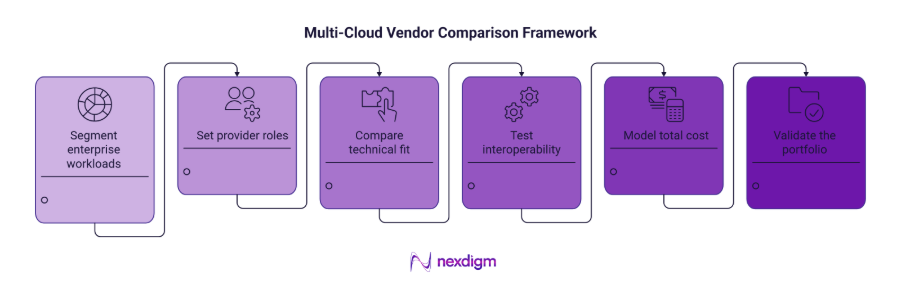
- Segment enterprise workloads: Classify applications by criticality, performance, data sensitivity and technology dependencies.
- Set provider roles: Define what each cloud platform is expected to deliver and where capabilities may overlap.
- Compare technical fit: Assess compute, storage, databases, networking, application services and regional availability.
- Test interoperability: Evaluate identity, security, monitoring, automation, data movement and workload portability.
- Model total cost: Include consumption, transfer, licensing, management, integration and exit costs.
- Validate the portfolio: Identify the smallest practical provider set that meets enterprise requirements without creating unnecessary dependencies.
Nexdigm can support technology procurement teams through cloud provider benchmarking, multi-cloud market research, commercial comparisons and supplier capability assessments. This helps organisations evaluate competing platforms, understand cost and integration trade-offs, and develop a sourcing strategy aligned with their enterprise architecture.
Nexdigm’s Case Study: Evaluating Multi-Cloud Enterprise Fit
Nexdigm compared 12 cloud providers across 6 enterprise technology requirements, assessing infrastructure, security, interoperability and pricing. The study identified a 23% variation in comparable service costs, shortlisted 4 providers and established 7 architecture and commercial evaluation criteria.
To take the next step, simply visit our Request a Consultation page and share your requirements with us.
Harsh Mittal
+91-8422857704