

Multi-node networks improve supply chain resilience and service coverage by distributing inventory, fulfilment, and delivery capabilities across multiple strategic locations instead of relying on a single central facility. As part of a market entry strategy, this model helps businesses reduce disruption risks, shorten delivery distances, and serve customers more consistently across regions.
Multi node distribution network strategy enables companies to balance cost efficiency with faster market access, especially in high-growth or geographically diverse markets. By creating multiple operating nodes, businesses can improve responsiveness, manage demand fluctuations, and build stronger supply chain continuity during market expansion.
The need for a Multi node distribution network strategy is reinforced by rising logistics scale and disruption risks. The global third-party logistics market was valued at about USD 1.6 trillion in 2025 and is expected to reach USD 4.3 trillion by 2035. Last-mile delivery is also projected to grow from USD 207.10 billion in 2026 to USD 378.59 billion by 2033, highlighting the importance of distributed nodes for coverage, resilience, and market entry strategy.
Using Multi-Node Distribution Networks as a Market Entry Strategy Enabler
Using multi-node distribution networks as a market entry strategy enabler helps businesses place inventory closer to customers, reduce delivery risks, improve service coverage, and scale operations across new regions efficiently:
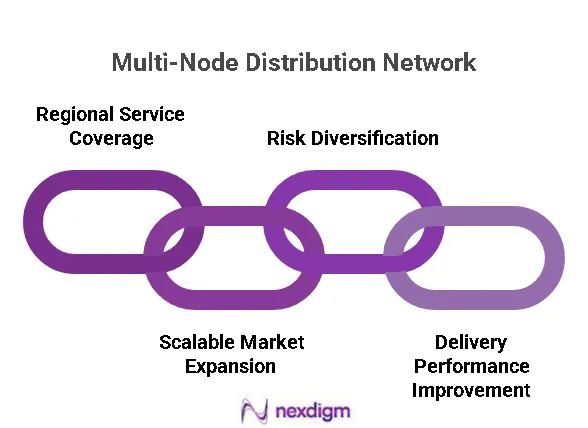
-
Regional Service Coverage
Expands delivery reach across target regions by using multiple fulfilment points closer to customer demand centres.
-
Risk Diversification
Reduces dependence on one facility, helping businesses maintain supply continuity during disruptions, delays, or demand fluctuations.
-
Scalable Market Expansion
Supports phased growth by adding nodes as demand increases, avoiding excessive upfront infrastructure investment.
-
Delivery Performance Improvement
Shortens transit times, improves order reliability, and strengthens customer experience in newly entered markets.
Nexdigm Risk and Resilience Advisory for Decentralised Supply Chain Models
Nexdigm can help businesses assess operational risks, demand variability, supplier dependency, logistics disruptions, compliance exposure, and infrastructure gaps across decentralised supply chains. This supports stronger continuity planning, risk mitigation, backup node design, and resilient market entry strategy across multiple regions.
Nexdigm Location Assessment for Multi-Node Fulfilment and Distribution Planning
Nexdigm can evaluate demand centres, transport connectivity, warehouse availability, operating costs, labour access, and risk exposure to identify suitable nodes for resilient fulfilment and distribution networks.
-
Demand Centre Analysis
Maps customer clusters, order volumes, and regional growth potential to identify locations supporting faster fulfilment and stronger market coverage.
-
Transport Connectivity Review
Assesses access to highways, ports, rail, airports, and last-mile routes for efficient multi-node distribution planning.
-
Warehouse Availability Assessment
Reviews storage capacity, facility quality, scalability, and lease options to support decentralised fulfilment network development.
-
Cost and Resource Evaluation
Compares rentals, labour costs, utilities, transport expenses, and operating overheads across potential node locations.
Nexdigm’s case:
Nexdigm assisted a consumer goods company to assess multi-node fulfilment and distribution locations across five target regions. By evaluating demand centres, transport connectivity, warehouse availability, operating costs, and disruption risks, Nexdigm helped the company shortlist four suitable nodes, improve service coverage by 38%, reduce average delivery time by 22%, and lower projected distribution costs by 14–17%.
To take the next step, simply visit our Request a Consultation page and share your requirements with us.
Harsh Mittal
+91-8422857704