

Multi-specialty healthcare models are gaining adoption as patients increasingly seek integrated care, faster access to specialists, and coordinated treatment under one network. A Multi-specialty healthcare service entry approach enables providers to combine primary care, diagnostics, specialty consultations, surgeries, and follow-up services within a structured delivery model. This supports a broader market entry strategy by helping healthcare organizations assess local demand, prioritize high-need specialties, optimize facility planning, and improve patient retention.
In expanding regional markets, multi-specialty models can strengthen clinical efficiency, enhance service convenience, and create scalable healthcare platforms aligned with evolving patient expectations.
Demand for integrated healthcare is rising as chronic and complex conditions increase globally. Noncommunicable diseases account for nearly 74% of all deaths worldwide, creating stronger need for coordinated multi-specialty care across cardiology, oncology, diabetes, diagnostics, and rehabilitation.
The global health workforce shortfall is also projected to reach 11 million by 2030, mostly in lower-income markets. These pressures make multi-specialty healthcare service entry important for improving efficiency, access, and continuity of care.
Building a Market Entry Roadmap for Multi-Specialty Healthcare Models
Building a market entry roadmap for multi-specialty healthcare models involves assessing demand, selecting priority specialties, evaluating regulations, planning infrastructure, defining partnerships, and creating phased expansion steps for sustainable regional growth:
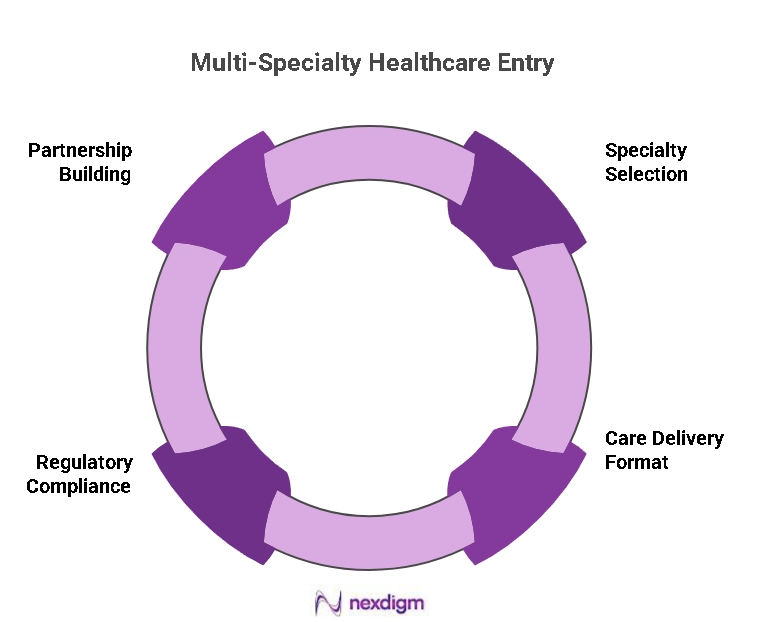
- Choosing the Right Mix of Specialties: Prioritize services such as cardiology, oncology, orthopedics, diagnostics, maternity, and chronic care based on local patient needs.
- Designing the Right Care Delivery Format: Decide whether clinics, diagnostic hubs, day-care centers, hospitals, or hub-and-spoke models are best suited for entry.
- Preparing for Local Rules and Approvals: Assess licensing, clinical staffing norms, ownership rules, facility approvals, and compliance requirements before entering the market.
- Building Trusted Local Partnerships: Identify hospitals, doctors, diagnostic providers, insurers, and community partners to improve patient inflow and service reach.
Nexdigm’s Business Setup and Entity Structuring Support for Healthcare Providers
Nexdigm’s business setup and entity structuring support helps healthcare providers establish the right legal, operational, and ownership structure for multi-specialty healthcare expansion. This includes entity formation, regulatory alignment, foreign investment considerations, governance planning, tax structuring, and compliance readiness. By creating a suitable setup framework, Nexdigm supports smoother market entry, scalable operations, and long-term healthcare network growth.
Nexdigm’s Financial Feasibility and Investment Planning for Multi-Specialty Expansion
Nexdigm’s financial feasibility and investment planning helps healthcare providers assess setup costs, revenue potential, payer mix, operating expenses, and expected returns to support informed multi-specialty expansion decisions.
- Forecasting Revenue Potential: Project income from consultations, diagnostics, surgeries, procedures, inpatient care, preventive health packages, and specialty services.
- Assessing Operating Cost Requirements: Review staffing, maintenance, utilities, consumables, technology, supply chain, and administrative expenses needed for daily operations.
- Modeling Return on Investment: Estimate payback period, profitability, cash flows, break-even timelines, and long-term returns for expansion decisions.
- Prioritizing Investment Phases: Plan capital deployment across pilot launch, specialty additions, capacity expansion, technology upgrades, and regional scaling.
Nexdigm’s case:
Nexdigm assisted a multi-specialty healthcare provider evaluate investment feasibility for expansion across four regional markets. Nexdigm assessed setup costs, payer mix, service-line revenue, and operating expenses for a planned 150-bed facility network. The analysis identified 22% higher revenue potential in two priority markets, optimized capital allocation by 18%, and projected break even within four years. These insights helped the company finalize a phased investment plan for scalable multi-specialty expansion.
To take the next step, simply visit our Request a Consultation page and share your requirements with us.
Harsh Mittal
+91-8422857704