

Multimodal transport becomes commercially attractive when the savings from a lower-cost line-haul mode outweigh the additional cost and complexity of moving cargo between modes. Road, rail, coastal shipping and inland waterways each have different cost and service characteristics, so the right combination depends on cargo, distance, network connectivity and delivery requirements.
The calculation therefore needs to extend beyond the freight rate quoted for the main transport leg.
The Cheapest Mode Is Not Always the Cheapest Shipment
A lower rail or coastal-shipping rate can lose its advantage once first-mile collection, terminal handling, transshipment and final delivery are included. Road transport carries a higher line-haul cost on many long-distance movements, but its direct factory-to-customer model can eliminate several intermediate charges and reduce handling.
The relevant comparison is the total door-to-door cost: origin transport, terminal charges, line-haul, destination handling, final delivery and the cost of any additional inventory required to absorb transit uncertainty.
This is particularly important when cargo is high-value or service-sensitive. A modest freight saving can be outweighed by the financial cost of additional dwell time, working capital and missed delivery commitments.
Rail Is Becoming More Accessible to Industrial Cargo
India’s expanding terminal infrastructure makes rail freight increasingly viable for multimodal networks, shifting the model so rail manages long-haul transit while road handles first- and last-mile legs.
- Surging Freight Volumes: Indian Railways recorded 1,670 million tonnes of freight in FY2025–26, up from 1,098 million tonnes in FY2014–15.
- Terminal Expansion: By August 2026, 142 Gati Shakti Multi-Modal Cargo Terminals were operational, offering 224 MTPA in handling capacity and drawing ₹10,000 crore in private investment.
- Bridging the Last Mile: These terminals handled 146 million tonnes in FY2025–26, directly solving the historic connectivity gap between rail networks and end facilities.
Reliability Can Change the Economics
Freight savings evaporate quickly if multimodal transport introduces delivery uncertainty. Shippers must evaluate total trade-offs among cost, consistency, and required service levels rather than transit speed alone.
- Dwell & Disruption Risks: Transit variability forces costly inventory buffers and risks plant downtime, SLA penalties, or emergency road spot-buys.
- Predictability Over Speed: A consistently slower route with dependable schedules is commercially viable; a cheaper route with erratic transit performance usually is not.
Cargo Determines Which Mode Combination Works
Multimodal feasibility depends heavily on cargo characteristics, volume regularity, and proximity to terminal hubs:
- Cargo Value & Volume: Heavy bulk commodities (minerals, construction materials) readily absorb transshipment costs to cut line-haul expense, whereas high-value or time-critical goods are vulnerable to inventory holding costs and transit delays.
- Flow Consistency: Predictable, aggregated volumes justify contracted rail or coastal capacity; sporadic, fragmented loads favor direct road transit.
- Terminal Proximity: Close access to railheads or ports keeps drayage legs short and cost-effective, while lengthy first- and last-mile road moves quickly erode multimodal savings.
Waterways Add Another Option, but Geography Matters
India’s inland waterways and coastal shipping offer competitive line-haul economics, but commercial viability remains restricted to high-density corridors with strong end-to-end connectivity:
- Rapid Growth, High Concentration: National Waterways freight expanded from 29 million tonnes in FY2014–15 to 218 million tonnes in FY2025–26 (20.13% CAGR), with ~85% of movement clustered across just four waterways.
- Corridor Prerequisites: Navigability alone does not guarantee modal shift; viability demands sufficient cargo volume, dependable sailing schedules, terminal access, and minimal drayage distance to destination sites.
- Coastal Shipping Alignment: Coastal routes operate under the same logic, providing substantial savings primarily for high-volume, predictable flows supported by well-connected port gateways.
Where the Multimodal Business Case Becomes Stronger
The strongest opportunities generally share several characteristics: long-distance movement, high shipment volumes, predictable cargo flows, accessible terminals and sufficient road connectivity for first- and last-mile movements.
The calculation should also account for directional imbalance. A corridor carrying substantial freight in one direction but little return cargo can create repositioning costs that weaken the apparent advantage of the lower-cost mode.
For logistics providers, this creates an opportunity to design networks around combinations of modes rather than treating each mode as a separate service. The objective is to identify where each mode performs its most economical function.
How Nexdigm Tests Multimodal Feasibility
Nexdigm can assess a multimodal network through six connected dimensions:
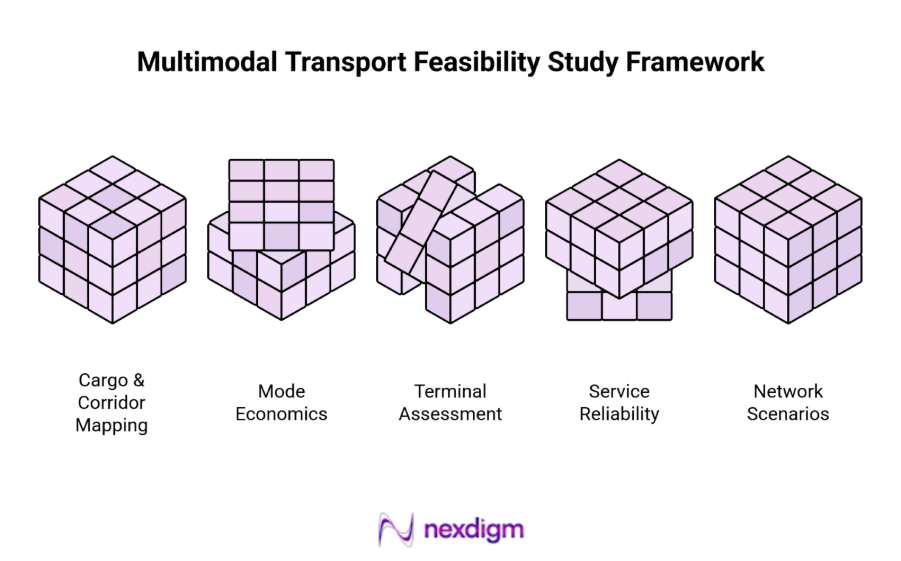
- Cargo and corridor mapping: Identify major origin-destination flows, shipment volumes, cargo characteristics and route concentration.
- Mode economics: Compare Road, rail, coastal and inland-waterway alternatives across the complete movement rather than only the line-haul component.
- Terminal and first/last-mile assessment: Evaluate terminal proximity, drayage distance, handling requirements, connectivity and potential dwell points.
- Service reliability: Examine transit-time variability, schedules, frequency, tracking capability and the service levels required by different cargo segments.
- Network scenarios: Model alternative combinations of modes, terminals, routes and shipment frequencies under different volume and cost assumptions.
A multimodal transport feasibility study consulting engagement therefore moves the analysis from “Which mode is cheaper?” to “Which combination of modes produces the strongest door-to-door economics for this cargo and corridor?”
Nexdigm Case: Reducing Freight Procurement Costs
In a freight-demand and pricing engagement, Nexdigm assessed transportation spending across multiple lanes for an industrial enterprise facing fragmented vendor allocation and exposure to spot-market pricing. By applying structured freight-demand analysis, lane consolidation and procurement standardisation, the engagement delivered a 21.2% reduction in freight procurement costs while improving capacity and pricing governance.
Transportation savings depend on understanding the structure of demand and network economics, not simply negotiating a lower rate for an individual shipment.
To take the next step, simply visit our Request a Consultation page and share your requirements with us.
Harsh Mittal
+91-8422857704