

Natural gas trade is expanding while its geography continues to change. GECF reports that global gas trade rose 3% to 1.20 trillion cubic metres in 2025, while LNG trade increased 6.5% to a record 437 million tonnes. Europe’s gas imports rose 6% to 382 bcm, whereas Asia remained the largest importing region at 463 bcm.
The U.S. also strengthened its export position: LNG exports averaged 17.4 Bcf/d in the first half of 2026, 23% above the same period in 2025. In July 2026, U.S. LNG exports reached 16.74 Bcf/d, with cargoes reaching 36 countries. These movements show why natural gas trade analysis needs to examine import markets, export hubs, supply sources, infrastructure, pricing, and destination shifts together.
Import Markets Are Being Reconfigured
Import growth is increasingly influenced by domestic production, storage levels, pipeline availability, LNG infrastructure, and power-sector requirements. In 2025, Europe’s LNG imports increased by 29 Mt to 130 Mt, while Asia remained the largest LNG-importing region at 273 Mt. These differences show how regional supply gaps and infrastructure conditions can redirect flexible gas cargoes between markets.
Export Hubs Are Gaining Strategic Importance
The supply side is also changing as new liquefaction capacity expands the number and scale of export hubs. In 2025, the U.S. accounted for 26% of global LNG exports, while the U.S., Qatar, and Australia together represented 63%. U.S. LNG shipments to Asia more than doubled in the first half of 2026 as disruptions altered established supply routes.
Nexdigm’s View of Global Natural Gas Trade Dynamics
Natural gas markets are influenced by multiple connected factors. Nexdigm brings these signals together to help businesses:
- Track Market Shifts: Analyze import growth, export activity, supplier movements, and destination changes to identify where natural gas trade is gaining or losing momentum.
- Connect Supply and Demand: Link production, consumption, LNG capacity, storage, infrastructure, and buyer activity to understand emerging market imbalances and sourcing requirements.
- Translate Trade into Strategy: Combine pricing, competitive, infrastructure, and trade insights to identify attractive markets, alternative suppliers, and potential commercial risks.
This integrated perspective helps businesses move from tracking natural gas flows to understanding the market opportunities and supply considerations behind them.
Nexdigm’s Natural Gas Trade Intelligence Expertise
Nexdigm combines energy-sector research, trade intelligence, market intelligence, pricing analysis, competitive intelligence, company research, and supply-chain assessment to evaluate natural gas markets.
Our natural gas trade analysis can cover LNG and pipeline flows, import and export markets, suppliers, buyers, origins, destinations, shipment activity, pricing, infrastructure, and trade routes.
By connecting these dimensions, Nexdigm can help businesses assess market attractiveness, supplier positioning, sourcing exposure, infrastructure access, and changing competitive conditions.
Nexdigm’s Natural Gas Trade Intelligence Service Offering
Understanding gas-market movements is only the first step. Businesses also need focused analysis that can translate changing trade flows, supply conditions, pricing, and market activity into practical decisions. Nexdigm’s services assess the following areas to help businesses with:
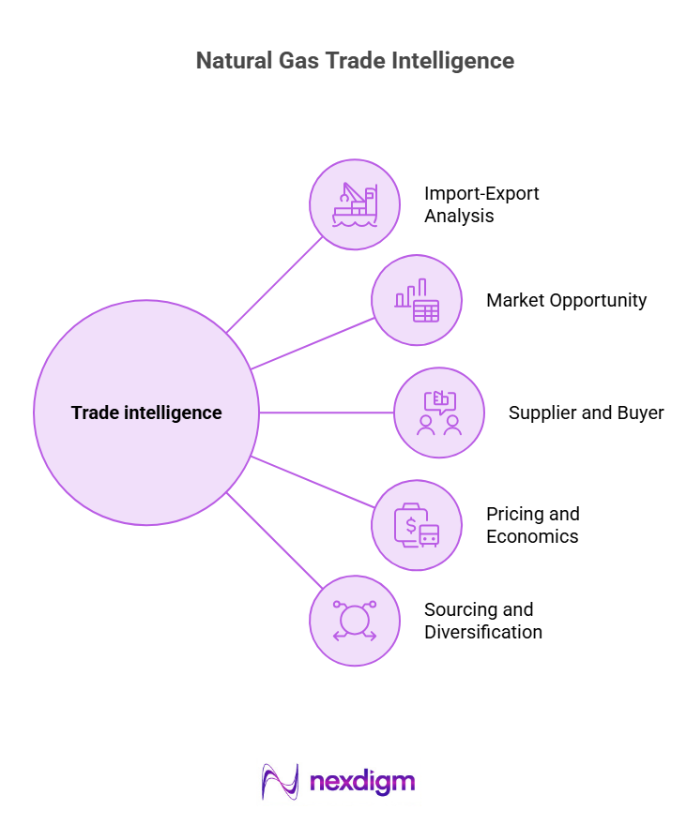
- Import-Export Trade Analysis: Analyze natural gas and LNG trade flows, volumes, origins, destinations, suppliers, buyers, and growth patterns.
- Market Opportunity Assessment: Screen import markets based on demand growth, supply gaps, pricing, infrastructure, competition, and market accessibility.
- Supplier and Buyer Intelligence: Identify major suppliers, emerging exporters, importers, utilities, traders, and changing commercial relationships.
- Pricing and Trade Economics: Compare regional pricing, trade values, transportation costs, and supplier economics to assess commercial attractiveness.
- Sourcing and Diversification Analysis: Identify alternative supply sources, emerging export hubs, and opportunities to reduce supplier or route concentration.
Together, assessing these areas enables businesses to move from raw gas-trade information to structured market intelligence and actionable commercial priorities.
Benefits of Nexdigm’s Natural Gas Trade Analysis
By connecting trade, supply, demand, pricing, infrastructure, and competitive signals, Nexdigm helps businesses convert complex gas-market information into clearer commercial decisions by:
- Identifying Growth Markets: Locating import markets where demand, supply gaps, and infrastructure support future trade potential.
- Tracking Emerging Export Hubs: Identifying suppliers and regions expanding LNG or pipeline-gas availability.
- Strengthening Sourcing: Comparing alternative suppliers, origins, pricing, routes, and accessibility to support diversification.
- Understanding Market Access: Evaluating pipelines, terminals, ports, storage, and regasification capacity affecting trade potential.
- Monitoring Competition: Tracking suppliers, buyers, market shares, and changing trade relationships to understand competitive positioning.
These benefits enable businesses to move beyond monitoring gas flows and develop a more informed view of market opportunities, sourcing choices, competitive dynamics, and supply risks.
Nexdigm’s Case
Nexdigm supported an energy-sector client by analyzing LNG and pipeline trade records across 19 markets, covering 31 suppliers, 45 origin-destination combinations, and 20+ infrastructure indicators. The assessment identified priority markets and 13 alternative supply relationships, supporting more targeted sourcing and market-expansion planning.
To take the next step, simply visit our Request a Consultation page and share your requirements with us.
Harsh Mittal
+91-8422857704