

Enterprise networks now extend across cloud platforms, remote users, connected devices, and third-party environments, making security controls harder to evaluate in isolation. The 2026 Verizon Data Breach Investigations Report found that exploitation of software vulnerabilities accounted for 31% of breaches, while ransomware was involved in 48%.
Microsoft’s Digital Defense Report also recorded nearly 40,000 CVEs in the first half of 2026, with the annual total on course to roughly double. These developments increase the importance of selecting network security suppliers that can protect changing infrastructure and respond to evolving attack methods.
Through network security supplier benchmarking, enterprises can compare firewall, zero-trust, monitoring, and threat-prevention capabilities against operational needs, architecture, and risk priorities, rather than relying on product claims alone.
Why Network Security Supplier Benchmarking Is Becoming Important
Network security supplier benchmarking helps organizations compare technologies against defined security outcomes rather than headline features. It can reveal differences in traffic inspection, access control, threat visibility, response automation, scalability, and integration. By examining these dimensions together, enterprises can understand whether a supplier’s solutions fit their network architecture, operating model, regulatory obligations, and tolerance for disruption across hybrid and distributed environments.
How Nexdigm Approaches Network Security Supplier Evaluation
Our experts can help organizations look beyond individual product specifications and understand how suppliers compete, innovate, and address changing enterprise security requirements. Our network security supplier benchmarking approach can examine three important dimensions:
- Supplier Positioning and Specialization: Assess how providers differentiate their offerings across enterprise, cloud-native, and distributed network security environments.
- Technology Development and Innovation: Track advancements in firewall architecture, zero-trust frameworks, AI-enabled monitoring, and automated threat prevention.
- Competitive and Strategic Developments: Examine vendor partnerships, acquisitions, product expansions, and market strategies that influence supplier capabilities and positioning.
This analytical view helps enterprises understand the broader supplier environment before progressing to detailed benchmarking and technology evaluation.
What Enterprises Should Compare Across Network Security Solutions
A meaningful comparison requires organizations to examine how different security technologies address specific network risks and operational requirements.
- Firewall and Traffic Inspection: Compare application awareness, intrusion prevention, traffic filtering, policy management, and encrypted traffic inspection across different network environments and deployment models.
- Zero-Trust and Access Controls: Evaluate identity-based access, device verification, network segmentation, policy enforcement, and continuous authentication to understand how suppliers restrict unauthorized access.
- Monitoring and Threat Prevention: Assess real-time visibility, threat intelligence, anomaly detection, response automation, and incident investigation to compare suppliers’ detection and prevention capabilities.
These dimensions provide a structured basis for understanding supplier differences and identifying areas that require deeper technical investigation.
Nexdigm’s Role in Building a Comparative View of Network Security Suppliers
Our benchmarking approach can translate supplier information into a structured benchmarking perspective aligned with enterprise requirements. This can involve:
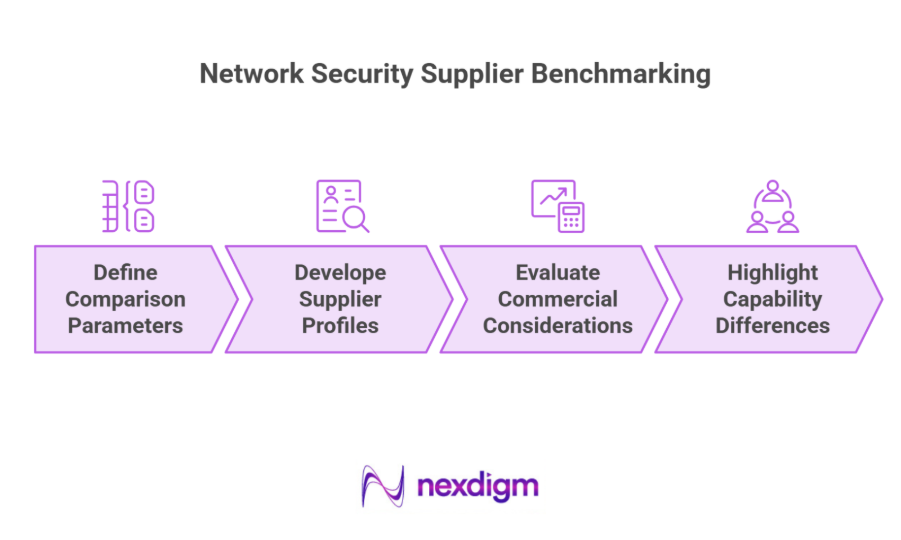
- Defining Comparison Parameters: Establish relevant criteria covering performance, security coverage, scalability, integration, deployment flexibility, and operational complexity.
- Developing Supplier Profiles: Consolidate information on product portfolios, technology specializations, target markets, partnerships, and competitive positioning.
- Evaluating Commercial and Deployment Considerations: Examine licensing approaches, deployment options, support models, and potential implementation considerations.
- Highlighting Capability Differences: Identify areas where suppliers offer differentiated features, broader coverage, or specialized solutions relevant to enterprise environments.
The resulting intelligence can help technology and procurement teams understand supplier strengths, limitations, and suitability for further evaluation.
Turning Benchmarking Insights into Better Sourcing Decisions
Our expertise can help enterprises use benchmarking findings to support practical supplier decisions through three outcomes:
- Recognizing Relevant Alternatives: Identify suppliers whose solutions address specific network security requirements and existing technology gaps.
- Improving Evaluation Discussions: Use structured comparisons to prepare focused questions for vendor demonstrations, technical assessments, and due diligence.
- Supporting Supplier Selection: Develop evidence-based comparisons and focused shortlists to guide procurement planning and subsequent commercial discussions.
This enables organizations to approach supplier evaluation with clearer priorities and a stronger understanding of available technology options.
Nexdigm’s Case
An enterprise sought to strengthen its network security capabilities. Nexdigm conducted an assessment of 18 suppliers, comparing firewall, zero-trust, monitoring, threat-prevention, and integration capabilities. The analysis identified gaps across 6 suppliers and helped shortlist 5 providers for further technical and commercial evaluation.
To take the next step, simply visit our Request a Consultation page and share your requirements with us.
Harsh Mittal
+91-8422857704