

A new product feasibility study is essential before companies invest in launch, distribution, and marketing because it helps validate whether the product has real market potential. Before committing resources, businesses must assess customer demand, product-market fit, pricing expectations, competition, regulatory requirements, channel readiness, and profitability. A strong market entry strategy uses feasibility insights to decide whether to launch, modify, delay, or reposition the product.
By conducting a new product feasibility study, companies can reduce investment risk, avoid weak market adoption, allocate budgets more effectively, and build a practical roadmap for successful product introduction and long-term growth.
Nearly 60% of new products underperform after launch and 42% of startups fail because there is no market need. Product launches also face delays due to weak validation, poor pricing, limited channel readiness, and unclear customer fit. By testing feasibility before investing in launch, distribution, and marketing, companies can reduce wasted spending and strengthen their market entry strategy.
How a New Product Feasibility Study Strengthens Market Entry Strategy
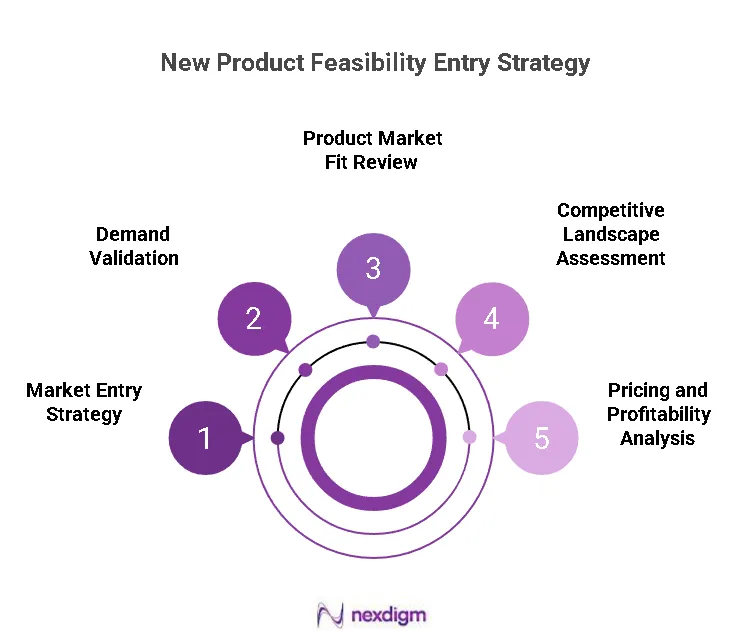
New Product Feasibility Study Strengthens Market Entry Strategy means validating demand, pricing, competition, channels, compliance, and profitability before launch to reduce investment risk and improve market adoption:
-
Demand Validation
Assess customer need, purchase intent, market size, and adoption potential before investing in product launch.
-
Product-Market Fit Review
Evaluate whether product features, benefits, pricing, and use cases match customer expectations in the target market.
-
Competitive Landscape Assessment
Study competitors, substitutes, pricing models, strengths, and gaps to identify positioning opportunities and market barriers.
-
Pricing and Profitability Analysis
Review willingness to pay, cost structure, margins, and revenue potential to support financially viable launch decisions.
-
Channel Readiness Evaluation
Assess distributors, retailers, digital platforms, and sales networks to confirm product availability after market entry.
Nexdigm’s Channel Readiness Assessment Before Distribution Investment
Nexdigm’s Channel Readiness Assessment Before Distribution Investment helps companies evaluate whether distributors, retailers, digital platforms, logistics partners, and sales networks are prepared to support a new product launch.
Nexdigm assesses channel reach, partner capability, stock availability, fulfillment capacity, regional coverage, and cost efficiency before investment, helping businesses reduce distribution risks and strengthen market entry strategy.
Nexdigm’s Investment Risk Assessment for Launch, Distribution, and Marketing Decisions
Nexdigm’s Investment Risk Assessment for Launch, Distribution, and Marketing Decisions helps companies evaluate demand, costs, pricing, channel readiness, marketing spend, compliance risks, and expected returns before committing resources.
-
Demand Risk Review
Nexdigm assesses customer need, purchase intent, market size, and adoption potential before launch investment decisions.
-
Launch Cost Assessment
Nexdigm evaluates product introduction costs, marketing budgets, staffing needs, and setup expenses to estimate investment exposure.
-
Distribution Investment Analysis
Nexdigm reviews channel costs, distributor margins, logistics expenses, and coverage requirements before committing distribution resources.
-
Marketing Spend Evaluation
Nexdigm assesses campaign budgets, customer acquisition costs, media channels, and expected reach to improve marketing efficiency.
-
Pricing and Margin Review
Nexdigm analyzes pricing potential, cost structures, competitor pricing, and margin expectations to support profitable launch planning.
Nexdigm’s case:
Nexdigm helped an international electric kitchen appliances brand assess investment risk before launching an energy-efficient induction cooktop range in India. Nexdigm reviewed urban household demand, retailer readiness, warranty expectations, pricing sensitivity, logistics costs, and marketing requirements. The assessment found that 51% of surveyed customers prioritized energy savings, 33% preferred EMI or bundled offers, and regional logistics costs varied by 14%–19%.
To take the next step, simply visit our Request a Consultation page and share your requirements with us.
Harsh Mittal
+91-8422857704