

Automotive supply chains remain exposed to concentrated suppliers, limited alternatives, regional dependencies, and disruptions deeper in the network. A 2026 ACEA analysis found that for six of 10 critical automotive inputs, refining and processing were among the most vulnerable stages, with risks concentrated across a limited number of countries, suppliers, and processing hubs.
The challenge also extends beyond direct suppliers. Analysis of automotive supply-chain incidents during 2024 and the first five months of 2025 recorded 12,663 natural-disaster events and 7,010 transportation and logistics events. More than 64% of recorded site incidents occurred at sub-tier suppliers, highlighting how disruption can remain hidden below Tier 1.
For OEMs, OEM supplier risk research and evaluation can therefore help identify where dependencies are concentrated, which suppliers or locations represent critical disruption points, and whether recovery options are strong enough to protect production continuity.
Supplier Risk Is Often Hidden Beyond the Direct Relationship
A direct supplier may appear stable while relying heavily on a single sub-tier processor, manufacturing site, raw-material source, or logistics corridor. This creates dependencies that may not be visible through conventional supplier reviews. A broader risk view needs to connect supplier concentration, geographic exposure, critical components, sub-tier dependencies, and recovery capability to understand where one disruption could create wider production consequences.
Risk Exposure Varies Across the Automotive Supply Base
Not every supplier represents the same level of exposure. A high-volume supplier with multiple plants may be less vulnerable than a smaller supplier providing a specialized, difficult-to-replace component. Similarly, regional concentration, limited capacity, long qualification cycles, and low substitution options can make certain relationships more critical. For OEMs, understanding these differences helps shift risk management from broad supplier monitoring toward focused attention on the dependencies most capable of affecting production continuity.
Nexdigm’s Approach to Prioritizing Critical Supplier Risks
Once supplier exposures are mapped, the next challenge is determining which risks require the greatest attention. Nexdigm can help OEMs prioritize risks by considering:
- Business Criticality: Link supplier exposure to the importance of the component, vehicle program, production volume, and potential operational impact.
- Likelihood of Disruption: Consider geographic concentration, financial strength, capacity constraints, operational dependencies, and external risk factors.
- Availability of Alternatives: Assess alternate suppliers, substitution possibilities, qualification timelines, inventory buffers, and production flexibility.
- Recovery Difficulty: Evaluate how quickly supply could be restored and the resources required to resume normal operations.
This approach helps transform OEM supplier risk research and evaluation from a broad risk inventory into a focused priority list for mitigation and continuity planning.
From Supplier Risk Signals to Clearer Decisions with Nexdigm
A large supplier network can generate numerous risk signals, but not every signal requires the same response. Nexdigm can help OEMs interpret these signals within their operational and business context:
- Distinguish Critical Signals: Separate emerging concerns from isolated issues that are unlikely to materially affect supply continuity.
- Connect Multiple Risk Factors: Examine how financial, geographic, operational, logistics, and supplier dependencies can combine to increase overall exposure.
- Define the Appropriate Response: Help determine whether a risk calls for immediate mitigation, closer monitoring, supplier engagement, or contingency planning.
- Support Focused Action: Translate complex risk findings into practical priorities for procurement, supplier management, and business teams.
Through OEM supplier risk research and evaluation, Nexdigm helps OEMs move beyond simply identifying risks toward understanding their significance and determining the most appropriate response.
Nexdigm’s Supplier Risk Assessment
Nexdigm can structure OEM supplier risk research and evaluation around the following steps:
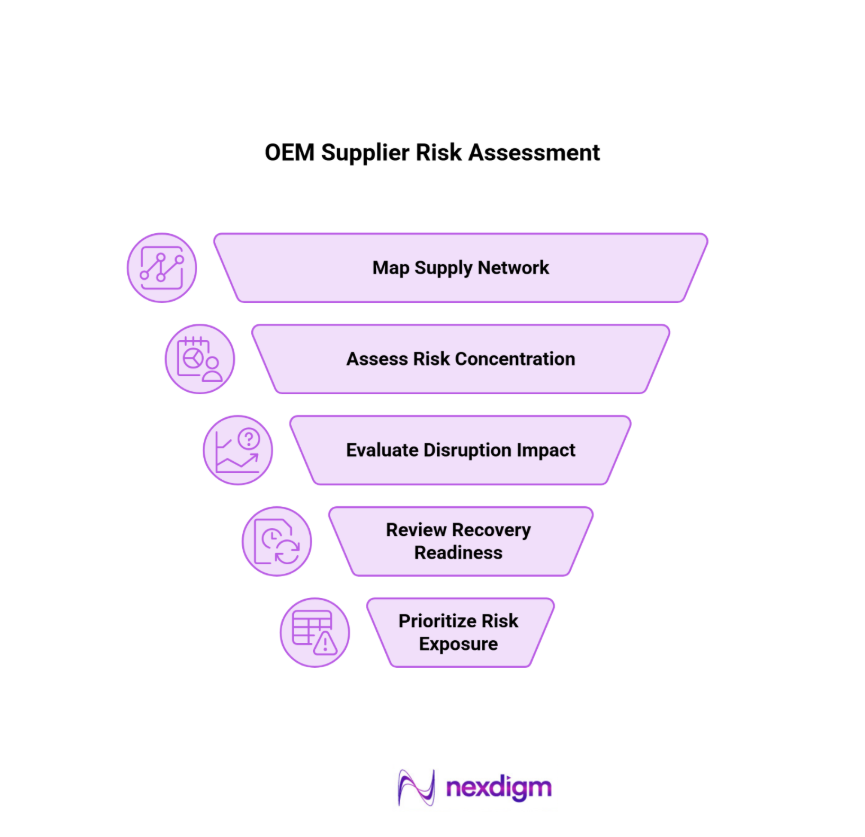
- Map the Supply Network: Identify critical suppliers, components, facilities, regions, and relevant Tier 2 and deeper dependencies.
- Assess Risk Concentration: Examine single-source exposure, geographic concentration, capacity constraints, financial vulnerability, and critical upstream dependencies.
- Evaluate Disruption Impact: Link supplier risks with component criticality, production volumes, lead times, substitution options, and potential operational consequences.
- Review Recovery Readiness: Assess alternate suppliers, inventory buffers, business continuity plans, production flexibility, and recovery timelines.
- Prioritize Risk Exposure: Rank suppliers and dependencies according to severity, likelihood, business impact, and availability of mitigation options.
This structured assessment helps OEMs develop a clearer view of where supplier risk is concentrated and which exposures require the greatest attention.
Nexdigm’s Case
An OEM evaluated 50 critical suppliers across six regions using Nexdigm’s OEM supplier risk research and evaluation approach. The assessment identified 26% of supplier relationships with elevated concentration exposure, while 18% had limited recovery alternatives. The findings helped procurement prioritize supplier diversification, continuity planning, and deeper-tier risk monitoring.
To take the next step, simply visit our Request a Consultation page and share your requirements with us.
Harsh Mittal
+91-8422857704