

Offshore drilling demand is determined by the volume, duration and technical requirements of planned drilling activity. Oil prices influence operator budgets, but their effect on rig requirements depends on how companies allocate capital across exploration, appraisal, infill drilling and field development. An operator may defer frontier exploration while protecting development wells needed to sustain production or bring an approved project online.
The distinction matters in a market where fleet availability and pricing can move in different directions. Westwood Energy reported that global marketed supply at the end of 2025 stood at approximately 439 jack-ups, 89 drillships and 73 semisubmersibles. Twenty-two rigs were retired during the year, including eight drillships, eight jack-ups and six semisubmersibles. Yet lower drilling demand also put pressure on day rates, demonstrating that fleet attrition alone does not guarantee stronger commercial conditions.
Rig demand therefore needs to be assessed by equipment class, basin and programme timing. Jack-ups serving shallow-water developments cannot substitute freely for deepwater drillships, while technically capable units may remain commercially unavailable because of existing contracts, mobilisation requirements or regional restrictions.
Where Exploration Spending Becomes Actual Rig Demand
Operator spending plans provide an initial indication of activity, but the conversion into rig demand requires a closer examination of project commitments. Exploration budgets indicate potential well activity; appraisal programmes depend on discoveries and reservoir evaluation; and development drilling is influenced by project approvals, production targets and infrastructure readiness.
Final investment decisions (FIDs), tender announcements and signed contracts offer different levels of evidence. An approved development with a defined drilling schedule provides a stronger near-term demand signal than an exploration budget covering several prospective basins. Tendered work is also not equivalent to an awarded contract, since programmes can be postponed, reduced or cancelled.
The 2026 outlook illustrates this distinction. In January 2026, Westwood reported approximately 355 rig-years of awarded demand for contracts starting during the year. It also identified 42 unawarded tenders with a combined duration approaching 67 rig-years. These figures indicate a substantial pipeline of potential activity, but the unawarded portion remains contingent on contracting decisions and project schedules.
For market participants, the implication is clear: forecasts should distinguish committed demand from probable and speculative activity. Combining them into a single estimate risks overstating the number of rigs operators will actually require.
Why Basin Activity Changes the Commercial Outlook
Offshore demand varies significantly across regions because geological prospects, development maturity, infrastructure and regulatory conditions shape drilling decisions.
Deepwater basins with established discoveries and progressing development projects can generate sustained drillship demand. Mature shallow-water provinces may offer repeat campaigns involving jack-ups, while frontier basins depend more heavily on licensing activity, exploration success and operators’ willingness to commit capital before commercial reserves are established.
Infrastructure also affects the conversion of exploration into development demand. Existing pipelines, processing facilities and export terminals can improve the economics of a discovery by reducing the additional investment required to commercialise production. Remote discoveries may require substantial supporting infrastructure, extending the period between exploration drilling and development activity.
Supply must be assessed at the same regional level. A rig available globally may not be suitable for a particular water depth, environmental condition or local-content requirement. Mobilisation costs, contract commitments and regulatory restrictions can further limit effective supply. Consequently, a basin with moderate drilling demand may offer better pricing conditions than a larger market where suitable rigs are readily available.
What Determines Whether Rig Demand Supports Day Rates?
Utilisation and day rates respond to the balance between executable drilling programmes and the fleet capable of serving them. High utilisation within a rig class can support pricing, but its effect depends on contract duration, regional competition and the timing of new requirements.
Westwood’s January 2026 outlook showed that market conditions differed across rig classes in 2025. Leading-edge day rates declined by 20.6% for jack-ups and 8.2% for drillships, while semisubmersible rates increased by just over 8%. The semisubmersible increase was influenced by the mix of disclosed awards, particularly high-specification harsh-environment units, rather than necessarily indicating broad-based pricing strength.
These differences make aggregate offshore market indicators insufficient for investment decisions. Rig owners need to understand where technically suitable demand is emerging, when contracts are likely to begin and whether competing units can be mobilised in time. Operators, meanwhile, need to assess whether the required specification is available at an economically acceptable rate.
Building a Rig-Demand Forecast That Supports Investment Decisions
Nexdigm’s offshore drilling demand assessment can help operators, rig owners and investors translate basin-level activity into a commercially relevant forecast. The assessment should connect four analytical stages:
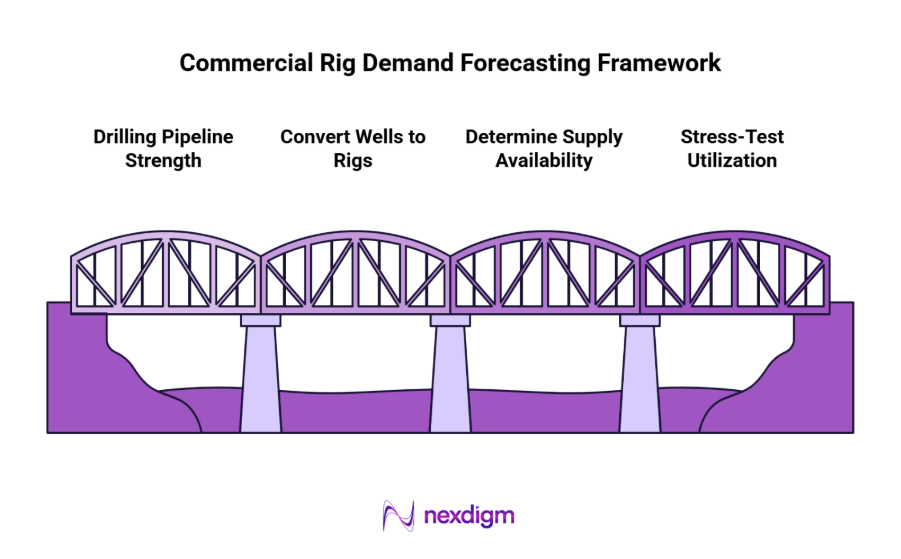
- Establish the strength of the drilling pipeline. Segment exploration, appraisal and development programmes by basin, operator and expected start date. Give greater weight to sanctioned projects, awarded contracts and defined well schedules than to preliminary spending intentions.
- Convert planned wells into rig requirements. Estimate drilling duration by well type and technical specification, then incorporate mobilisation, weather-related downtime, maintenance and schedule overlap. Aggregate the resulting rig-days by class and region to identify the expected demand profile.
- Determine how much supply is genuinely available. Map contracted, idle, stacked and retiring rigs by capability, contract expiry and geographic accessibility. Exclude units that cannot meet the relevant technical requirements or mobilise within the required timeframe.
- Stress-test utilisation and pricing. Model alternative scenarios for oil prices, project approvals, well counts, contract delays and fleet attrition. Compare the resulting demand with effective supply to identify where utilisation may tighten, where excess capacity may persist and which contract windows warrant attention.
This approach enables clients to distinguish a growing drilling pipeline from a market capable of supporting additional rig deployment, contract awards or fleet investment.
Nexdigm Case: Prioritising Offshore Rig Opportunities
An assessment of three offshore basins evaluates 120 planned wells across jack-up, semisubmersible and drillship requirements. After adjusting for drilling duration, 15% schedule slippage and contractually unavailable rigs, the model identifies two basins with potential capacity tightness by 2028. The client prioritises tenders in those markets while deferring expansion in the oversupplied basin.
To take the next step, simply visit our Request a Consultation page and share your requirements with us.
Harsh Mittal
+91-8422857704