

Offshore exploration starts with acreage, but acreage alone says little about commercial potential. A basin can contain substantial prospective resources and still attract limited investment if geological uncertainty is high, fiscal terms are unattractive, infrastructure is distant or operators cannot justify the cost of drilling.
A stronger assessment follows the opportunity through its likely development path. Start with the geological evidence, then examine whether operators are committing capital, whether wells can be drilled economically and whether a discovery could eventually reach market.
Brazil provides a useful example of why licensing activity matters. The National Agency of Petroleum, Natural Gas and Biofuels publishes information on offshore blocks, licensing processes and work commitments. Its 2025 licensing activity illustrates how acreage awards translate into concrete exploration obligations. Bid levels, awarded blocks and committed work can therefore provide a more useful indication of operator appetite than headline estimates of basin potential.
What Would Make an Operator Drill?
The next test is whether geological potential is strong enough to justify a well.
Compare source-rock maturity, reservoir quality, trap type, seismic coverage, water depth, discovery history, play extension and prospective resources. Unrisked volumes should be separated from chance-weighted resources and from recoverable commercial reserves. This distinction becomes particularly important in frontier basins, where large resource estimates can coexist with substantial geological uncertainty.
Operator behaviour provides another signal. Track licensing commitments, seismic programmes, announced wells, rig contracts, spud dates, drilling results and exploration budgets. Separate binding work programmes from preliminary intentions. A basin receiving sustained drilling commitments from multiple operators presents a different market opportunity from one where activity depends on a single speculative programme.
For service providers, this distinction can be more commercially relevant than the total resource estimate because exploration spending creates near-term demand before a basin ever produces hydrocarbons.
Drilling Cost Changes the Attractiveness of the Basin
Offshore drilling economics are shaped by more than day rates. Rig specification, availability, mobilisation distance, contract duration, water depth and well complexity all influence the cost of obtaining geological information.
Compare expected well cost with the probability and value of the information generated. A lower day rate does not necessarily make a basin attractive if wells have low geological success rates or require expensive mobilisation. Conversely, a high-value prospect may justify a premium rig when the equipment materially reduces technical or operational risk.
Oil-price expectations, operator capital allocation and partner alignment also influence drilling decisions. A technically attractive basin can therefore experience weak activity if operators are redirecting budgets toward producing assets or lower-risk discoveries elsewhere.
Discovery Does Not Equal Development
The commercial test changes once a discovery is made.
Map the route from the field to market, including subsea infrastructure, pipelines, floating production systems, tieback opportunities, ports, shore bases, service vessels and export routes. A discovery close to existing production infrastructure may have a materially shorter development timeline and lower capital requirement than an isolated discovery of similar size.
Spare capacity matters as much as physical proximity. Existing pipelines, processing facilities and export systems must have available capacity and commercially workable third-party access. Environmental permitting, fisheries, protected areas, local-content requirements and community engagement can also affect the path to development.
The result is a sequence of increasingly demanding tests. Geological potential attracts acreage interest. Drilling activity validates operator commitment. A discovery establishes technical potential. Infrastructure and development economics determine whether that potential can become production.
Offshore Exploration Investment Screening Framework
An offshore basin can be evaluated through four progression gates:
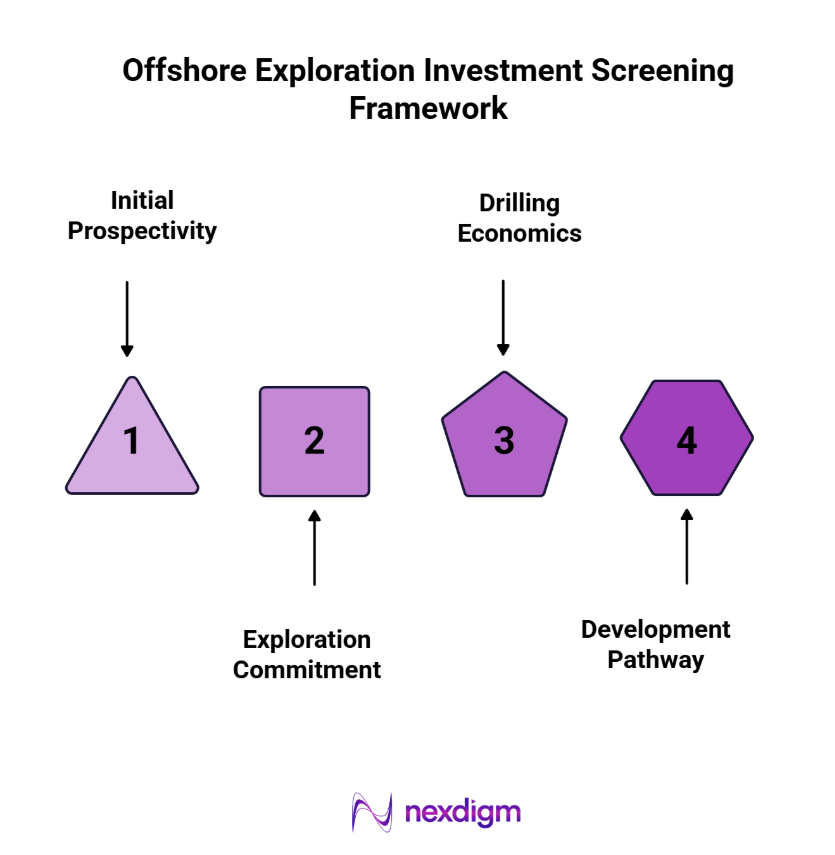
- Basin Prospectivity
Assess geological evidence, prospective resources, seismic coverage, discovery history and uncertainty to establish the quality of the exploration opportunity. - Exploration Commitment
Track licensing awards, work programmes, seismic activity, planned wells, rig contracts and operator budgets to measure whether the basin is attracting real capital. - Drilling Economics
Compare rig availability, day rates, mobilisation, well complexity and expected information value to determine whether exploration can be sustained economically. - Development Pathway
Test infrastructure access, tieback potential, export routes, permitting and development costs to establish whether a successful discovery can realistically reach first production.
Nexdigm can integrate these stages into a basin-level market assessment that distinguishes long-term geological potential from near-term exploration activity and commercially actionable opportunities.
Nexdigm Case Study
Nexdigm compared four offshore basins using prospectivity, licensing commitments, planned wells, rig availability, drilling costs and infrastructure access. One basin offered the strongest geological potential but limited export infrastructure. A second had lower resource scale but stronger development connectivity, leading a service provider to prioritise near-term exploration opportunities there.
To take the next step, simply visit our Request a Consultation page and share your requirements with us.
Harsh Mittal
+91-8422857704