

Offshore acreage can look compelling on a basin map and still fail as a commercial opportunity. Resource potential must be weighed against discovery probability, water depth, infrastructure, fiscal terms, development cost and time to first production.
Recent activity shows that exploration opportunities remain active in established as well as frontier settings. Brazil recorded 19 exploratory wells started in 2025, compared with 10 in 2024, and reported 13 discovery notifications. The activity is meaningful, but a discovery count alone does not establish commerciality. Each prospect needs a path from subsurface evidence to a financeable development.
Assess the basin and the evidence
Start with the petroleum system: source, reservoir, seal, trap and timing. Review seismic coverage, well results, play analogues and remaining uncertainty. Distinguish mapped prospectivity from recoverable resources, and use ranges that reflect geological confidence rather than a single headline volume.
The basin’s operating history matters. Existing production, nearby discoveries and available infrastructure may reduce uncertainty and development cost. Frontier acreage can offer larger undrilled potential, but sparse data, complex geology and limited services can increase appraisal time and capital exposure.
A structured offshore exploration opportunity assessment research program should also review the licensing position, work commitments, environmental constraints, local content requirements, decommissioning obligations and fiscal terms. These factors can change the value of the same resource across jurisdictions.
Convert a discovery into a development case
Commerciality depends on what can be produced, how quickly, and at what cost. Screen water depth, distance to shore, subsea requirements, export routes, host facilities and access to drilling rigs and vessels. Where infrastructure exists, assess spare capacity and tie-back options. Where it does not, estimate the full development system rather than just the well cost.
Time to first production is especially important. Offshore projects require long lead times for appraisal, approvals, engineering, procurement and construction. Delays increase exposure to cost inflation, commodity cycles and changing fiscal or operating conditions.
Model a range of outcomes for recoverable volumes, well productivity, recovery factor, capital cost, operating cost, schedule and price. Include abandonment liabilities and the cost of gathering additional data. Rank prospects by risk-adjusted value and the amount of capital required to reach the next decision point.
Manage uncertainty through staged investment
Exploration is a sequence of decisions, not a single commitment. Seismic acquisition, prospect maturation, drilling, appraisal and development each provide new evidence. Capital should be released against clear decision gates, with defined stop, continue and partner options.
A discovery may be valuable even if it does not support a standalone development. Nearby fields, shared infrastructure, farm-down partners or a broader hub plan can change the economics. The assessment should therefore consider portfolio fit and regional development potential alongside the individual prospect.
Framework: Basin-to-Barrel Offshore Screen
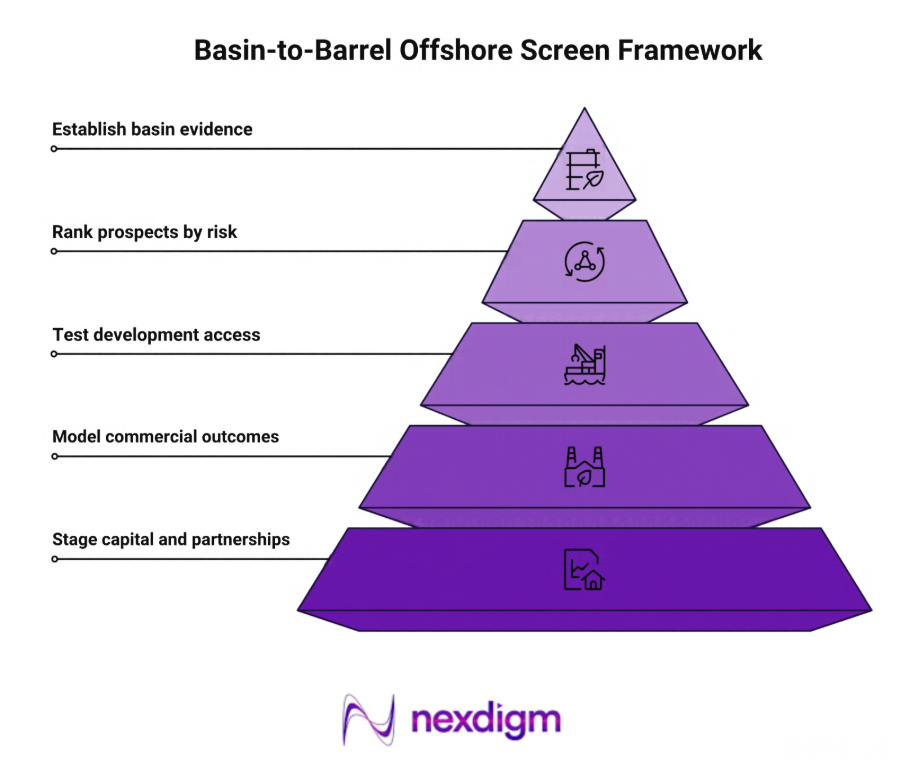
- Establish basin evidence
Review petroleum systems, seismic quality, well results, discoveries and remaining geological uncertainty. - Rank prospects by risk
Estimate resource ranges, chance of success and the information needed to mature each prospect. - Test development access
Assess water depth, infrastructure, export routes, services, host capacity and regulatory requirements. - Model commercial outcomes
Stress-test volumes, productivity, cost, schedule, fiscal terms, price and abandonment exposure. - Stage capital and partnerships
Define decision gates, appraisal requirements, partner options and criteria for stopping or advancing.
Nexdigm Case Study
Nexdigm screened 18 offshore prospects across three basins, combining geological maturity, infrastructure access, fiscal terms and development timing. Our model prioritized four prospects for further technical work; two ranked highly because nearby facilities could support tie-back scenarios. In the base case, those two prospects reached development thresholds with 22% lower estimated capital intensity than standalone concepts.
To take the next step, simply visit our Request a Consultation page and share your requirements with us.
Harsh Mittal
+91-8422857704