

Competition in oil and gas is shaped by production capacity, access to export infrastructure, supply costs, long-term contracts and the ability to reach attractive end markets. A producer can increase output without improving its competitive position if rivals expand faster or capture a larger share of demand.
For energy companies, competitive intelligence should therefore examine the relationships between production, exports, customer markets and infrastructure rather than ranking competitors by output alone.
Identify Changes In Competitive Position
A useful competitor assessment begins by defining the market. Crude oil, refined petroleum products, pipeline gas and LNG operate under different commercial and infrastructure conditions. Combining them into a single market view can conceal important differences.
The International Energy Agency’s Oil 2025 report analyses global oil supply, demand, refining and trade through 2030. Its outlook demonstrates why competitive positions must be assessed across the value chain: changes in upstream output, refinery activity and product demand can affect exporters differently.
Businesses should track several indicators:
- Production And Capacity: Compare actual output with available and planned capacity.
- Export Market Share: Measure each supplier’s share of imports in target destinations.
- Customer Concentration: Identify dependence on a limited number of buyers.
- Product And Quality Fit: Assess whether supply matches refinery configurations and customer specifications.
- Delivered Cost: Compare product pricing alongside freight, insurance and other relevant expenses.
These measures reveal whether a competitor’s apparent advantage is based on scale, market access, product suitability or pricing.
Map Supply Networks And Commercial Relationships
Competitor analysis becomes more useful when it identifies how companies reach customers. Export terminals, pipelines, shipping arrangements, processing facilities and storage assets determine which markets a supplier can serve efficiently.
OPEC’s Annual Statistical Bulletin 2025 provides country-level information on production, reserves, refining and petroleum trade. Such data can help establish a baseline for comparing major producers and their export destinations.
For more granular analysis, customs and trade databases can reveal which countries supply specific markets and how those relationships change over time. UN Comtrade supports product-level trade analysis using international commodity classifications, enabling researchers to separate crude petroleum from refined petroleum products and petroleum gases.
However, trade values alone can misrepresent competitive movement when commodity prices change. Volume, unit value, market share and product mix should be reviewed together wherever data is available.
Detect Where Competitors Are Expanding
The keyword oil and gas competitive intelligence captures a broader task than monitoring announcements. It involves verifying whether new projects, supply agreements and infrastructure investments are translating into commercially meaningful market access.
Companies should distinguish between announced projects, projects reaching final investment decision, facilities under construction and operational capacity. Each stage carries a different level of certainty.
For LNG, contract duration and destination flexibility are especially relevant. The IEA’s Gas 2025 analysis found that long-term agreements accounted for 75% of LNG volumes contracted since 2022. This demonstrates the continued importance of long-term commercial commitments even as trading flexibility develops.
A competitor securing long-term contracts may gain reliable demand visibility, while another may retain more flexibility to redirect cargoes. Neither position is universally superior; the commercial outcome depends on pricing, customer requirements and market conditions.
Convert Competitive Findings Into Strategy
Competitive intelligence should result in decisions about where to defend market share, pursue new customers, establish partnerships or invest in additional capacity.
An effective assessment combines market attractiveness with a company’s own capabilities. A fast-growing destination may not be suitable if the business lacks the required product specifications, transportation access or regulatory approvals.
Competitor monitoring should also include changes in sanctions, trade policy, financing conditions and infrastructure access. These factors can alter the relative attractiveness of suppliers without any change in production capacity.
Nexdigm’s Oil And Gas Competitive Position Framework
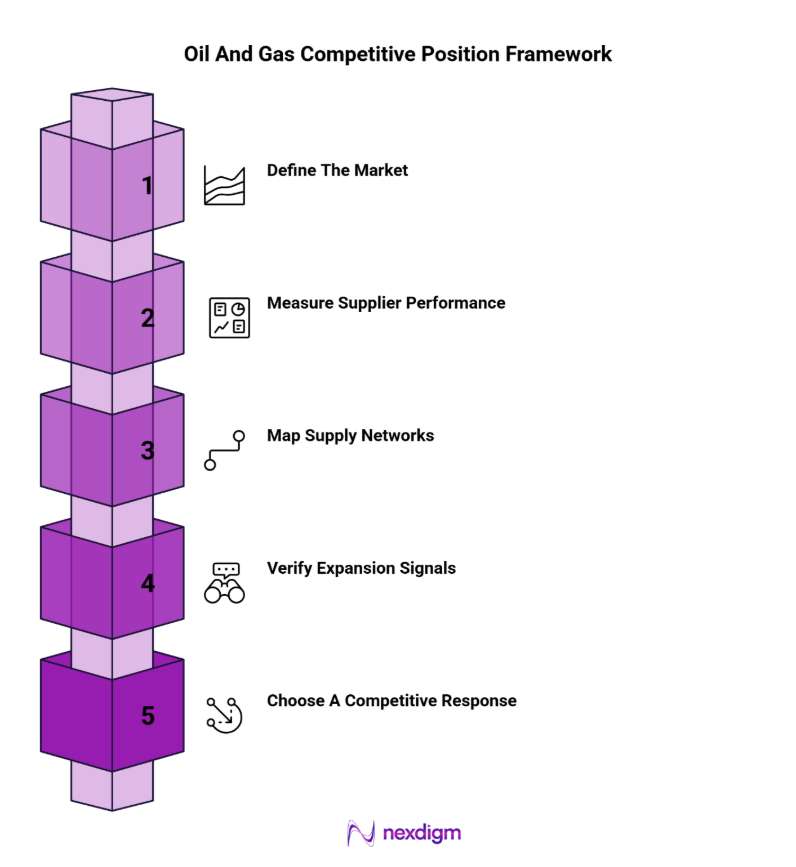
- Define The Market: Separate products, regions, customer groups and relevant trading corridors.
- Measure Supplier Performance: Compare output, export volumes, destination shares and delivered costs.
- Map Supply Networks: Identify infrastructure access, processing assets, transport links and customer relationships.
- Verify Expansion Signals: Assess project status, contract commitments and actual trade performance.
- Choose A Competitive Response: Prioritise markets, partnerships, pricing changes or capacity investments based on evidence.
Case Study: Finding A Defensible Market Position
A petroleum products exporter finds that its regional market share has declined despite stable shipments. Competitor analysis shows that rivals are supplying a wider product mix and serving additional buyers. The exporter prioritises two underserved customer segments and evaluates whether product adjustments can improve competitiveness.
Competitive intelligence is most valuable when it links verified market movements to specific commercial decisions. By monitoring supply networks, buyer relationships and delivered-cost differences, energy businesses can identify where they have a defensible advantage and where their market position needs to change.
To take the next step, simply visit our Request a Consultation page and share your requirements with us.
Harsh Mittal
+91-8422857704