

Oil and gas companies often have several plausible routes to growth: enter a new geography, launch a service for existing customers, build a local partnership or pursue a new customer segment. The challenge is deciding where the company has a credible advantage and how to convert that position into signed, profitable business.
Current investment patterns make this discipline especially important. The International Energy Agency expects global oil investment to fall below $500 billion in 2026, while natural gas investment is projected to reach $330 billion, supported by new LNG projects. At the same time, the IEA estimates nearly 90% of upstream investment since 2019 has been directed toward offsetting declines at existing fields. These shifts create opportunities, but they also mean budgets and buying priorities vary by commodity, basin and type of work.
A useful oil and gas go-to-market assessment consulting process starts by defining the offer and the buyer’s problem. A drilling technology provider, an engineering contractor and a chemicals supplier face different decision makers, qualification requirements and sales cycles. Even within one operator, procurement may evaluate price and contract terms while an asset team weighs reliability, technical fit and production impact.
Connect the Offer to the Buying Process
The first step is to divide the market into segments that can actually be served. Relevant factors include basin activity, asset maturity, operator type, project stage, service intensity and local-content requirements. A segment should be specific enough to support a different commercial approach. “National oil companies” is rarely precise enough; a mature onshore asset with recurring intervention needs may be.
Next, map the buying process. Identify who specifies the solution, who operates it, who approves the budget and who manages the contract. Determine when suppliers can influence technical requirements, how vendors qualify, and whether a local partner is necessary. For major projects, the best point of engagement may be during design or prequalification, well before a tender is issued.
A commercial plan should also test the route to market. Direct sales may work for a technically differentiated service with a small number of large buyers. Local distributors, agents or joint ventures may be necessary where regulation, content rules or field presence create barriers. Partnerships can speed market access, but the assessment should define responsibilities for delivery, customer ownership, technical support and revenue sharing.
Finally, connect the sales case to an outcome the buyer values. Operators may respond to reduced non-productive time, faster production restoration, lower lifting costs or improved recovery. Claims should be supported by field evidence and translated into the customer’s economics. A generic promise of efficiency is unlikely to carry a complex product through technical approval and procurement.
Framework: Opportunity-to-Execution Path
Nexdigm can use this five-stage framework to move from market screening to a practical commercial plan.
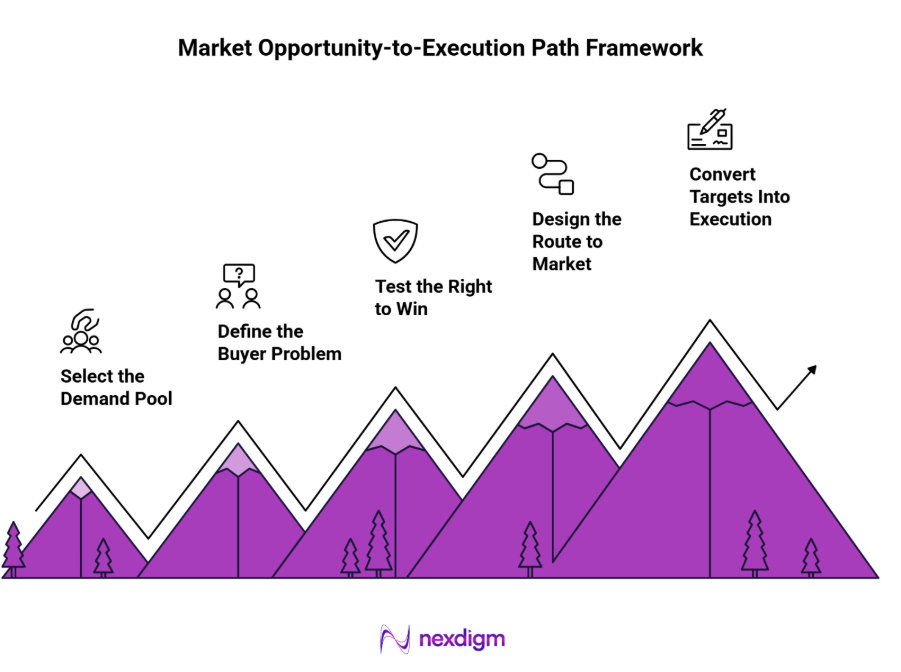
- Select the Demand Pool
Rank geographies, basins, customer types and service lines by funded activity, recurring need and addressable spend. Separate established demand from projects that remain dependent on approvals or commodity prices. - Define the Buyer Problem
Identify the operational or economic constraint the offer addresses. Validate the problem through customer interviews, asset data, tender documents and evidence from comparable deployments. - Test the Right to Win
Compare technical differentiation, track record, price position, local presence and qualification status against competitors. Identify missing certifications, partnerships or field capabilities that could prevent a sale. - Design the Route to Market
Choose direct sales, local representation, distribution or partnership based on buyer access and delivery requirements. Set account ownership, support responsibilities and commercial terms before committing resources. - Convert Targets Into an Execution Plan
Build a named-account pipeline with decision makers, qualification steps, tender timing, expected deal size, probability and next action. Set review points for conversion, margin and delivery readiness.
Nexdigm Case Study
Nexdigm modelled entry into three Middle East markets for an oilfield chemicals provider, screening 42 operators and service partners. The assessment ranked 11 accounts as near-term targets and found that local field support was a qualification gap for 7. We recommended a regional partner route and a phased account plan tied to pilot awards.
To take the next step, simply visit our Request a Consultation page and share your requirements with us.
Harsh Mittal
+91-8422857704